CREATORS OF THE COMPLIANCE TUNE-UP®

AARMR | ABA | ACAMS | ALTA | ARMCP | IAPP | IIA | MBA | MERS® | MISMO | NAMB

Showing posts with label Mortgage Originator Compensation. Show all posts

Thursday, February 24, 2011

Compensation: Coming or Going?

Foxx_(2009.04.02)

Jonathan Foxx is a former Chief Compliance Officer of two publicly traded financial institutions. He is the President and Managing Director of Lenders Compliance Group, the nation’s first full-service, mortgage risk management firm in the country.

Line-Webpage
Prophecy is above my pay grade, but if I were a betting man - which I'm not! - I would bet on a postponement of the TILA loan officer compensation requirements currently scheduled to go into effect on April 1, 2011. Rarely have I seen such a messy roll out of a regulatory change that actually affects virtually all aspects of the mortgage banking industry in general, and mortgage brokers in particular.
Because I'm not a betting man, I hope for the best outcome for industry stability, but will prepare for the "alternative." Our clients will be as prepared as possible, whatever the situation, come April 1, 2011!
Post Separator-2-LCG
Perfect Storm - Exhibit 1: Congress
The Senate's Committee on Banking, Housing, and Urban Affairs, chaired by Tim Johnson (R-SD), is concerned that "regulators are not allowing adequate time for meaningful public comment on their proposed rules. We also believe that regulators are not conducting rigorous analyses of the costs and benefits of their rules and the effects those rules could have on the economy."
Dated February 15, 2011, the letter was sent by ten members of the Committee to Timothy Geithner of the Treasury, Gary Gensler of the CFTC, Sheila Bair of the FDIC, Ben Bernanke of the FRS, Mary Schapiro of the SEC, and John Walsh of the OCC.
In their letter, the Senators observe what has become abundantly obvious to most industry members: "the unprecedented scope and pace of agency rulemakings under the Dodd-Frank Act make it more important than ever that agencies engage in deliberative and rational rulemaking."
The letter enumerates five questions for the recipients to answer, and here is my abbreviated version:
1. Will the respective agencies provide at least 60 days for public comment on all proposed rules and studies required by the Dodd-Frank Act?
2. What steps are being taken to ensure that the rules you adopt under the Dodd-Frank Act are the least burdensome way to achieve the statutory mandate. (Provide how those steps satisfy the obligations under the Administrative Procedure Act and other applicable statutes to conduct cost-benefit and economic impact analyses.)
3. What steps are being taken to ensure that all empirical data and economic analyses submitted by commenters are thoroughly considered before a final rule is adopted.
4. What steps are being taken to ensure that the respective agency is acting in coordination with other agencies charged with adopting related rules? (How is this coordinating being established?)
5. Given the importance of rigorous cost-benefit and economic impact analyses and the need for due consideration of public comments, would additional time for adoption of the Dodd-Frank Act rules improve the respective agency's rulemaking process and the substance of its final rules?
Post Separator-2-LCG
Perfect Storm - Exhibit 2: SBA Office of Advocacy
The SBA Office of Advocacy has written not one, but two letters to the FRB, expressing concern that the "Federal Reserve has not analyzed properly the full economic impact of the proposal on small entities as required by the Regulatory Flexibility Act (RFA)" and recommending that the FRB prepare an initial regulatory flexibility analysis (IRFA).

The result of the first letter, dated January 13, 2011, brought forth from the FRB a "compliance guide" on January 26, 2011.
I put that FRB issuance in quotes, because (as previously noted) it is 'inadequate, incomplete, and regurgitates most features of the "already known" aspects of the Regulation Z final rule amendments affecting loan officer compensation.' Best as I can tell, the "compliance guide" seemed meant to be a rush-job response to SBA's January 13, 2011 letter. In other words, this "compliance guide" is 'a transparent attempt to satisfy a regulatory requirement, though the dubious result adds little to an overall resolution.'
In response to the FRB's "compliance guide," the SBA issued a second letter on January 26, 2011 to the FRB, noting specifically that the "guide may not meet the requirements of the Small Business Regulatory Enforcement Fairness Act (SBREFA)." The SBA letter points up the flaws in the "compliance guide," suggests that revisions should be made to it, and requests postponement.
The FRB's response to the SBA's second letter is, essentially, silence.
Post Separator-2-LCG
Perfect Storm - Exhibit 3: Lawsuits and Consternation
Several industry groups have expressed an intention to sue the FRB, or pursue some form of judicial recourse, with the aim of preventing implementation of the loan officer compensation rule on April 1, 2011. As but one example, the National Association of Independent Housing Professionals (NAIHP) is threatening to sue the FRB within the next few days. NAIHP has invited the NAMB to join them in their suit against the FRB. 
According to a statement posted on the NAIHP website, the organization has been preparing legal action against the FRB for almost 2 months. Marc Savitt, the organization's President, states that preparation for their lawsuit has included "interviewing law firms, lining up expert witnesses, research, countless hours of planning and most importantly, raising funds."
In December, the Mortgage Bankers Association (MBA) sent a 19 page, carefully written and comprehensive letter to the FRB's Ben Bernanke  and Sandra F. Braunstein of its Consumer and Community Affairs Division. Under the rubric of "Questions on Federal Reserve Loan Originator Compensation Rule," the MBA lists 42 (sic) topics, plus sub-topics, of concern, confusion, and uncertainty, mixed with requests for clarity, interpretive guidance, and statutory support.
The Impact Mortgage Management Advocacy & Advisory Group (IMMAAG) has been very involved in seeking to "delay implementation until the appropriate impact studies have been concluded "or at least delay implementation to allow for a 'real' guide to be published and to allow the industry to absorb it and get questions answered."
The National Association of Mortgage Brokers (NAMB) has weighed in mightily and has intimated their interest in pursuing a legal remedy if nothing else will work. The NAMB is also threatening now to take "legal action." (Video)
In January, Michael J. D'Alonzo, President of the NAMB sent a letter to the FRB's Bernanke and Braunstein, requesting a delay in implementation of the loan officer compensation requirements, based in part on alleging that the FRB "has no legal basis for treating mortgage broker companies differently than other firms  carrying out the same or substantially similar business operations" and expressly seeking "clarification as to why the Rule permits  one class of mortgage market participants to: (1) receive incentive compensation based upon the type of loan originated; (2)  reduce their own compensation or income in order to capture more business; and (3) remain exempt from restrictions and  prohibitions set forth in the Rule, while other classes of market participants are held to significantly different standards."
Post Separator-2-LCG
Perfect Storm or Safe Harbor
The new loan officer compensation requirements have produced a plethora of webinars, lectures, training videos, questionnaires, surveys, so-called automated solutions, breakout sessions, magazine and news articles - a virtual cottage industry of Google Ads proclaiming "End-to-end mortgage automation solution for bankers and lenders," and "Confused About Dodd-Frank Changes? Sign Up For Onsite/Webinar Training."
In many of the aforementioned venues, speculation is a proxy for regulatory fact. Having a famous speaker or bigwig compliance professional opining on uninterpreted and unclarified TILA statutes makes me uneasy. There just is no replacement for regulatory guidance. Period!
Here's the reality: the largest loan originators and creditors will fend for themselves in this de facto unregulated environment, and all others will fall in line, unless and until the FRB provides clarification or delays implementation. Otherwise, the notion that the large originators get to make the interpretation of federal statutes, in the absence of the FRB interpreting them concisely, unambiguously, and cogently, is all a bit too Darwinian for my taste!
This is precisely why FRB regulations are promulgated: to assure a stable market and to avoid large companies determining for all the other companies what the FRB means. Furthermore, impact of the new loan officer compensation rules on the industry is a fundamental feature of any such foundational change to the residential real estate finance market. How is it even conceivable that such a change can be implemented without comprehensive impact studies required by federal statutes?

This is not a wave, but a tsunami of confusion with no safe harbor in sight - yet!

I am not a prophet, but betting on a delay seems like a good bet!

Be prepared to implement the loan officer compensation rules on April 1, 2011 - and be sure to consult competent compliance professionals for guidance - even if this dynamic environment continues to cause confusion and ambiguity. But, in the absence of the FRB adequately responding to its role in this debacle it is also wise to do what you can to stand up for the greater good of all market participants.
Post Separator-2-LCG
What do you think?
I would welcome your comments.
Please feel free to email me or leave your comments below.


Action Button Image 1
Line-Webpage

Tuesday, February 15, 2011

Compensation: One Statute Too Many?

Foxx_(2009.04.02)
Jonathan Foxx is a former Chief Compliance Officer of two publicly traded financial institutions. He is the President and Managing Director of Lenders Compliance Group, the nation’s first full-service, mortgage risk management firm in the country.

Line-Webpage


As I've previously notified you, I am writing an article on the loan officer compensation requirements that are due to go into effect on April 1, 2011. While I have been writing the article, in the current environment some of our clients seem to be forming a sort of siege mentality.

And I can't blame them, since there is so much confusion and, more substantively, the actual reading of federal staff commentaries to specific statutes in the revised TILA are causing them quite a bit of consternation.

We'll look at just one of the more controversial provisions!

Separator-Glow
Going too far?
Separator-Glow
Let's read the following passage together, slowly, carefully, attentively. 
Below I will deconstruct it.
We are going to consider the FRB commentary on a TILA section, entitled "Compensation in connection with a particular transaction" [§ 226.36(d)(2)]:
"If any loan originator receives compensation directly from a consumer in a transaction, no other person may provide any compensation to a loan originator, directly or indirectly, in connection with that particular credit transaction. ... The restrictions imposed [under this section] relate only to payments, such as commissions, that are specific to, and paid solely in connection with, the transaction in which the consumer has paid compensation directly to a loan originator.
Thus, payments by a mortgage broker company to an employee in the form of a salary or hourly wage, which is not tied to a specific transaction, do not violate [this section] even if the consumer directly pays a loan originator a fee in connection with a specific credit transaction.
However, if any loan originator receives compensation directly from the consumer in connection with a specific credit transaction, neither the mortgage broker company nor an employee of the mortgage broker company can receive compensation from the creditor in connection with that particular credit transaction."
Separator-Glow
Interpolation & Interpretation
Separator-Glow
Now, permit me to unpack this language and render it in less ambiguous terms:
First, let's recognize that the terminology and phrasing in this provision are somewhat mangled. For interpretive ease, staying within the context of the commentary itself, it seems entirely clear that the "loan originator" is a mortgage broker, a company or employer.
Second, I will use some literary license and call the employee of a mortgage broker a "loan officer."
So, here goes my interpolation and interpretation:
Compensation tied to Transaction
Text: If any loan originator receives compensation directly from a consumer in a transaction, no other person may provide any compensation to a loan originator, directly or indirectly, in connection with that particular credit transaction. ... The restrictions imposed [under this section] relate only to payments, such as commissions, that are specific to, and paid solely in connection with, the transaction in which the consumer has paid compensation directly to a loan originator.
Interpolation: When a mortgage broker is directly compensated by a consumer, no other compensation may be provided to the mortgage broker from another source, directly or indirectly.
Interpretation: When the consumer directly compensates the mortgage broker in a transaction, the mortgage broker may not receive additional compensation from any other source, directly or indirectly; but, the text does not restrict the mortgage broker from paying a portion of such compensation to the loan officer.
Example
Text: Thus, payments by a mortgage broker company to an employee in the form of a salary or hourly wage, which is not tied to a specific transaction, do not violate [this section] even if the consumer directly pays a loan originator a fee in connection with a specific credit transaction.
Interpolation: The mortgage broker may pay salary or hourly wages to a loan officer for originating loans that are not tied to a specific loan transaction, although a consumer may pay a fee to the mortgage broker to originate a specific loan.
Interpretation: Salary and hourly wages are incidental to loan officer compensation, when not tied to a specific loan transaction, irrespective of whether a mortgage broker receives direct compensation from a consumer for a particular transaction.
Source of Compensation
Text: However, if any loan originator receives compensation directly from the consumer in connection with a specific credit transaction, neither the mortgage broker company nor an employee of the mortgage broker company can receive compensation from the creditor in connection with that particular credit transaction.
Interpolation: When a mortgage broker is directly compensated by a consumer in a transaction, no other compensation may be paid to the mortgage broker and the loan officer by the creditor.
Interpretation: Compensation paid directly by the consumer to the mortgage broker on a transaction concomitantly causes the elimination of the mortgage broker's and loan officer's ability to receive compensation by the creditor.
Separator-Glow
Does the FRB disagree with itself?
Separator-Glow
One would think that the plain meaning of the text - such as it may be derived in its own context - is sufficiently clear to make sense of the FRB's actual position on loan officer compensation, at least with respect to compensation directly paid to mortgage loan originators by consumers.
However, some of our clients have contacted me about an alleged position unofficially circulated by the FRB itself, which seems to contradict my aforementioned interpretations. Various industry and media organizations are stating that the FRB allegedly holds that loan officers can be paid only salary or hourly wages on loan transactions where mortgage broker compensation is directly received by the consumer. Supposedly, this view is alleged to be held by certain industry organizations and some lawyers who are offering legal opinions.
Perhaps I am in the minority, but the plain meaning of the text - as I see it - does not prevent a loan officer from receiving compensation from a mortgage broker on specific loan transactions where compensation to the mortgage broker is directly paid by the consumer, so long as the above-mentioned constructs are fully met. If it were otherwise, certain TILA statutes - and numerous RESPA statutes, and various provisions in the Dodd-Frank Act - would become incoherent.
I don't think I've got the wrong interpretation. Maybe the FRB should read its own statutes and then revise its own commentary.
And if the allegation is true, is the FRB asserting that some kind of "dual compensation" would take place if mortgage brokers shared a portion of their commission with their loan officers? I think that conclusion would be contrary to a fair reading of the above-outlined provision.
An official clarification would be nice!
Until that happens - and I expect it to happen! - let's keep in mind that the rampant confusion in the mortgage industry, caused in no small part by the revised loan officer compensation requirements, is just one more reason why the implementation date of April 1, 2011 should be delayed.
Separator-Glow
Postpone Implementation
Separator-Glow
The FRB needs to provide credible, clear, and unambiguous information for the entire residential mortgage industry in order to expect systemic compliance with foundational changes.

Here are two recent newsletters we have sent out on this subject.
Until the mortgage industry:
(1) adequately understands its Regulation Z (TILA) enforcement obligations and loan officer compensation requirements; and
(2) has been given the statutorily mandated findings of the overall economic impact on the industry of the aforementioned provision, among others; and
(3) receives a complete and comprehensive mortgage compliance guide from the FRB, containing the requisite outline provided by the SBA's Office of Advocacy;
and until, that is, other planning requirements are met, I don't see how compelling the implementation of the loan compensation requirements on April 1, 2011 can be viewed as anything but disruptive, if not destructive, to the livelihoods of mortgage loan originators.
Post Separator-2-LCG

Tuesday, August 17, 2010

Reverse Mortgages: Compliance & Reputation Risk

Overview

On August 16, 2010, the federal banking agencies and Federal Financial Institutions Examination Council (FFIEC) issued the attached final guidance (Guidance) reverse mortgages and complex loan products typically offered to elderly consumers.

Institutions are expected to use the Guidance to manage the risks associated with reverse mortgages, including consumer protection concerns, such as counseling requirements, conflicts of interest, related policies, procedures, internal controls, and third party risk management. In addition to legal considerations, the Guidance provides directives regarding:

Key Policy Issues Raised by the Reverse Mortgage Guidance

Consumer Information and Understanding
Existence and Effectiveness of Consumer Counseling
Conflicts of Interest and Abusive Practices
Third-Party Risk Management

If you have any questions about this matter or would like assistance with mortgage compliance, please contact Jonathan Foxx.

Highlights

Legal Considerations

Consumer protection laws and regulations applicable to both Home Equity Conversion Mortgages (HECM) and proprietary reverse mortgage products, including those required by the Federal Trade Commission Act, which prohibits unfair or deceptive acts or practices, the Truth in Lending Act, and other special provisions set forth in HUD regulations.

Key Policy Issues

Consumer Information and Understanding

Borrowers do not consistently understand the terms, features, fees, alternatives to and risks of their loans.

Remedy

  • Provide consumers with clear and balanced information about the relative benefits and risks of reverse mortgage products, at a time that will help them make informed decisions.
  • Review advertisements and other marketing materials to ensure that important information is disclosed clearly and prominently.
  • Ensure that marketing materials do not provide misleading information about product features, loan terms, or product risks, or about the borrower's obligations with respect to taxes, insurance, and home maintenance.
  • Develop promotional materials and other product descriptions that provide information about the costs, terms, features, and risks of reverse mortgage products.

Existence and Effectiveness of Consumer Counseling

While counseling is mandatory for HECM transactions, it may not be required for proprietary products. Counseling conducted over the telephone, in particular, may not be adequate in all cases.

Remedy

  • Require that consumers obtain counseling from a qualified independent counselor.
  • Adopt policies that prohibit steering a consumer to any one particular counseling agency and that prohibit contacting a counselor on the consumer's behalf.
  • Strongly encourage the consumer to obtain counseling in person, whenever possible, and to attend counseling sessions with family members.

Conflicts of Interest and Abusive Practices

Potential for inappropriate sales tactics and other abusive practices in connection with reverse mortgages is greater where the lender or another party involved in the transaction has conflicts of interest or has an incentive to market other products and services.

Remedy

  • Borrowers are not required to purchase any other financial or other product from the lender or broker in order to obtain the reverse mortgage.
  • Originators do not have an inappropriate incentive to sell other products that may appear to be linked to the granting of a reverse mortgage.
  • Compensation policies guard against other inappropriate incentives for loan officers and third parties, such as mortgage brokers and correspondents, to make a loan.

Third-Party Risk Management

When making, purchasing, or servicing reverse mortgages through a third party, such as a mortgage broker or correspondent, institutions should take steps to manage the compliance and reputation risks presented by such relationships.

Visit Library for Issuance

Law Library Image

Reverse Mortgage Products
Guidance for Managing Compliance and Reputation Risks
FR, Vol. 75, No. 158, pp 50801-50812 (8/16/10)

Lenders Compliance Group is the first full-service, mortgage risk management firm in the country, specializing exclusively in mortgage compliance and offering a full suite of hands-on and automated services in residential mortgage banking.

Mortgage Originator Compensation and the Dodd-Frank Act

We now enter the era when the Dodd-Frank Act has become the law of the land. Today's brief review (provided below) is at the advent of this period and introduces some of the many changes resulting from this landmark legislation.

But first a comment.

Consolidation of regulatory authorities will be considerable!

There will be transfer and consolidation of enforcement authorities into the Consumer Financial Protection Bureau (Bureau) over the consumer financial protection functions currently performed by the Federal Reserve's Board of Governors, the Office of the Comptroller of the Currency (OCC), the Office of Thrift Supervision (OTS), the Federal Deposit Insurance Corporation (FDIC), the National Credit Union Administration (NCUA) and the Federal Trade Commission (FTC) - including exclusive authority over all related research, rulemaking, guidance, supervision, examination and enforcement activities.

At least sixteen (16) existing consumer protection laws will be included in the transfer, giving new exclusive rulemaking and examination authority to the Bureau.

I have published articles extensively on this subject; indeed, forthcoming this month, I will publish a 3-part series in the National Mortgage Professional Magazine on the financial reform legislation and its impact on the mortgage industry.

If you want to read more, go PDF 12x12here, PDF 12x12here, here, and here.

For the next few years, we will be seeing numerous announcements implementing the changes required by the Dodd-Frank Act. These issuances will come from various agencies as well as the new Bureau and will affect revisions to existing regulations, enumerated laws, Bureau mandates, and many other implementation requirements.

It is essential that you review and continually monitor for these changes, because there will indeed be many and, in various instances, the statutory requirements are complex, extensive, and interlock or interact with other laws - and violations can be enormously costly.

Because of the many regulatory compliance areas that are affected, we urge you to approach the required compliance proactively, seeking guidance now from a competent residential mortgage compliance professional.

Overview

On August 16, 2010, the Federal Reserve Board announced final rules to protect mortgage borrowers from unfair, abusive, or deceptive lending practices that can arise from loan originator compensation practices. The new rules apply to mortgage brokers and the companies that employ them, as well as mortgage loan officers employed by depository institutions and other lenders. The Board is publishing these final rules, amending Regulation Z, which implements the Truth in Lending Act (TILA) and Home Ownership and Equity Protection Act (HOEPA).

At this time, lenders may pay loan originators more compensation if the borrower accepts an interest rate higher than the rate required by the lender (commonly referred to as a "yield spread premium"). Under the final rule, however, a loan originator may not receive compensation that is based on the interest rate or other loan terms. The ostensible purpose of this regulation is to prevent loan originators from increasing their own compensation by raising the consumers' loan costs (i.e., by increasing the interest rate or points).

However, loan originators can continue to receive compensation that is based on a percentage of the loan amount.

There is also a prohibition that prevents a loan originator that receives compensation directly from the consumer from also receiving compensation from the lender or another party. This new rule requires that consumers who agree to pay the originator directly will not also pay the originator indirectly through a higher interest rate, thereby paying more in total compensation than they realize.

The final rule prohibits loan originators from directing or "steering" a consumer to accept a mortgage loan that is not in the consumer's interest in order to increase the originator's compensation.

The final rules apply to closed-end transactions secured by a dwelling where the creditor receives a loan application on or after April 1, 2011.

Effective Compliance Date: April 1, 2011.

If you have any questions about this matter or would like assistance with mortgage compliance, please contact Jonathan Foxx.

Highlights

  • Prohibits payments to the loan originator that are based on the loan's interest rate or other terms. Compensation that is based on a fixed percentage of the loan amount is permitted.
  • Prohibits a mortgage broker or loan officer from receiving payments directly from a consumer while also receiving compensation from the creditor or another person.
  • Prohibits a mortgage broker or loan officer from "steering" a consumer to a lender offering less favorable terms in order to increase the broker's or loan officer's compensation.
  • Provides a safe harbor to facilitate compliance with the anti-steering rule.

The safe harbor is met if:

1. The consumer is presented with loan offers for each type of transaction in which the consumer expresses an interest (that is, a fixed rate loan, adjustable rate loan, or a reverse mortgage); and

2. The loan options presented to the consumer include the following:

  • (A) the lowest interest rate for which the consumer qualifies;
  • (B) the lowest points and origination fees, and
  • (C) the lowest rate for which the consumer qualifies for a loan with no risky features, such as a prepayment penalty, negative amortization, or a balloon payment in the first seven years.

Visit Library for Issuances

Law Library Image

Truth in Lending, 12 CFR Part 226, Final rule and Official Staff Commentary, FRB (8/16/10)

Highlights of Final Rules on Loan Originator Compensation and Steering, FRB (8/16/10)

Lenders Compliance Group is the first full-service, mortgage risk management firm in the country, specializing exclusively in mortgage compliance and offering a full suite of hands-on and automated services in residential mortgage banking.

Monday, August 16, 2010

Good Faith Estimate: Top 10 Broker Mistakes

Since the introduction of the effective implementation date of the new Good Faith Estimate (GFE) on January 1, 2010, we have been working closely with our clients to assure proper disclosure compliance. During this time, we have documented literally hundreds of issues that have required resolution and guidance pertaining not only to the GFE but also the new HUD-1 Settlement Statement (HUD-1).

Even now, these many months into the use of the new GFE, we receive numerous requests from clients seeking a better understanding of this form's nuances and requirements.

Regarding proper implementation of the GFE and HUD-1, we have compiled a database of resolutions and guidelines for regulatory compliance, and will soon make it available to our clients in the first release of our online client website.

However, there are still gaps and we look to the Department of Housing and Urban Development (HUD) for further written clarifications.
There have been eight (8) updates to the New RESPA Rule FAQs (RESPA FAQs) since HUD issued the Final Rule on November 17, 2008: six were issued in 2009, and two were issued in 2010 - with the second (and most recent) issued on April 2, 2010. Although HUD issued a RESPA Roundup in July, that document provided virtually no GFE guidance.

Given that the last RESPA FAQs update was in early April, another update is long overdue. HUD should update the RESPA FAQs soon.

We thought we'd share with you some mistakes made by mortgage brokers and the positions taken by our wholesale lending clients in response to those errors. Obviously, our retail mortgage banker clients have different issues and disclosure concerns. Nevertheless, wholesale lending has certain issues quite unique to the origination and loan flow processes.

If you have any questions about this matter or would like assistance with mortgage compliance, please contact Jonathan Foxx.

Highlights

Top 10 GFE Mistakes Made By Brokers

1. Broker submits a 2009 GFE. The 2010 HUD-approved GFE is the only version acceptable to the lender. Obviously, this mistake was happening during the early transition period, but the percentage of occurrences was inordinately high at the time.

2. Broker submits a 2010 GFE without a complete Service Provider List. All GFEs must include a Service Provider List and must clearly indicate all services that the broker has chosen for the borrower if the broker is selecting the provider. If the borrower chooses from the service provider(s) or if the broker chooses the service provider(s) the 10% tolerance must be adhered to.

3. Broker includes the YSP in Line #1, but leaves Line #2 completely blank. Line 2 should always be the Gross YSP. The adjustment for what the broker wants to make as income and what the broker would like to credit the borrower is adjusted in Line 1.

Here's an example taken from our files:

Scenario-1

4. Broker includes the YSP in Line #2, but fails to include it in Line #1. The adjustment for what the broker wants to make as income and what the broker would like to credit the borrower is adjusted in Line 1.

Here's an example taken from our files:

Scenario-2

5. Broker does not disclose the lender's underwriting fee in Line #1. The lender's underwriting fee should be included in Line #1.

6. Broker leaves Line #1 completely blank or is calculated incorrectly. Line #1 should include all income fees for the broker and lender.

Here's an outline taken from our files:

Chart-GFE-Outline-3

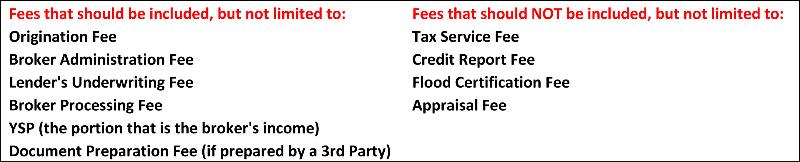
7. Broker does not include 3rd party fees in Line #3. Third party fees, including lender's fees [i.e., Tax Service Fee, Flood Certification Fee, Appraisal Fee (even if it is paid outside of closing), Credit Report Fee, FHA Upfront Mortgage Insurance Premium (MIP) Fee VA Funding Fee, and so forth], should be included in Line #3.

8. Broker does not disclose any and all seller paid items. All fees should be included on the GFE even if the seller is paying closing costs.

9. Broker does not include the transfer tax fees on the GFE in states where transfer tax is a requirement. The transfer tax fees must be disclosed in states where required. If state or local law is unclear or does not specifically attribute transfer tax to a seller or the borrower, the amount to be disclosed by the broker is governed by common practice or experience in the locality. Because not disclosing this fee is in the zero tolerance box, our wholesale lenders charge the broker if not disclosed upfront.

10. Broker does not include all income fees in Box 1 including the lender's underwriting fee. All broker income fees must be included in Box 1 along with the lender's underwriting fee. No additional fees can be added after the initial GFE.

Visit Library for Issuances

Law Library Image

New Good Faith Estimate and HUD-1 Settlement Statement
RESPA - Final Rule and New RESPA Rule FAQs

Lenders Compliance Group is the first full-service, mortgage risk management firm in the country, specializing exclusively in mortgage compliance and offering a full suite of hands-on and automated services in residential mortgage banking.

Tuesday, July 20, 2010

FHA: Only Quality Loans Need Apply

On July 19, 2010, FHA Commissioner David H. Stevens issued a Special Edition statement about lenders "exuberance in the marketplace to find ways to increase loan origination revenues."

While not singling out "opportunistic lenders" or acknowledging a more widespread trend, Commissioner Stevens wants to be "very clear on FHA's position as it relates to underwriting, lender accountability and affordable programs."

In this carefully worded notice, Commissioner Stevens states unequivocally that:

  • Quality underwriting is not only essential - it is expected, and
  • Affordable products are core to FHA serving its mission.

If you have any questions about this matter or would like assistance with mortgage compliance, please contact Jonathan Foxx, Managing Director or call 516-442-3456 x 100.

Highlights

I. Quality underwriting is not only essential - it is expected.

  • Every lender engaging in business with FHA is expected to perform and maintain quality underwriting standards.
  • Mortgagees are expect to have the right people and processes in place to make quality underwriting decisions, perform thoughtful analysis of a borrower's ability to repay the loan, and adhere to realistic underwriting ratios.
  • Processes and staff must be well-equipped to assess the overall quality of the loan, determine a realistic income level and analyze the borrower's true ability to repay the loan. It is imperative we look at income levels, credit history, and qualifying ratios realistically and make decisions responsibly.

FHA Implementing Loan Level Review Tools

  • FHA has refined and re-tooled its loan level review processes to more effectively spot unsatisfactory underwriting performance.
  • Utilizing updated risk targeting criteria and a collaborative approach, FHA is executing an enhanced strategy to identify underwriting deficiencies and take action to protect FHA from unwarranted risks and losses.
  • Comprehensive and calculated risk management will permit FHA to single out those lenders that are needlessly endangering FHA and the continued availability of its programs.

Tools

  • Loan Level Reviews: FHA's loan level review processes have been enhanced to more effectively manage risks and minimize losses arising from poorly underwritten or fraudulent loans.
  • Loan Evaluation: processes have been modified and aligned across all Single Family offices to achieve a collaborative and comprehensive approach to evaluating loans throughout the loan life cycle.
  • Post-Endorsement Technical Reviews: case selection criteria have been revised and review procedures enhanced and standardized.
  • Lenders and Servicer Reviews: the targeting tools and methodology have been strengthened to better target lenders and loans that pose the greatest risks to FHA.
  • Quality Control: methodologies to areas where some originators may try to take unique advantage of the flexibility of FHA without the appropriate focus on quality (i.e., loans originated for non-FHA to FHA refinanced loans).
  • Streamline Refinances: risk can now be identified simply by looking at the original loan quality before it was refinanced into an FHA loan.

II. Affordable products are core to FHA serving its mission.

  • Avoiding Overcharges and Adverse Selection: FHA expects lenders to maintain the spirit and intention of these programs by providing close control over how these programs are implemented and how compensation on these loans is paid to an originator's staff.
  • Compensation: Lenders must keep very close control over compensation programs to ensure borrowers are not paying more than they should to have access to FHA's affordable programs.

Visit Library for Issuance

Law Library Image

Special Edition
FHA Commissioner David H. Stevens
7/19/10

Monday, May 24, 2010

Mortgage Loan Officers Lose Administrative Exemption

Jonathan Foxx, former Chief Compliance Officer of two publicly traded financial institutions, is the President and Managing Director of Lenders Compliance Group.

This post is excepted from our Regulatory Compliance Outlook column which is published monthly in the National Mortgage Professional Magazine, the premier magazine of the mortgage banking industry.

Summary

In an Administrator's Interpretation (Interpretation),[1] issued March 24, 2010, the U. S. Department of Labor (DOL) determined that employees who perform the typical duties of a mortgage loan officer have a primary duty of making sales for their employers and, therefore, do not qualify as bona fide administrative employees exempt under the Fair Labor Standards Act (Act).[2]

Accordingly, mortgage loan officers are subject to minimum wage and overtime requirements.

Administrator’s Interpretation

The Interpretation applies to employees who:

  • spend the majority of their time working inside their employer's place of business, including employees who work in offices located in their homes, rather than mortgage loan officers who are customarily and regularly engaged away from their employer's place of business, and
  • do not spend the majority of their time engaging in "cold-calling," contacting potential customers who have not in some manner expressed an interest in obtaining information about a mortgage loan.

By issuing this Interpretation, the DOL has now rejected its own September 8, 2006 Wage and Hour Opinion Letter FLSA 2006-31, asserting that its previous position provided an "inappropriately narrow definition of sales" as including only customer-specific persuasive sales activity (i.e., the time that a mortgage loan officer spends directly engaged in selling mortgage loan products to customers).[3]

Exempt versus Non-Exempt

The Act identifies two types of employees: non-exempt employees and exempt employees:

· Non-exempt employees are employees who, based on the duties performed and the manner of compensation, are required to account for time worked and sick leave, vacation, and other leave on an hourly and fractional hourly basis. The Act requires that these employees be paid overtime at the premium (time-and-one-half) for actual time worked in excess of 40 hours per week.

· Exempt employees are employees who, based on the duties performed and the manner of compensation, are exempt from the Act’s minimum wage and overtime provisions. Exempt employees are paid an established monthly or annual salary and are expected to fulfill the duties of their positions regardless of the hours worked. They do not receive premium overtime, straight overtime or compensatory time for working more than 40 hours in a work week.

To be considered "exempt" from the Act’s requirements, employees must meet two tests: the Salary Basis Test and the Duties Test. The Act has a number of white collar exemptions from overtime and minimum wage. Changes made to the Act in August 2004 modified these tests, compelling an examination of how to classify and pay mortgage loan officers. Eligibility for these exemptions is based on the primary duties of their job functions and their weekly salary.

Table of Certain White-Collar Exemptions

The August 2004 revisions to the Act elucidated the requirements for certain white-collar exemptions. The following table provides a brief synopsis, with salary requirements, of those revisions:[4]

Executive Employees

Pre-August ‘04 Rule

Beginning August ‘04

Minimum Compensation

$250 qualified weekly salary

$455 qualified weekly salary

Duties Required

  • Primary duty consists of management of enterprise or recognized department or subdivision thereof; and
  • Customarily and regularly directs work of two or more other employees.
  • Same
  • Same
  • Authority to hire/fire other employees (or suggestions about hiring/firing/promotion/other status changes given particular weight).

Administrative Employees

Pre-August ‘04 Rule

Beginning August ‘04

Minimum Compensation

$250 qualified weekly salary

$455 qualified weekly salary

Duties Required

  • Primary duty consists of performing office or non-manual work directly related to management policies or general business operations of the employer or the employer’s customers; and
  • Includes work requiring exercising discretion and independent judgment.
  • Same
  • Primary duty includes the exercise of discretion and independent judgment with respect to matters of significance.

Outside Sales Employees

Pre-August ‘04 Rule

Beginning August ‘04

Minimum Compensation

  • None
  • Same

Duties Required

  • Employed for the purpose of, and customarily and regularly engaged away from the employer’s place of business in, making sales; or in obtaining orders or contracts for services or for the use of facilities; and
  • Devotes no more than 20 percent of hours worked by nonexempt employees to activities not incidental to and in conjunction with employee’s own outside sales or solicitations.
  • Primary duty of making sales, or obtaining orders or contracts for services or use of facilities; and
  • Customarily and regularly engaged away from the employer’s place of business.

Highly Compensated Employees

Pre-August ‘04 Rule

Beginning August ‘04

Minimum Compensation

  • No such exemption
  • $100,000 / year (including minimum weekly salary of $455)

Duties Required

  • No such exemption
  • Non-manual or office work
  • Customarily and regularly performs one or more exempt duties or responsibilities of an executive, administrative or professional employee.

Exemption Test

Under the Interpretation, to fall within the meaning of an "employee employed in a bona fide administrative capacity" (therefore, exempt) an employee's job duties and compensation must meet all of the following tests:

1. The employee must be compensated on a salary or fee basis as defined in the regulations at a rate not less than $455 per week;

2. The employee's primary duty must be the performance of office or non-manual work directly related to the management or general business operations of the employer or the employer's customers; and

3. The employee's primary duty must include the exercise of discretion and independent judgment with respect to matters of significance.

The DOL, contending that the second test (listed above) does not apply to mortgage loan officers, argues that the typical, primary duty of the mortgage loan officer is sales, not office or non-manual work directly related to the management or general business operations of their employer or their employer's customers.

Mortgage Loan Officer is a Sales Person

Although mortgage loan officers compile and analyze potential customers' financial data, they do so because doing so is necessary to evaluate the customers' qualifications for a loan (in order to consummate a sale); that is, the DOL's position is that mortgage loan officers are not analyzing the customers' information to provide advice to the customer, which the customer could take and use elsewhere, but performing "screening" for the benefit of the employer, rather than servicing for the benefit of the customer.

In determining whether an employee's primary duty is making sales, the DOL's view is that work performed incidental to sales should also be considered sales work.

An employee who performs the typical duties of a mortgage loan officer, as defined by the Department, does not qualify for exempt status as bona fide administrative employees. In short, the Interpretation’s position is that a mortgage loan officer’s primary duty is sales and not the management or general business operation of the employer.

Salary Arrangements

In structuring salary arrangements to meet the $455 / week, the issue of commissions and draws must be considered.[5] The general rule is that an exempt employee may be paid solely on a commission basis if the payments for each work week are sufficient to meet the salary basis requirement for that work week. A draw may not reduce an employee’s earning to below the salary basis requirement for hours worked. Additionally, commissions may not be used for weeks other than when earned as a means of making up amounts in a different week where commission earnings are insufficient to meet the statutory amount.

The Act permits an agreement between an employer and employee which provides that the employee will receive the statutory amount for all hours worked along with any additional amount by which commissions may exceed the statutory amount required. It appears that a monthly commission period may be utilized; however, the computation and recording of hours must be on a work week basis.


[1] Administrator’s Interpretation 2010-1, Department of Labor. (This is the first Administrator’s Interpretation ever issued by the DOL.)

[2] See: 29 U.S.C. § 213(a)(1)

[3] The withdrawn opinion letter is Opinion Letter FLSA 2006-31. (Also withdrawn was a previously supporting interpretation Opinion Letter: FLSA 2001 WL 1558764.)

[4] The analysis of this article pertains to federal law. State law and licensing requirements must also be considered in determining how to classify employees. In addition, the Federal Reserve Board is considering a proposal to eliminate compensation based on the “terms” of the loan.

[5] A mortgage loan officer who cannot satisfy the administrative exemption may still satisfy the highly compensated employee exemption by “customarily and regularly” performing at least one of the exempt responsibilities associated with the three exemption criteria for that category.