CREATORS OF THE COMPLIANCE TUNE-UP®

AARMR | ABA | ACAMS | ALTA | ARMCP | IAPP | IIA | MBA | MERS® | MISMO | NAMB

Showing posts with label Yield Spread Premiums. Show all posts

Tuesday, August 17, 2010

Mortgage Originator Compensation and the Dodd-Frank Act

We now enter the era when the Dodd-Frank Act has become the law of the land. Today's brief review (provided below) is at the advent of this period and introduces some of the many changes resulting from this landmark legislation.

But first a comment.

Consolidation of regulatory authorities will be considerable!

There will be transfer and consolidation of enforcement authorities into the Consumer Financial Protection Bureau (Bureau) over the consumer financial protection functions currently performed by the Federal Reserve's Board of Governors, the Office of the Comptroller of the Currency (OCC), the Office of Thrift Supervision (OTS), the Federal Deposit Insurance Corporation (FDIC), the National Credit Union Administration (NCUA) and the Federal Trade Commission (FTC) - including exclusive authority over all related research, rulemaking, guidance, supervision, examination and enforcement activities.

At least sixteen (16) existing consumer protection laws will be included in the transfer, giving new exclusive rulemaking and examination authority to the Bureau.

I have published articles extensively on this subject; indeed, forthcoming this month, I will publish a 3-part series in the National Mortgage Professional Magazine on the financial reform legislation and its impact on the mortgage industry.

If you want to read more, go PDF 12x12here, PDF 12x12here, here, and here.

For the next few years, we will be seeing numerous announcements implementing the changes required by the Dodd-Frank Act. These issuances will come from various agencies as well as the new Bureau and will affect revisions to existing regulations, enumerated laws, Bureau mandates, and many other implementation requirements.

It is essential that you review and continually monitor for these changes, because there will indeed be many and, in various instances, the statutory requirements are complex, extensive, and interlock or interact with other laws - and violations can be enormously costly.

Because of the many regulatory compliance areas that are affected, we urge you to approach the required compliance proactively, seeking guidance now from a competent residential mortgage compliance professional.

Overview

On August 16, 2010, the Federal Reserve Board announced final rules to protect mortgage borrowers from unfair, abusive, or deceptive lending practices that can arise from loan originator compensation practices. The new rules apply to mortgage brokers and the companies that employ them, as well as mortgage loan officers employed by depository institutions and other lenders. The Board is publishing these final rules, amending Regulation Z, which implements the Truth in Lending Act (TILA) and Home Ownership and Equity Protection Act (HOEPA).

At this time, lenders may pay loan originators more compensation if the borrower accepts an interest rate higher than the rate required by the lender (commonly referred to as a "yield spread premium"). Under the final rule, however, a loan originator may not receive compensation that is based on the interest rate or other loan terms. The ostensible purpose of this regulation is to prevent loan originators from increasing their own compensation by raising the consumers' loan costs (i.e., by increasing the interest rate or points).

However, loan originators can continue to receive compensation that is based on a percentage of the loan amount.

There is also a prohibition that prevents a loan originator that receives compensation directly from the consumer from also receiving compensation from the lender or another party. This new rule requires that consumers who agree to pay the originator directly will not also pay the originator indirectly through a higher interest rate, thereby paying more in total compensation than they realize.

The final rule prohibits loan originators from directing or "steering" a consumer to accept a mortgage loan that is not in the consumer's interest in order to increase the originator's compensation.

The final rules apply to closed-end transactions secured by a dwelling where the creditor receives a loan application on or after April 1, 2011.

Effective Compliance Date: April 1, 2011.

If you have any questions about this matter or would like assistance with mortgage compliance, please contact Jonathan Foxx.

Highlights

  • Prohibits payments to the loan originator that are based on the loan's interest rate or other terms. Compensation that is based on a fixed percentage of the loan amount is permitted.
  • Prohibits a mortgage broker or loan officer from receiving payments directly from a consumer while also receiving compensation from the creditor or another person.
  • Prohibits a mortgage broker or loan officer from "steering" a consumer to a lender offering less favorable terms in order to increase the broker's or loan officer's compensation.
  • Provides a safe harbor to facilitate compliance with the anti-steering rule.

The safe harbor is met if:

1. The consumer is presented with loan offers for each type of transaction in which the consumer expresses an interest (that is, a fixed rate loan, adjustable rate loan, or a reverse mortgage); and

2. The loan options presented to the consumer include the following:

  • (A) the lowest interest rate for which the consumer qualifies;
  • (B) the lowest points and origination fees, and
  • (C) the lowest rate for which the consumer qualifies for a loan with no risky features, such as a prepayment penalty, negative amortization, or a balloon payment in the first seven years.

Visit Library for Issuances

Law Library Image

Truth in Lending, 12 CFR Part 226, Final rule and Official Staff Commentary, FRB (8/16/10)

Highlights of Final Rules on Loan Originator Compensation and Steering, FRB (8/16/10)

Lenders Compliance Group is the first full-service, mortgage risk management firm in the country, specializing exclusively in mortgage compliance and offering a full suite of hands-on and automated services in residential mortgage banking.

Monday, August 16, 2010

Good Faith Estimate: Top 10 Broker Mistakes

Since the introduction of the effective implementation date of the new Good Faith Estimate (GFE) on January 1, 2010, we have been working closely with our clients to assure proper disclosure compliance. During this time, we have documented literally hundreds of issues that have required resolution and guidance pertaining not only to the GFE but also the new HUD-1 Settlement Statement (HUD-1).

Even now, these many months into the use of the new GFE, we receive numerous requests from clients seeking a better understanding of this form's nuances and requirements.

Regarding proper implementation of the GFE and HUD-1, we have compiled a database of resolutions and guidelines for regulatory compliance, and will soon make it available to our clients in the first release of our online client website.

However, there are still gaps and we look to the Department of Housing and Urban Development (HUD) for further written clarifications.
There have been eight (8) updates to the New RESPA Rule FAQs (RESPA FAQs) since HUD issued the Final Rule on November 17, 2008: six were issued in 2009, and two were issued in 2010 - with the second (and most recent) issued on April 2, 2010. Although HUD issued a RESPA Roundup in July, that document provided virtually no GFE guidance.

Given that the last RESPA FAQs update was in early April, another update is long overdue. HUD should update the RESPA FAQs soon.

We thought we'd share with you some mistakes made by mortgage brokers and the positions taken by our wholesale lending clients in response to those errors. Obviously, our retail mortgage banker clients have different issues and disclosure concerns. Nevertheless, wholesale lending has certain issues quite unique to the origination and loan flow processes.

If you have any questions about this matter or would like assistance with mortgage compliance, please contact Jonathan Foxx.

Highlights

Top 10 GFE Mistakes Made By Brokers

1. Broker submits a 2009 GFE. The 2010 HUD-approved GFE is the only version acceptable to the lender. Obviously, this mistake was happening during the early transition period, but the percentage of occurrences was inordinately high at the time.

2. Broker submits a 2010 GFE without a complete Service Provider List. All GFEs must include a Service Provider List and must clearly indicate all services that the broker has chosen for the borrower if the broker is selecting the provider. If the borrower chooses from the service provider(s) or if the broker chooses the service provider(s) the 10% tolerance must be adhered to.

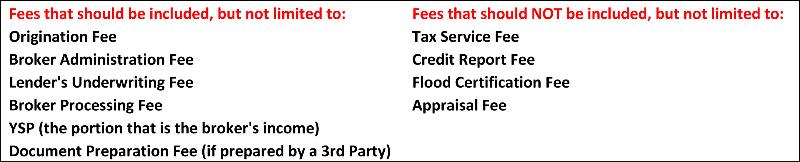
3. Broker includes the YSP in Line #1, but leaves Line #2 completely blank. Line 2 should always be the Gross YSP. The adjustment for what the broker wants to make as income and what the broker would like to credit the borrower is adjusted in Line 1.

Here's an example taken from our files:

Scenario-1

4. Broker includes the YSP in Line #2, but fails to include it in Line #1. The adjustment for what the broker wants to make as income and what the broker would like to credit the borrower is adjusted in Line 1.

Here's an example taken from our files:

Scenario-2

5. Broker does not disclose the lender's underwriting fee in Line #1. The lender's underwriting fee should be included in Line #1.

6. Broker leaves Line #1 completely blank or is calculated incorrectly. Line #1 should include all income fees for the broker and lender.

Here's an outline taken from our files:

Chart-GFE-Outline-3

7. Broker does not include 3rd party fees in Line #3. Third party fees, including lender's fees [i.e., Tax Service Fee, Flood Certification Fee, Appraisal Fee (even if it is paid outside of closing), Credit Report Fee, FHA Upfront Mortgage Insurance Premium (MIP) Fee VA Funding Fee, and so forth], should be included in Line #3.

8. Broker does not disclose any and all seller paid items. All fees should be included on the GFE even if the seller is paying closing costs.

9. Broker does not include the transfer tax fees on the GFE in states where transfer tax is a requirement. The transfer tax fees must be disclosed in states where required. If state or local law is unclear or does not specifically attribute transfer tax to a seller or the borrower, the amount to be disclosed by the broker is governed by common practice or experience in the locality. Because not disclosing this fee is in the zero tolerance box, our wholesale lenders charge the broker if not disclosed upfront.

10. Broker does not include all income fees in Box 1 including the lender's underwriting fee. All broker income fees must be included in Box 1 along with the lender's underwriting fee. No additional fees can be added after the initial GFE.

Visit Library for Issuances

Law Library Image

New Good Faith Estimate and HUD-1 Settlement Statement
RESPA - Final Rule and New RESPA Rule FAQs

Lenders Compliance Group is the first full-service, mortgage risk management firm in the country, specializing exclusively in mortgage compliance and offering a full suite of hands-on and automated services in residential mortgage banking.

Monday, June 14, 2010

FINANCIAL REFORM: Restricts Loan Officer Compensation

OVERVIEW

On May 20, 2010, by a vote of 59-39 the Senate passed the so-called "Finance Reform Bill," otherwise known as Restoring American Financial Stability Act of 2010 - Amendment (S 3217) (Act). Nearly sixteen hundred pages long, it passed as an Amendment to the House's own version of over sixteen hundred pages (HR 4173), the Restoring American Financial Stability Act of 2010 (HR 4173).

On June 10, 2010, the Senate and House began reconciling their respective financial regulatory reform bills. Thus began the process of "reconciliation" between Senate and House versions to produce a final version that is supposed “to end 'too big to fail,' to protect the American taxpayer by ending bailouts, to protect consumers from abusive financial services practices, and for other purposes.”

In a Summary published by the the House Financial Services Committee, a brief outline was provided which, among other things, confirms the adoption of restrictions on a mortgage originator's compensation through Yield Spread Premiums (YSP).

The reconciled version:

●Clarifies that mortgage compensation can only be financed if all originator compensation is paid by the borrower (not third parties) and the borrower pays the entire fee by financing it; and,

●Permits compensation through rate for all mortgages as long as they satisfy the "borrower pays fee" financing provision (previously the House bill only required this for "Qualified Mortgages").

Under the rubric of "anti-steering regulations," the YSP  would now be  restricted as compensation to the mortgage originator.

The restrictions on loan officer compensation are meant to reconcile the Senate and House versions of the Act and will presumably be in the final version to be signed by the President.

HIGHLIGHTS

Section 1073 (Page 1444 - HR 4173)
PROHIBITED PAYMENTS TO MORTGAGE ORIGINATORS

PROHIBITION ON STEERING INCENTIVES

(1) IN GENERAL: For any consumer credit transaction secured by real property or a dwelling, no loan originator shall receive from any person and no person shall pay to a loan originator, directly or in-directly, compensation that varies based on the terms of the loan (other than the amount of the principal).

(2) RESTRUCTURING OF FINANCING ORIGINATION FEE:

  (A) IN GENERAL: For any consumer credit transaction secured by real property or a dwelling, a loan originator may not arrange for a consumer to finance through the rate any origination fee or cost except bona fide third party settlement charges not retained by the creditor or loan originator.

  (B) EXCEPTION: Notwithstanding sub-paragraph (A), a loan originator may arrange for a consumer to finance through the rate an origination fee or cost if:

    (i) the loan originator does not receive any other compensation, directly or indirectly, from the consumer except the compensation that is financed through the rate;

    (ii) no person who knows or has reason to know of the consumer-paid compensation to the loan originator, other than consumer, pays any compensation to the loan originator, directly or indirectly, in connection with the transaction; and

    (iii) the consumer does not make an upfront payment of discount points, origination points, or fees, however denominated (other than bona fide third party settlement charges).

(3) RULES OF CONSTRUCTION: No provision of this subsection shall be construed as:

  (A) limiting or affecting the amount of compensation received by a creditor upon the sale of a consummated loan to a subsequent purchaser;

  (B) restricting a consumer's ability to finance, at the option of the consumer, including through principal or rate, any origination fees or costs permitted under this subsection, or the loan originator's right to receive such fees or costs (including compensation) from any person, subject to paragraph (2)(B), so long as such fees or costs do not vary based on the terms of the loan (other than the amount of the principal) or the consumer's decision about whether to finance such fees or costs; or

  (C) prohibiting incentive payments to a loan originator based on the number of loans originated within a specified period of time.

Visit Library for HR 4183: Section 1073 and Full Text

Visit our Library for Issuances

 Law Library Image

●Restoring American Financial Stability Act of 2010 (HR 4183)
●Restoring American Financial Stability Act of 2010 - Amendment (S 3217)
●HR 4183: Section 1073 - Prohibited Payments to Mortgage Originators

Friday, January 29, 2010

New RESPA Reform Rule - Overview

by Jonathan Foxx

Jonathan Foxx, former Chief Compliance Officer of two publicly traded financial institutions, is the President and Managing Director of Lenders Compliance Group.

As published in the January 2010 Edition of National Mortgage Professional Magazine.

[>> Printable Version]

In 2008, the Department of Housing and Urban Development (HUD) issued both technical and substantive amendments to the rule that implements RESPA.[i] The technical changes took effect on January 16, 2009 and substantive changes have taken effect on January 1, 2010.

Recently, I provided a brief analysis of the new Good Faith Estimate (GFE).[ii] In this article I will offer some procedural guidance that incorporates several substantive changes that took effect on January 1, 2010. This analysis is meant as an overview of those changes.[iii]

Notably, the federal regulatory agencies will now begin examining for compliance with the new substantive provisions of the new RESPA Reform Rule on January 1, 2010.[iv]

Among other things, substantial changes have been made to:

  • Good Faith Estimate (GFE)
  • HUD-1 Settlement Statement (HUD-1)
  • HUD-1A Settlement Statement (HUD-1A)
  • Settlement Cost Booklet[v]

To facilitate the understanding of this article and the new RESPA Reform Rule, visit HUD’s RESPA section.

My firm’s website Library contains all of the documents listed above, the Final Rule, all New RESPA FAQs updates, as well as RESPA Appendices A and C, respectively, Instructions for completing the HUD-1/1A, and Instructions for completing the Good Faith Estimate, and the revised Settlement Cost Booklet.

I will consider the five following RESPA revisions:[vi]

  1. New Good Faith Estimate Form
  2. Binding Good Faith Estimate
  3. Tolerances on Settlement Costs
  4. HUD-1/1A Settlement Statement
  5. Settlement Cost Booklet

New Good Faith Estimate form[vii]

As of January 1, 2010, lenders and mortgage brokers[viii] must provide a standard Good Faith Estimate (GFE) form to a borrower within three business days[ix] of receipt of an application for a mortgage loan. The new GFE compares settlement costs and loan terms from various loan originators. Areas covered by the GFE include:

  • a summary of loan terms and a summary of estimated settlement charges
  • key dates (i.e., expiration dates of the interest rate and settlement charges)
  • settlement charges disclosed as subtotals for eleven (11) cost categories
  • a table explaining which charges can change at settlement
  • a trade-off table showing the relationship between the interest rate and the settlement charges
  • a chart for comparing the costs and terms of loans offered by different originators

First Page of GFE

The first page of the GFE discloses identifying information such as the name and address of the “loan originator” which includes the lender or the mortgage broker originating the loan. The “purpose” section indicates what the GFE is about and directs the borrower to the Truth in Lending disclosures and HUD’s Website for more information. The borrower is informed that only the borrower can shop for the best loan and that the borrower should compare loan offers using the shopping chart on the third page of the GFE.

The “important dates” section requires the loan originator to state the expiration date for the interest rate for the loan provided in the GFE as well as the expiration date for the estimate of other settlement charges and the loan terms not dependent upon the interest rate.

While the interest rate stated on the GFE is not required to be honored for any specific period of time, the estimate for the other settlement charges and other loan terms must be honored for at least ten (10) business days from when the GFE is provided.

  • The form must state how many calendar days within which the borrower must go to settlement once the interest rate is locked (i.e., rate lock period). The form also requires disclosure of how many days prior to settlement the interest rate would have to be locked, if applicable.
  • The “summary of your loan” section requires disclosure of the loan amount; loan term; initial interest rate; initial monthly payment for principal, interest, and any mortgage insurance; whether the interest rate can rise, and if so, the maximum rate to which it can rise over the life of the loan, and the period of time after which the interest rate can first change; whether the loan balance can rise if the payments are made on time, and if so, the maximum amount to which it can rise over the life of the loan; whether the monthly amount owed for principal, interest, and any mortgage insurance can rise even if payments are made on time, and if so, the maximum amount to which the monthly amount owed can ever rise over the life of the loan; whether the loan has a prepayment penalty, and if so, the maximum amount it could be; and, whether the loan has a balloon payment, and if so, the amount of such payment and in how many years it will be due.
  • The “escrow account information” section requires the loan originator to indicate whether the loan does or does not have an escrow account to pay property taxes or other property related charges. In addition, this section also requires the disclosure of the monthly amount owed for principal, interest, and any mortgage insurance.
  • The bottom of the first page includes subtotals for the adjusted origination charges and charges for all other settlement charges listed on page two, along with the total estimated settlement charges.

Second Page of GFE

The second page of the GFE requires disclosure of all settlement charges. It provides for the estimate of total settlement costs in eleven categories discussed below. The adjusted origination charges are disclosed in “Block A” and all other settlement charges are disclosed in “Block B.” The amounts in the blocks are to be added to arrive at the “total estimated settlement charges” which is required to be listed at the bottom of the page.

Block A - Disclosure of Adjusted Origination Charge

Block A addresses disclosure of origination charges, which include all lender and mortgage broker charges. The “adjusted origination charge” results from the subtraction of a “credit” from the “origination charge” or the addition of a “charge” to the origination charge.

Block 1 – the origination charges, which includes lender processing and underwriting fees and any fees paid to a mortgage broker.

Note: This block requires the disclosure of all charges that all loan originators involved in the transaction will receive for originating the loan (excluding any charges for points). A loan originator may not separately charge any additional fees for getting the loan, such as application, processing or underwriting fees. The amount in Block 1 is subject to zero tolerance (i.e., the amount cannot change at settlement). (See “Tolerances” below.)

Block 2 – a “credit” or “charge” for the interest rate chosen:

Note: Differentiation is made between transactions involving a mortgage broker and transactions that do not involve a mortgage broker.

Transaction Involving a Mortgage Broker. Block 2 requires disclosure of a “credit” or charge (points) for the specific interest rate chosen. The credit or charge for the specific interest rate chosen is the net payment to the mortgage broker (i.e., the sum of all payments to the mortgage broker from the lender, including payments based on the loan amount, a flat rate or any other compensation, and in a table funded transaction, the loan amount less the price paid for the loan by the lender).

When the net payment to the mortgage broker from the lender is positive, there is a “credit” to the borrower and it is entered as a negative amount. [For example, if the lender pays a yield spread premium (YSP) to a mortgage broker for the loan set forth in the GFE, the payment must be disclosed as a “credit” to the borrower for the particular interest rate listed on the GFE (reflected on the GFE at Block 2, checkbox 2). The term “yield spread premium” is not featured on the GFE or the HUD-1 Settlement Statement.]

Note: Points paid by the borrower for the interest rate chosen must be disclosed as a “charge” (reflected on the GFE at Block 2, third checkbox). A loan cannot include both a charge (points) and a credit (yield spread premium).

Transaction Not Involving a Mortgage Broker. For a transaction without a mortgage broker, a lender may choose not to separately disclose any credit or charge for the interest rate chosen for the loan in the GFE. If the lender does not include any credit or charge in Block 2, it must check the first checkbox in Block 2 indicating that “The credit or charge for the interest rate you have chosen is included in ‘our origination charge’ above.” Only one of the boxes in Block 2 may be checked: a credit and charge cannot occur together in the same transaction.

Block B - Disclosure of Charges for All Other Settlement Services

Block B totals the sums for all settlement services (other than the origination charges).

Block 3 – service providers selected by the lender (i.e., appraisal, flood certification fees)

Block 4 – title service fees and the cost of lender’s title insurance

Block 5 – owner’s title insurance

Block 6 – other required services for which the consumer may shop

Block 7 – government recording charges

Block 8 – transfer tax charges

Block 9 – initial deposit for escrow account

Block 10 – daily interest charges

Block 11 – homeowner’s insurance charges

Third Page of GFE

The third page of the GFE includes the following information:

  • Tolerance Chart: identifies the charges that can change at settlement (See “Tolerances” below.)
  • Trade-Off Table: requires the loan originator to provide information on the loan described in the GFE and at the loan originator’s option, information about alternative loans (i.e., lower settlement charges but a higher interest rate, lower interest rate but higher settlement charges)
  • Shopping Chart: allows the consumer to fill in loan terms and settlement charges from other lenders or brokers to use to compare loans
  • Disclosure: language indicating that some lenders may sell the loan after settlement, but any fees the lender receives in the future cannot change the borrower’s loan or the settlement charges.

Binding Good Faith Estimate[x]

With limited exceptions, the loan originator will be bound to the settlement charges and loan terms listed on the GFE. For the interest rate, the loan originator will be required to indicate on the GFE the period during which a rate is available. After that period, the interest rate and other rate related charges, the adjusted origination charges, and the per diem interest can change until the interest rate is locked.

For settlement charges and all other loan terms, the loan originator will be required to honor the estimated settlement charges and loan terms for at least 10 business days from the date the GFE is provided. The charges and terms in the GFE will be binding, unless a revised GFE is provided to the borrower prior to settlement based on “changed circumstances” as defined in the rule (see below). NOTE: if a lender accepts a GFE issued by a mortgage broker, the lender is subject to the loan terms and settlement charges listed in the GFE, unless a revised GFE is issued prior to settlement.

Changed Circumstances are:

  • Acts of God, war, disaster or other emergency
  • Information particular to the borrower or transaction that was relied on in providing the GFE that changes or is found to be inaccurate after the GFE has been provided
  • New information particular to the borrower or transaction that was not relied on in providing the GFE
  • Other circumstances particular to the borrower or transaction, including boundary disputes, the need for flood insurance or environmental problems

Changed circumstances do not include: borrower’s name, borrower’s monthly income, property address, estimate property value, mortgage loan amount, and any information contained in any credit report obtained by the loan originator prior to providing the GFE (unless the information changes or is found to be inaccurate after the GFE has been provided). Also, market price fluctuations by themselves do not constitute changed circumstances.

Changed circumstances affecting settlement costs are those circumstances that result in increased costs for settlement services such that the charges at settlement would exceed the tolerances or limits on those charges established by the regulations.

Changed circumstances affecting the loan are those circumstances that affect the borrower’s eligibility for the loan. For example, if underwriting and verification indicate that the borrower is ineligible for the loan provided in the GFE, the loan originator would no longer be bound by the original GFE. In such cases, if a new GFE is to be provided, the loan originator must do so within three business days of receiving information sufficient to establish changed circumstances. The loan originator must document the reason that a new GFE was provided and must retain documentation of any reasons for providing a new GFE for no less than three years after settlement.

None of the information collected by the loan originator prior to issuing the GFE may later become the basis for a “changed circumstance” upon which it may offer a revised GFE, unless:

1) it demonstrates that there was a change in the particular information; or

2) the information was inaccurate; or

3) it did not rely on that particular information in issuing the GFE.

A loan originator has the burden of demonstrating non-reliance on the collected information, but may do so through various means (for example, through a documented record in the underwriting file or an established policy of relying on a more limited set of information in providing GFEs).

NOTE: if a loan originator issues a revised GFE based on information previously collected in issuing the original GFE and “changed circumstances,” it must document the reasons for issuing the revised GFE, such as its non-reliance on such information or the inaccuracy of such information.

Tolerances on settlement costs[xi]

Established “tolerances” or limits are placed on the amount actual settlement charges can vary at closing from the amounts stated on the Good Faith Estimate. Three tolerance categories of settlement charges are disclosed. At settlement, if the charges exceed the charges listed on the GFE by more than the permitted tolerances, the loan originator must cure the tolerance violation, at settlement or within 30 calendar days after settlement, by reimbursing to the borrower the amount by which the tolerance was exceeded.

Tolerance Categories

1. Zero tolerance category. This category of fees is subject to a zero tolerance standard. The fees estimated on the GFE may not be exceeded at closing. These fees include:

  • the loan originator’s own origination charge, including processing and underwriting fees
  • the credit or charge for the interest rate chosen (i.e., yield spread premium or discount points) while the interest rate is locked
  • the adjusted origination charge while the interest rate is locked
  • state/local property transfer taxes

2. Ten percent tolerance category. For this category of fees, while each individual fee may increase or decrease, the sum of the charges at settlement may not be greater than ten (10%) percent above the sum of the amounts included on the GFE. These fees include:

  • loan originator required settlement services, where the loan originator selects the third-party settlement service provider
  • loan originator required services, title services, required title insurance and owner’s title insurance when the borrower selects a third-party provider identified by the loan originator
  • government recording charges

3. No tolerance category. This category of fees is not subject to any tolerance restriction. The amounts charged for the following settlement services included on the GFE can change at settlement and the amount of the change is not limited. These fees include:

  • loan originator required services where the borrower selects his or her own third-party provider
  • title services, lender’s title insurance and owner’s title insurance when the borrower selects his or her own provider
  • initial escrow deposit
  • daily interest charges
  • homeowner’s insurance

HUD-1/1A Settlement Statement[xii]

The revised HUD-1/1A Settlement Statement form provides a reference between the HUD-1/1A and the relevant line from the GFE.[xiii] (Inadvertent or technical errors on the HUD-1/1A will not be deemed to be a violation of RESPA, if a revised HUD-1/1A is provided to the borrower within 30 days of settlement.)

Key Enhancements

There are no substantive changes to the first page of the HUD-1/1A form. However, there are changes to the second page of the form to facilitate comparison between the HUD-1/1A and the GFE, as indicated above. Each designated line on the second page of the revised HUD-1/1A includes a reference to the relevant line from the GFE.

  • No Cost Loans. Where “no cost” refers only to the loan originator’s fees (see Section L, subsection 800 of the HUD-1 form), the amounts shown for the “origination charge” and the “credit or charge for the interest rate chosen” should offset, so that the “adjusted origination charge” is zero. Where “no cost” encompasses loan originator and third-party fees, all third-party fees must be itemized and listed in the borrower’s column on the HUD-1/1A. These itemized charges must be offset with a negative adjusted origination charge (Line 803) and recorded in the columns.
  • Comparisons. The revised HUD-1 includes a new third page (second page of the HUD-1A) that allows borrowers to compare the loan terms and settlement charges listed on the GFE with the terms and charges listed on the closing statement. The first half of the third page includes a comparison chart that sets forth the settlement charges from the GFE and the settlement charges from the HUD-1 to allow the borrower to easily determine whether the settlement charges exceed the charges stated on the GFE.[xiv]
  • As indicated above, inadvertent or technical errors on the settlement statement are not deemed to be a violation of Section 3500.4 of RESPA if a revised HUD-1/1A is provided to the borrower within 30 calendar days after settlement.[xv]
  • The second half of the third page sets forth the loan terms for the loan received at settlement in a format that reflects the summary of loan terms on the first page of the GFE, but with additional loan related information that would be available at closing. A note at the bottom of the page indicates that the borrower should contact the lender if the borrower has questions about the settlement charges or loan terms listed on the form.
  • Section 3500.8(b) of RESPA (“Charges to be stated”) and the instructions for completing the HUD-1/1A Settlement Statement provide that the loan originator shall transmit sufficient information to the settlement agent to allow the settlement agent to complete the “loan terms” section. (The loan originator must provide the information in a format that permits the settlement agent to enter the information in the appropriate spaces on the HUD-1/1A, without having to refer to the loan documents.)

Settlement Cost Booklet[xvi]

A loan originator is required to provide the borrower with a copy of the Settlement Cost Booklet, entitled “Shopping for Your Home Loan,” at the time a written application is submitted, or no later than three business days after the application is received. (If the application is denied before the end of the three-business-day period, the loan originator is not required to provide the booklet.) If the borrower uses a mortgage broker, the broker rather than the lender, must provide the booklet. The booklet does not need to be provided for refinancing transactions, closed-end subordinate lien mortgage loans, and reverse mortgage transactions, or for any other federally related mortgage loan not intended for the purchase of a one-to-four family residential property.


[i] 73 Fed. Reg. 68204 (Nov. 17, 2008).

[ii] Regulatory Compliance Outlook, National Mortgage Professional Magazine, December 2009, Volume 1, Issue 8,

[iii] For detailed information, review the following Appendices from the RESPA regulation: Appendix A – Instructions for completing the HUD-1 and HUD-1A; Appendix C – Instructions for completing the Good Faith Estimate (GFE).

[iv] Lenders are responsible for the disclosures provided by mortgage brokers and, therefore, should implement procedures to assure that mortgage brokers with whom they do business comply with the new RESPA requirements.

[v] HUD issued the revised Settlement Cost Booklet on December 15, 2009. Entitled “Shopping for Your Home Loan,” the new booklet must be used with the new GFE and HUD–1.

[vi] Portions of this overview incorporate guidance from OTS: Consumer Affair Laws and Regulations, Section 1320.1 (12/2009)

[vii] The GFE must be completed in accordance with the Instructions set forth in Appendix C of 24 CFR Part 3500.

[viii] The RESPA Reform Rule changed the definition of “mortgage broker” to mean a person or entity (not an employee of a lender) that renders origination services and serves as an intermediary between a lender and a borrower in a transaction involving a federally related mortgage loan, including such person or entity that closes the loan in its own name and table funds the transaction. The definition will also apply to a loan correspondent approved under 24 CFR 202.8 for Federal Housing Administration (FHA) programs. The definition would also include an “exclusive agent” who is not an employee of the lender.

[ix] Weekdays, except Sundays and specified, legal Holidays.

[x] See: 24 CFR 3500.7(f)

[xi] See: 24 CFR 3500.7(e) and (i)

[xii] See: 24 CFR 3500.8

[xiii] No settlement statement is required for home equity plans subject to the Truth in Lending Act and Regulation Z.

[xiv] If any charges at settlement exceed the charges listed on the GFE by more than the permitted tolerances, the loan originator may cure the tolerance violation by reimbursing to the borrower the amount by which the tolerance was exceeded. A borrower will be deemed to have received timely reimbursement if the financial institution delivers or places the payment in the mail within 30 calendar days after settlement.

[xv] See: 24 CFR 3500.4: Reliance upon Rule, Regulation or Interpretation by HUD

[xvi] Op. Cit. 5

Monday, January 4, 2010

New Good Faith Estimate

by Jonathan Foxx

Jonathan Foxx, former Chief Compliance Officer of two publicly traded financial institutions, is the President and Managing Director of Lenders Compliance Group.

As published in the December 2009 Edition of National Mortgage Professional Magazine.

The Department of Housing and Urban Development (HUD) published a final regulation on November 17, 2008. This final regulation made substantial changes to Regulation X – the implementing regulation of the Real Estate Settlement Procedures Act (RESPA). Among other things, HUD has made substantial changes to the:

· Good Faith Estimate (GFE)

· HUD–1 Settlement Statement (HUD-1)

· HUD–1A Settlement Statement, and

· Settlement Cost Booklet.

This article will highlight certain features of the new Good Faith Estimate.[1] The next article will highlight changes to the HUD-1Settlement Statement.

Implementation Date: January 1, 2010 [2]

The new GFE is 3 pages in length and contains more information than the previous GFE.

  • Main sections of the new GFE:

General headings (originator and borrower information) – Page 1

On the top of page one you will see the General headings information. The left hand side gathers information about the originator, including name, address, phone number, and email address. The right hand side gathers information about the borrowers, including name and address. This section also includes the date that the GFE is prepared.

Purpose (See “Shopping for your loan”)

Shopping for your loan

The “Purpose” and “Shopping for your loan” sections, containing standardized language from HUD. These sections explain to the borrower the purpose of the GFE and how to use it to shop for the loan that is best for that borrower.

Important dates

This section contains dates that are important to the borrower and lender.

Line #1, the originator provides the date (and time, if necessary) through which the disclosed interest rate information is available. NOTE: This is not intended to be an interest rate lock.

Line #2, the originator provides the date through which all settlement service charges disclosed on the GFE are available. HUD requires this date to be at least 10 business days from the date of the GFE, in order to give the borrower time to shop around for the best mortgage.

Line #3, the originator provides information about the rate lock. After the rate has been locked, the borrower will have a stated number of days to go to settlement in order to receive the locked interest rate.

Line #4, the originator lists the number of days before settlement that the interest rate must be locked.

Summary of your loan

This section includes information about the initial loan amount, loan term, initial interest rate, and periodic (i.e., monthly) payment amount.

This section also includes specific “yes or no” questions with regard to whether the interest rate, loan balance, and payment amounts can increase during the life of the loan.

There are specific “yes or no” questions with regard to whether the loan has a prepayment penalty or a balloon payment.

NOTE: If the answer to any of these questions is “yes,” then the new GFE requires additional information about that feature.

There are many calculations in this area that have not been a part of previous RESPA requirements before (i.e., new monthly payment at first interest rate change date, or maximum monthly payment for a variable rate loan). Review carefully.

Escrow account information

The Escrow section discloses if the originator requires an escrow account to be set up to pay such items as hazard insurance, real estate taxes, and so forth. NOTE: The monthly payment amount disclosed here includes only principal, interest, and any mortgage insurance, but does not include taxes and insurance (escrows).

Summary of your settlement charges

This section contains a summary of (A) the adjusted original charge, (B) charges for all other settlement services, and (A + B) the total estimated settlement charges. Detailed information about the charges appears on page 2. The amounts are summarized on page 1 for the convenience of the borrower.

Understanding your estimated settlement charges – Page 2

Your Adjusted Origination Charge

This subsection consists of blocks.

Block #1: the loan originator discloses all the charges that the loan originator will receive, except for any charges for the specific interest rate chosen (the points). [3]

Block #2: discloses the credit or charge (points) for the specific interest rate chosen. [4]

Transactions not involving a broker. There are 2 choices:

(1) Lender discloses the points or yield spread premium as part of the origination charge in Block #1. If the lender chooses this approach, then in Block #2, the lender should check the box that says, “The credit or charge for the interest rate of ____% is included in ‘Our origination charge.’ (See item 1 above)”

(2) Lender discloses the points or yield spread premium as a separate line item in Block #2. If the lender chooses this approach, then in Block #2, the lender should follow the instructions for transactions involving brokers.

Transactions involving a broker. For transactions involving brokers, brokers do not have the option of using the first check box in Block #2 (to indicate that the credit or charge for the interest rate is included in the origination charge). Brokers must check either the second or the third check box under Block #2.

(1) If there is a yield spread premium being paid, check the box that says, “You receive a credit of $________ for this interest rate of ____%. This credit reduces your settlement charges.”

NOTE: The amount of the credit is listed as a negative number.

(2) If points are paid to the lender, check the box that says, “You pay a charge of $ _____ for this interest rate of _____%. This charge (points) increases your total settlement charges.”

NOTE: The amount of the charge is listed as a positive number.

NOTE: At the bottom of this subsection is a line designated as Line A – “Your Adjusted Origination Charge.” The amount disclosed here is the sum of the “Our origination charge” and the credit or charge for the specific interest rate chosen.

Your Charges for All Other Settlement Charges

This subsection consists of blocks.

Block #3: the fees disclosed are those fees for which the loan originator chooses the service provider. The individual services and the charges for those services are disclosed and totaled in the right hand column.

Block #4: is for title services and lender’s title insurance. The lender’s title insurance premium is included in this total.

Block #5: includes the owner’s title insurance fees, regardless of who pays for it.

Block #6: is for the required services for which the borrower can choose the service provider. The borrower can choose a service provider from a list that the loan originator may provide, or the borrower can shop for a provider on his/her own. [5]

Block #7: discloses the total of the government recording charge.

Block #8: discloses the total of the transfer taxes.

Block #9: discloses the initial deposit for the escrow account (if applicable).

Block #10: discloses the amount of daily interest charges from the date of settlement until the first day of the next month of the first day of the normal mortgage payment cycle. NOTE: Also discloses the per diem charges, the number of days for interest charges, and the estimated date of settlement.

Block #11: discloses the types and amounts of homeowners insurance that will be required to be paid by settlement and totaled in the right hand column.

NOTE: At the end of this subsection is a line designated as B – “Your Charges for All Other Settlement Charges.” The amount disclosed here is the total of all the charges under “Your Charges for All Other Settlement Charges.” Lines A and B are totaled together to disclose the “Total Estimated Settlement Charges.”

Understanding which charges can change at settlement – Page 3

This section gives information to the borrower to help the borrower understand what to expect for final charges on the HUD–1 Settlement Statement. There are no completion fields in the Understanding section; therefore, it is important to place each fee in the appropriate category.

Charges fall into one of 3 categories:

1. Charges that cannot increase at settlement

2. The total of these charges can increase up to 10% at settlement

3. These charges can change at settlement.

The loan originator is bound by the initial GFE and the tolerances described in the Understanding which charges can change at settlement section. There are a limited number of circumstances under which a revised GFE may be given. The revised RESPA rules refer to this situation as a “changed circumstance.” If a changed circumstance allows for re–disclosure of the GFE, then the charges from the re–disclosed GFE will be used when comparing the GFE charges with the HUD–1 charges. This comparison is found on page 3 of the new HUD-1. [6]

Using the tradeoff table

The table in this section is meant to help the borrower compare the transaction disclosed on the GFE with similar transactions:

The same loan with lower settlement charges but a higher interest rate.

The same loan with a lower interest rate but higher settlement charges.

NOTE: Loan originators have the option of completing this section.

Using the shopping chart

The shopping chart section is meant to give the borrower the ability to compare the information from this GFE with the information from the GFEs of other loan originators.

The “This loan” column is completed by the loan originator. Columns labeled “Loan 2,” “Loan 3,” and “Loan 4” would be completed by the borrower by hand as the borrower shops around with other loan originators.

If your loan is sold in the future

This section informs the borrower that the lender may sell the loan after settlement.


[1] For more detailed information, please review the following Appendix from the RESPA regulation: Appendix C – Instructions for completing the Good Faith Estimate (GFE)

[2] Lenders can choose to implement the GFE and HUD-1 earlier than January 1, 2010

[3] All of these various charges (i.e., origination fee, application fee, underwriting fee, etc.) – and their impact on APR and Section 32 – are all lumped together into the “origination charge” for purposes of disclosure on the GFE and the HUD-1.

[4] Completed in different ways, depending upon whether a broker is involved in the transaction.

[5] If the loan originator does provide a list of service providers, the loan originator is held accountable for the accuracy of the disclosed charges.

[6] The only fees that may change are fees that were affected by the changed circumstance.

Monday, August 24, 2009

Service Release Premium versus Yield Spread Premium: Match or Mismatch?

by Jonathan Foxx

Jonathan Foxx, former Chief Compliance Officer of two publicly traded financial institutions, is the President and Managing Director of Lenders Compliance Group.

Published in the August Edition of National Mortgage Professional Magazine.

What’s in a Name?

Juliet says, in Shakespeare’s “Romeo and Juliet:”

“What’s in a name? That which we call a rose
By any other name would smell as sweet.”[1]

Is a name just a contrived and meaningless convention?

Is the undisclosed income paid to a bank when it sells an above par residential mortgage loan into the secondary market elementally distinguishable from the disclosed income paid to a mortgage broker when it sells an above par loan to a bank? The former, known as the Service Release Premium (SRP), and the latter, known as the Yield Spread Premium (YSP), seem to share similar functionality, but may soon have quite different fates. The YSP will virtually cease to exist if the Mortgage Reform and Anti-Predatory Lending Act, passed by the House of Representatives on May 7, 2009, and sent to the Senate, is eventually signed by President Obama into law. [2]

But the SRP will live on and on, with no regulatory change affecting its use. Call each one what you will “by any other name,” though characteristically the same, the destinies of the SRP and the YSP diverge right at the point where an entire class of loan originators, the mortgage brokers, will be effectively trounced by another class of loan originators, the banks! Rarely has the power of the banking lobby been more apparent in its quest to eliminate competition.

Match or mismatch?

Bicameral Rivalry

In addition to the House’s foray into attacking the YSP, while still surely preserving the SRP, there is yet another shark in these controversial waters!

Seemingly not to be outdone by the machinations of Barney Frank’s (D-MA) House Financial Services Committee, which was the architect of the afore-mentioned legislation,[3] two new Senate bills were introduced by Oregon Senator Jeff Merkley (D-OR). Each of these two new Senate bills, if made into law, would adversely affect the mortgage brokerage community. The first is slyly called the Promoting Mortgage Responsibility Act,[4] which prohibits prepayment penalties,[5] and the second is ironically called Transparency for Homeowners Act of 2009,[6] which specifically prohibits Yield Spread Premiums, but does not prohibit or give transparency whatsoever to the Service Release Premium. The word “transparency” has been bandied about quite a bit recently by certain politicians, but Senator Merkley’s understanding of transparency clearly does not extend to requiring the disclosure of the Service Release Premium.[7] As Alice cried, this is becoming “Curiouser and curiouser!”[8]

The YSP has been villanized and compared to a “kickback.” As recently as April of this year, a New York Times editorial ominously declared that the “first step must be to outlaw the kickbacks” and “the most clearly unethical form of payment is the so-called yield-spread premium.”[9] The SRP was not mentioned even once in this editorial. The typical opinion of the political and media castes is that the YSP is anathema. In previous articles, we argued that the YSP is not a kickback under existing law[10] and can be saved so that it will continue to provide important benefits to the consumer.[11] Why destroy the YSP and keep the SRP, when there is not a single factor representative of YSP abuse that cannot also be representative of SRP abuse? Let’s look just a bit closer at these parallels.

“You say either and I say eyether, You say neither and I say nyther;
Either, eyether, neether, nyther, Let's call the whole thing off!”
[12]

“Either, eyether, neether, nyther,” however the mortgage brokers and banks may choose to agree or disagree about the roles played by two succinctly similar premiums, it is readily apparent that one of them is surely not accessible to the consumer’s purview. Maybe it’s time to consider making both the YSP and the SRP available to the public, create full transparency, and give control to the borrower with respect to their application.

The YSP has been criticized because it can lead to price discrimination, thus not necessarily offering the borrower a savings and, therefore, can be used to increase the cost. Certainly, it has been statistically demonstrated that total loan costs are elevated in loans containing YSPs, discount points, and seller contributions to closing costs.[13] The U. S. Department of Housing and Urban Development (HUD) has given extensive guidance in determining the proper application of the YSP.[14] Furthermore, those who want the YSP permanently eliminated from residential mortgage loan originations argue that the YSP (1) can be used to charge borrowers more, (2) do not always provide a dollar for dollar financing offset, and (3) may represent compensation in excess of goods and services. But each one of the above-mentioned abuses can certainly occur in using the SRP. One exception does pertain to the YSP: the borrower is given information about the YSP on the Good Faith Estimate (GFE) and the HUD-1 Settlement Statement,[15] but otherwise denied any and all information about the SRP on any loan application document or disclosure![16]

Note, however, that charging a higher YSP without providing a financing offset is prima facie violative of the Real Estate Settlement Procedures Act (RESPA);[17] and, in any event, not providing a dollar for dollar financing offset[18] and excessively charging for goods and services are violations of HUD’s long-standing policies as well as its well-known “Two-Part Test.”[19]

Although HUD has given clear guidance on the proper application of the YSP, it has provided virtually no similar guidance to banks regarding the SRP. There’s a reason for this: RESPA does not actually govern a bank’s use of the SRP. To be sure, being exempt from RESPA, this is not a statute that a bank must comply with; though, of course, every mortgage broker must adhere to RESPA’s requirements. HUD, therefore, even in its administrative oversight of RESPA, takes no position on the SRP’s use by banks!

So, let’s compare the fully disclosed YSP with the fully undisclosed SRP.

Comparative Analysis

Potential for Abuse

YSP

SRP

Price Discrimination

Measurable

Not Measureable

Excessive Charges

Measurable

Not Measureable

No Dollar for Dollar Financing

Measurable

Not Measureable

Overpaying for goods, services, facilities

Measurable

Not Measureable

There is a potential for either the YSP or the SRP to be applied in an abusive manner. I have suggested elsewhere that the abuse of the YSP can be largely curtailed by crediting it to the borrower, thereby permitting the borrower to choose how it is to be used in accordance with the borrower’s own interests.[20] Once borrowers agree to how the YSP will be used and on what terms, market forces will take over. But, the borrower has no idea what the value of the SRP is, because it is an entirely undisclosed premium and, therefore, a consumer cannot hope to control how or if it is to be applied. Indeed, a bank provides no information for the consumer to determine whether the SRP complies with fair lending laws, avoids excessive charges, offers dollar for dollar financing opportunities, or avoids overpayment for goods, services, and facilities. Those important aspects of consumer protection are relegated to the transparent domain of the YSP.[21] The SRP’s lack of transparency masks from public scrutiny each one of these criteria.

"If you don't know where you are going, you will wind up somewhere else."

– Yogi Berra

The borrower is ultimately paying both the YSP and the SRP, so why not disclose each of them and let the consumer determine how they are to be used? Without properly regulating the SRP, a bank can use it to increase its profit, though providing no incremental benefit to the borrower. The above-mentioned House legislation and the two new Senate bills are clearly based on the premise that the YSP disadvantages borrowers, whereas the SRP does not. Or, at least, that is the most generous conclusion to be reached. Given the strength of the banking lobby, other conclusions can be easily conceived.

Doing away with the fully disclosed YSP, but keeping intact the undisclosed SRP obviously gives an advantage to banks and, presuming the passage of the aforesaid legislation, the continuation of the SRP as a de facto mark-up tool further emboldens and strengthens banks – but certainly weakens mortgage brokers. And such an outcome will also weaken the public’s ability to use the benefits which the YSP offers, such as providing a dollar for dollar financing offset by legitimately reducing the up-front cash requirements to borrowers.[22]

The borrower has heretofore benefited from the YSP, when properly applied. Eliminating it, but retaining the SRP, does not end the potential for abuse, but actually magnifies it by exposing consumers to potentially adverse effects, due to the SRP being undisclosed. It is generally axiomatic that lack of disclosure often leads to abusive practices. By fully disclosing both the YSP and the SRP to borrowers, greater control over pricing and services will be vetted by market forces and create a truly competitive environment. Borrowers should receive a credit for each premium and allocate it according to their own interests. This will bring about a reliable standard and eliminate unfair competition between banks and mortgage brokers. The public would benefit with full disclosure of both the Yield Spread Premium and the Service Release Premium, and the mortgage industry’s regulators, in their role as consumer advocates, will be better able to adopt and enforce new means to effectuate appropriate oversight.


[1] Romeo and Juliet (II, ii, 1-2), William Shakespeare

[2] H. R. 1728: “ Mortgage Reform and Anti-Predatory Lending Act”

[3] There’s probably no connection between Congressman Frank’s position on this legislation and the fact that one of the largest sectors donating to his campaign committee is the banking industry. See: OpenSecrets.org’s composite, compiled from the 2009-2010 election cycle and based on Federal Election Commission data available electronically on July 03, 2009.

[4] Senate 911, April 28, 2009, 111th Congress

[5] Very few residential loan products these days contain prepayment penalties, having almost entirely ceased to exist due to their abuse in subprime loan originations. Legislating to abolish a practice that is already abandoned seems somewhat frivolous and unavailing.

[6] Senate 912, April 28, 2009, 111th Congress

[7] There’s probably no connection between Senator Merkley’s legislation and the fact that the largest sectors donating to his campaign PAC have been Finance, Insurance, and Real Estate. See: OpenSecrets.org’s composite, based on Federal Election Commission data available electronically on Monday, June 29, 2009.

[8] Carroll, Lewis, Alice's Adventures in Wonderland and Through the Looking-Glass, Chapter 2, Grosset & Dunlap, 1946

[9] Editorial Opinion, The New York Times, 4/10/09, p. A22, New York Edition

[10] “Yield Spread Premiums: Compensation or Kickback?”, Jonathan Foxx, National Mortgage Professional Magazine, June 2009, Volume 1, Issue 2, pp 18-20

[11] “Saving the Yield Spread Premium”, Jonathan Foxx, National Mortgage Professional Magazine, July 2009, Volume 1, Issue 3

[12] From “Let’s call the Whole Thing Off”, 1937, a song by George and Ira Gershwin, written for the film “Shall We Dance”

[13] Research Works, Volume 5, Number 8, September 2008, p. 1

[14] See 24 CFR Part 3500 (RESPA): Statement of Policy 1999-1, U.S. Department of HUD, 2/22/99, and Statement of Policy 2001- 1, U.S. Department of HUD, 10/18/2001

[15] Indeed, the new Good Faith Estimate and HUD-1Settlement Statement, required to be implemented beginning January 1, 2010, contain no information about the SRP.

[16] The new GFE contains the following statement on the bottom of page 3: “Some lenders may sell your loans after settlement. Any fees lenders receive in the future cannot change the loan you receive or the charges you paid at settlement.” The Mortgage Bankers Association has asserted that this may be a “rationale” for not disclosing the SRP. See: Preliminary Information on HUD’s Forthcoming RESPA Rule, 11/12/08, “Good Faith Estimate”

[17] 24 CFR 3500, Real Estate Settlement Procedures Act

[18] “Yield spread premiums permit homebuyers to pay some or all of the up front settlement costs over the life of the mortgage through a higher interest rate. Because the mortgage carries a higher interest rate, the lender is able to sell it to an investor at a higher price. In turn, the lender pays the broker an amount reflective of this price difference. The payment allows the broker to recoup the up front costs incurred on the borrower’s behalf in originating the loan. Payments from lenders to brokers based on the rates of borrowers’ loans are characterized as “indirect” fees and are referred to as yield spread premiums.” See: 24 CFR Part 3500 (RESPA), Statement of Policy 2001-1, Part A, U.S. Department of HUD, 10/18/01

[19] HUD offered a “Two-Part Test,” in its Statement of Policy 1999-1, to determine if a loan origination is RESPA compliant: (1) whether services were actually furnished and actually performed for the compensation paid, and (2) whether the compensation payments are reasonably related to the value of the services actually furnished and performed. See: 24 CFR Part 3500 (RESPA), Statement of Policy 1999-1, U.S. Department of HUD, 2/22/99

[20] Foxx, op.cit., Note 11.

[21] In fact, all fees and payments received by a mortgage broker from a lender and a borrower – including YSPs and even SRPs – must be recorded on the GFE and listed in the 800 series on the HUD-1 Settlement Statement. See: 24 CFR Part 3500 (RESPA), Appendix B to Part 3500 (13) Commentary. Mortgage Bankers are not required to disclose the SRP.

[22] 24 CFR Part 3500 (RESPA) Statement of Policy 2001-1, Section I.A

Wednesday, August 5, 2009

Saving the Yield Spread Premium

By Jonathan Foxx
President and Managing Director

Published in the July Edition of National Mortgage Professional Magazine.

The ancient Roman god, Janus, was two-faced – his back-to-back visages looking at the past and into the future – a symbolic representation of ineluctable transitions through the passage of time, a reminder of essential change from one condition to another, whether for better or worse. Like it or not, the Yield Spread Premium (YSP) will be going through its own transition soon, and, depending on the politics – and not necessarily the facts – the essential change will be enduring and irreversible.

If the YSP is believed to be a legitimate financing tool, and proves to be a useful means in the service of borrowers, it may yet survive; if not, its demise is on the way. At this time, it is in danger of becoming extinct! The House recently passed the Mortgage Reform and Anti-Predatory Lending Act,[1] which will amend the Truth in Lending Act, and it has gone to the Senate.[2] Its provisions directly affect the fate of the YSP. If it passes on to the White House in its current form and President Obama signs it, this legislation will become law.

A key provision is the virtual removal of Yield Spread Premiums![3]

Prior to the enactment of the Real Estate Settlement Procedures Act (RESPA) in 1974, the US Department of Housing and Urban Development (HUD) and the Veterans Administration issued a report asserting, amongst other things, that “settlement charges often are based on factors unrelated to the cost of providing the services,” and advocated regulating settlement costs. This position was an underlying feature of the debate, beginning in 1972, which led up to the formation of RESPA.[4] Congress decided that RESPA should not implement price controls, such as setting maximum allowable costs, believing instead that proper disclosure and prohibiting certain practices were sufficient to avoid abuse. HUD has maintained that RESPA is not intended to be a rate-making statute. And it has indicated in various policy issuances that the YSP is not per se legal or illegal. Yet in the near future the YSP – a component of total compensation, and a means whereby a borrower, if properly empowered, could actually determine its use – will be heading to the dustbin of history.

This controversy can be considered by briefly exploring certain evaluative criteria.

Broadly, the following areas constitute the core of the debate:

  • Can the YSP cause price discrimination?
  • Can borrowers be charged more because of the YSP?
  • Can the YSP provide a dollar for dollar financing offset?
  • Does the YSP cover the cost of goods and services?

Let us briefly consider each of these questions. Afterward, a suggestion will be offered that, if implemented, would strongly empower the borrower, fortify the lender and broker relationship, preserve continuity and potency of market forces, and save the YSP.

Price Discrimination

Can the YSP cause price discrimination?

There is some evidence that less sophisticated borrowers and borrowers with certain racial profiles have paid higher loan costs. According to HUD’s Office of Policy Development and Research, “price discrimination has been known to occur,” whereby “loan fees are highly correlated to race and education characteristics, with African-American and Latino borrowers paying an average of $415 and $365 more, respectively, than other borrowers.”[5]

HUD’s recent, final version of Regulation X revisions,[6] designed to create a more level playing field, were in part a response to a regulatory impact analysis – required by the Regulatory Flexibility Act – that stated “there is strong evidence of information asymmetry between mortgage originators and settlement service providers and consumers, allowing loan originators to capture much of the consumer surplus in this market through price discrimination.”[7] Total loan costs are elevated in loans containing YSPs, discount points, and seller contributions to closing costs. The YSP may not necessarily offer the borrower a savings, though it can be used to increase the cost. “Research shows that borrowers saved only $20 in upfront cash for each $100 paid in YSP. Mortgage-brokered loans benefited the least, saving only $7 per $100 in YSP.”[8] Higher fees, lower savings, meaning increased costs to borrowers, can lead directly to price discrimination.

Higher Costs

Can borrowers be charged more because of the YSP?

Mortgage brokers can obviously increase their compensation by selecting for the lender that offers a higher YSP for a loan, though another lender may offer a loan with similar features, but at a lower YSP. It does not matter that the compensation is paid indirectly (i.e., YSP paid by lender), the consumer is ultimately paying for it. If such increased compensation is not used as a financing offset, the mortgage broker could be incentivized to choose the higher YSP, without having to provide any additional financing, products, or services to the borrower. This is a prima facie violation of RESPA,[9] because a borrower’s up-front cash requirements are not lowered, yet the mortgage broker’s compensation is increased in excess of what is reasonably related to the total value of the origination services provided by the broker.[10]

Offset Financing

Can the YSP provide a dollar for dollar financing offset?

HUD has consistently taken the position that the YSP can play a significant role in offsetting financing costs.[11] In its Statement of Policy 2001-1, HUD stated that “a yield spread premium can be a useful means to pay some or all of a borrower’s settlement costs. In these cases, lender payments reduce the up-front cash requirements to borrowers. In some cases, borrowers are able to obtain loans without paying any up-front cash for the services required in connection with the origination of the loan. Instead, the fees for these services are financed through a higher interest rate on the loan. The yield spread premium thus can be a legitimate tool to assist the borrower”[12] (Emphasis added.) Indeed, HUD believes this use of the YSP “fosters homeownership.”[13] Analogous to the case of the YSP having the potential to cause a higher cost loan, if the YSP is only used to increase the borrower’s interest rate as well as the broker’s overall compensation, but does nothing to lower up-front cash requirements for the borrower, this use of the YSP would not be a bona fide source of financing and certainly violates RESPA.[14]

Goods and Services

Does the YSP cover the cost of goods and services?

This is an area that has been litigated extensively and, even to this day, the outcome is uncertain.

The legal landscape has stretched far and wide, in various jurisdictions, from initially maintaining that the YSP is a referral prohibited by RESPA’s Section 8,[15] to the YSP being a form of compensation and not a violation of RESPA;[16] from the YSP being a permissible payment for goods (i.e., loans with YSPs),[17] to a reversal of that position, holding that the YSP was potentially a prohibited referral fee under Sections 8(a) and 8(c) of RESPA.[18] In that latter ruling, a case decided by the Court of Appeals for the Eleventh Circuit, in Culpepper v. Inland Mortgage Corp (“Culpepper”), the Court offered a two-pronged test to determine if the YSP was compliant with RESPA: (1) Are goods or services provided in exchange for the yield spread premium?, and, (2) Was the YSP a payment in exchange for those goods or services. First, the Court decided that the YSP was not a payment for the good itself (i.e., the “good” being the loans with YSPs, table-funded), because the lender, not the broker, actually owned the loan already. Second, the Court decided that the YSP was not a payment for the good itself, asserting that direct payments to the broker is the allowable compensation, and, in any event, given that the YSP is calculated on the basis of the loan’s interest rate, where there is no ostensible difference between a loan with a YSP and a loan without a YSP, the YSP had to be a prohibited referral fee.

HUD then weighed in, offering its Statement of Policy 1999-1, and in so doing offered its own Two-Part Test. Essentially, HUD’s position was (and still is) that a mortgage broker’s total compensation is RESPA-compliant (1) if “goods or facilities were actually performed for the compensation paid,” and (2) if the “payments are reasonably related to the value of the goods or facilities that were actually furnished or services that were actually performed.”[19] HUD provided a list of compensable services which, although it is not (and was not meant to be) exhaustive, clearly identifies numerous services that mortgage brokers render in return for direct and/or indirect compensation from the borrower. Importantly, HUD identified certain goods provided by a mortgage broker, but it made clear that the loan (i.e., a loan with YSP, table-funded) was not itself a “good.” Explicitly, HUD stated that, “while a broker may be compensated for goods or facilities actually furnished or services actually performed, the loan itself, which is arranged by the mortgage broker, cannot be regarded as a ‘good’ that the broker may sell to the lender and that the lender may pay for based upon the loan's yield's relation to market value, reasonable or otherwise.”[20] Even though HUD had answered key questions, many Courts still vacillate in their interpretations.

Indeed, litigation continued, bringing about an additional response from HUD. Its 2001-1 Statement of Policy [21] was issued, in part, to clarify HUD’s position on YSPs, due to a decision of the Court of Appeals for the Eleventh Circuit, in Culpepper v. Irwin Mortgage Corp which upheld certification of a class in a case alleging that yield spread premiums violated Section 8 of RESPA.[22] The Court had found that the lender, pursuant to a prior understanding with mortgage brokers, had paid yield spread premiums to the brokers based solely on the brokers’ delivery of above par interest rate loans. Furthermore, the court described HUD’s 1999-1 Statement of Policy as “ambiguous.” At the time, other courts were rendering conflicting decisions. HUD’s response asserted the legality of yield spread premiums, when services are actually rendered for compensation reasonably related to the value of the services and it makes clear the operational effectiveness and purpose of YSPs in increasing home ownership as well as identifying those areas where the YSP may be abused.

But how to determine that the compensation payments are reasonably related to the value of the services actually furnished and performed?

Suggestion

Implicit in each of the criteria given above is the view that the YSP can be abused, though it may serve a legitimate purpose. Many commercial transactions are subject to abuse, if left unregulated. To eliminate the YSP, when it is a useful means and legitimate tool to originating residential mortgage loans, would not only deprive the borrower of its application but also cause a pervasively destructive impact on the mortgage brokerage industry. This is clearly a case that cries out for better regulation.

HUD had recommended regulatory measures in 1997, when it published a proposed rule to give a qualified "safe harbor" for payments to mortgage brokers under RESPA’s Section 8.[23] HUD proposed that there would be no violation of RESPA – and a presumption would be made that broker fees, both direct and indirect, were legal – if a mortgage broker should enter “into a contract with consumers explaining the broker's functions (whether or not it represented the consumer) and the total compensation the broker would receive in the transaction, before the consumer applied for a loan.”[24]

Recent RESPA reform has been an attempt to remediate through increased disclosure. The new Good Faith Estimate (GFE), consisting of three pages, provides a rather thorough outline of the settlement charges. The GFE requires the YSP to be disclosed more comprehensively, requiring a “credit” field to be used to disclose a yield spread premium and a “charge” field to be used for discount points.[25]

However does this go far enough in determining the extent to which the YSP is applied to the loan and, importantly, establish the “reasonableness” of this particular compensation for goods or services actually rendered? After all, HUD’s remedy would simply be to require an enhanced disclosure of the YSP to the borrower. Indeed, the Mortgage Reform and Anti-Predatory Lending Act, mentioned above, will surely add a whole new set of mandatory disclosures to the already huge number of disclosures required by existing law. But the resolution will not be found in more and more disclosures or by allowing the government to interpose itself between the consumer and private enterprise through more disclosure forms and promulgating arbitrary standards.

An important piece is still missing, one that gives the consumer (and, therefore, market forces) the ability to set a fair market standard for compensation payments that are “reasonably related to the value of the services actually furnished and performed.”[26] In the long run, if appropriately implemented, it would also remedy many of the issues involving price discrimination, higher costs, and offset financing, because it would give the borrower control over the use of the YSP.

The missing piece is simply to credit the YSP directly to the borrower. The borrower would then have the choice to use the YSP in accordance with the borrower’s own interests. Once the borrower specifically authorizes how the YSP is to be used, a standard of “reasonableness” would be established. Market forces will respond accordingly, as borrowers agree to the utilization of the YSP. Placing the control of the YSP into the hands of the borrower and letting its use be determined by the borrower will protect the borrower and provide a true “safe harbor.”

Like the Roman god, Janus, we now occupy the middle ground between the past and the future, between how the YSP has been used in the past and how (or even if) it will be used in the future. As events unfold, however, saving the YSP by empowering the borrower to authorize its use may not go far enough! For the Service Release Premium (SRP), the undisclosed income paid to a lender when it sells an above par loan into the secondary market, is in some ways an analogue to the YSP. RESPA does not require a lender to disclose the SRP to the borrower, though it does require a mortgage broker to disclose the YSP. Should the YSP be revised or eliminated without concomitantly changing the application of the SRP? Legislation aimed at changing the YSP, but not the SRP, seems to favor the lender over the mortgage broker. Both the lender and broker serve the consumer! Borrowers will benefit from the proper use of the YSP and the SRP. In future articles, we will explore the role played by the SRP in originating residential mortgage loans, and, importantly, how revising the application of the SRP will benefit consumers, maintain a stable market, and preserve the vitality of all loan originators.


[1] H.R. 1728

[2] Passed by the House on May 7, 2009; received in the Senate on May 12, 2009

[3] Amending TILA Sec 129B, inter alia, by inserting a new subsection after subsection (b): Sec 103(4)(A) “No provision of this subsection shall be construed as permitting yield spread premiums or other similar incentive compensation.”

[4] Hearing before the Subcommittee on Housing of the House Committee on Banking and Currency (1972), Real Estate Settlement Costs: FHA Mortgage Foreclosures, Housing Abandonment, and Site Selection Policies

[5] Research Works, Volume 5, Number 8, September 2008, pp 1-2

[6] Released: November 12, 2008

[7] FR-5180, Filed: 5/8/09

[8] Research Works, Op. cit., p.1

[9] 24 CFR 3500, Real Estate Settlement Procedures Act

[10] HUD offered a “Two-Part Test,” in its Statement of Policy 1999-1, to determine if a loan origination is RESPA compliant: (1) whether services were actually furnished and actually performed for the compensation paid, and (2) whether the compensation payments are reasonably related to the value of the services actually furnished and performed. See: 24 CFR Part 3500 (RESPA), Statement of Policy 1999-1, US Department of HUD, 2/22/99

[11] 54 FR 38646 (September 20, 1989), final rule in Deregulation of Mortgagor Income Requirements; HUD’s recognition in 1992 that the YSP must be disclosed, codified in “Fact Situations” 5 and 13 in Appendix B to 24 CFR Part 3500; see also, Op. cit. Statement of Policy 1999-1

[12]24 CFR Part 3500 (RESPA) Statement of Policy 2001-1, Section I.A

[13] Ibid.

[14] 24 CFR 3500.14 (g)(1)(iv), permits “a payment to any person of a bona fide salary or compensation or other payment for goods or facilities actually furnished or for services actually performed.”

[15] Mentecki v. Saxon Mortgage, Inc., 1997 WL 45088 (E.D. Va. 1997).

[16] Barbosa v. Target Mortgage Corp., 968 F.Supp. 1548 (S.D. Fla. 1997).

[17] Culpepper v. Inland Mortgage Corp., 953 F.Supp. 367 (N.D. Ala. 1997)

[18] Culpepper v. Inland Mortgage Corp., 132 F.3d 692 (11th Cir. 1998)

[19] HUD Policy Statement, 64 FR 10080, 10084, Op. cit., Note 10

[20] Op. cit., Note 10, Statement of Policy 1999-1, Section II.C

[21] Op. cit., Note 12, Statement of Policy 2001-1

[22] Culpepper v. Irwin Mortgage Corp., 253 F.3d 1324 (11th Cir. 2001)

[23] Codified at 62 FR 53912

[24] Op. cit., Note 10, Statement of Policy 1999-1, Section F. This qualified “safe harbor” would only be available to those payments that did not exceed a test to preclude “unreasonable fees.” The test was to be established in the rulemaking.

[25] 24 CFR Parts 203 and 3500, FR: Vol. 73, No. 222, pp. 68204-68288 (11/17/08)

[26] Op.cit., Note 10, Statement of Policy 1999-1, “Two-Part Test”

Jonathan Foxx is a former Chief Compliance Officer of two publicly traded financial institutions and the President and Managing Director of Lenders Compliance Group.