Several years ago, our firm, Lenders Compliance Group, provided unique guidance to the mortgage division of a bank.* The bank wished to build a special origination platform for its mortgage brokers. At that time, the prevailing regulations required disclosure of the Yield Spread Premium (YSP), and the bank wanted to give their Third Party Originators (TPOs) an opportunity to close in their own name, with their own funds, and, among other things, by-pass disclosure of the YSP. In building the platform for the bank, many features were needed to implement these relationships in accordance with federal and state law, as well as safety and soundness metrics. This all took place at a time when a 3% fee cap on broker revenue was not even a glimmer in the eyes of legislators or regulators, and Elizabeth Warren[i] had yet to promote the creation of the Consumer Financial Protection Bureau (CFPB).
As Shakespeare wrote in The Tempest, “What’s past is prologue.”
Since the early part of this year, many lenders are building a new origination channel. The proximate cause for the new channel is found in the Final Rule pertaining to the Ability-to-Repay guidelines and the requirements of a Qualified Mortgage (Rule).[ii]
The new channel is meant specifically for brokers who hope to by-pass a 3% cap on loan amounts above $100,000, the new CFPB requirement that substantially and principally affects broker TPOs.[iii] The loans covered by the Rule are first lien and junior lien mortgage loans that are closed-end mortgage loans secured by a dwelling, including home purchase, refinance and home equity loans. (Excluded loans are HELOCs; Timeshares; Reverses; Bridges with a term of 12 months or less and loans to purchase a new dwelling where the consumer plans to sell another dwelling within 12 months; Vacant Lot loans; Loan Modifications not subject to the "refinancing" provisions under TILA; and Business Loans.)[iv]
In particular, many brokers usually seek to charge fees between 2% and 3% per loan transaction; however, as of January 10, 2014,[v] any excess above 3% in total points and fees virtually guarantees that such loans, originated by brokers, will not be eligible for treatment as a Qualified Mortgage (QM). The result of the Final Rule and specifically the 3% cap is to create an incentive for many brokers to morph into a new kind of correspondent, termed the “Mini-Correspondent.” The new origination channel developed by some wholesale lenders is aptly called the “Mini-Correspondent Channel.”
One of us, Jonathan Foxx, has written extensively – both in magazine articles and newsletters – about the Ability-to-Repay guidelines (ATR), the Qualified Mortgage, and the Non-Qualified Mortgage (viz., which he has titled the “NQM”). For additional details and guidance, please read those publications.[vi]
In this article, we are going to explore two interrelated issues. First, we will discuss the 3% cap, its implementation and placement within the QM framework, and the way it affects the originations of the mortgage broker. To do that, we will provide the QM framework into which the 3% cap is situated. Secondly, we will discuss the structure of and certain requirements relating to a mini-correspondent TPO. Bear in mind that this new type of TPO is taking place in a dynamic regulatory environment and loan origination market; therefore, aspects of our observations may change, due to a regulatory response, or other material factors, that pertain to originating loans through this new channel.
Two Classes of Qualified Mortgages
Essentially, the Rule creates two types of QMs, one of which provides a safe harbor from liability and another which does not provide a safe harbor, but does offer a rebuttable presumption of compliance with the Rule. Obviously, the former is preferred, though the latter is not without its merits.
The safe harbor is only available if the creditor complies with all aspects of the Rule, including, at minimum, all the ATR guidelines, and where the Annual Percentage Rate (APR) on a first lien loan must be within 1.5 percentage points of the “average prime offer rate” (APOR) as of the date the interest rate is set (viz., the APR on a junior lien must be within 3.5 percentage points of the APOR).[vii] If the APR threshold is exceeded, the creditor has a rebuttable presumption of compliance.
The distinction between the safe harbor and rebuttable presumption is very significant. With the safe harbor, a lender obtains a conclusive presumption of compliance and may refute a claim that it violated the Rule, such as not complying with the ATR guidelines. But if the lender obtains only a rebuttable presumption of compliance, a claim can be litigated on the basis of a creditor not making a “reasonable” and “good faith” determination of the borrower’s ability to repay, irrespective of a lender’s complying fully with various aspects of the Rule, such as the ATR guidelines.
The ATR test promulgated by the Rule consists of eight factors. Neither the safe harbor nor the rebuttable presumption is available to a lender solely because a loan is underwritten to the ATR test’s guidelines. The ATR factors require the lender to underwrite and verify (1) current or reasonably expected income or assets, other than the value of the dwelling, (2) current employment status (viz., if the creditor is relying on employment income), (3) monthly payment, (4) monthly payment on any “simultaneous loan” of which the creditor is (or should be) aware, (5) mortgage-related obligations, (6) current debt obligations (including alimony, palimony, and child support), (7) monthly Debt-to-Income (DTI) ratio or residual income, and (8) borrower credit history. It should be noted that the ATR test itself does not place limits on points and fees.
Qualified Mortgage and the 3% Cap
As mentioned above, a QM with an APR that does not exceed the APOR thresholds receives a safe harbor from liability (i.e., compliance with the ATR guidelines). If the APOR thresholds are exceeded, this means that the loan is a higher-priced QM, and, as such, receives the rebuttable presumption of compliance. In effect, the two classes of QM constitute a prime and non-prime market, with the prime entitled to safe harbor and the non-prime entitled to a rebuttable presumption.[viii]
But there are several challenges that a lender must overcome in order to use the safe harbor defense, one of which is the 3% cap. The Rule excludes from the points and fees 3% cap any compensation paid, per transaction, by a mortgage broker to an employee of the mortgage broker and compensation paid by a creditor to its loan officers. Compensation paid by a creditor to a loan originator other than an employee of the creditor (i.e., paid to a broker by a creditor on a lender paid transaction) is included in the 3% cap along with other upfront charges paid by the consumer to the creditor or its affiliates.[ix] Furthermore, the 3% cap includes certain fees paid to affiliates, mortgage originator compensation paid directly or indirectly by the consumer, and amounts imposed by secondary market investors and passed through to borrowers to compensate for credit risk. When these "points and fees" are factored into the loan origination costs, many loans will exceed the 3% limit.[x]

LENDERS COMPLIANCE GROUP® is the country's first full-service mortgage risk management firms in the United States, devoted to offering a full suite of services in residential mortgage banking, respectively, to banks and nonbanks, independent mortgage professionals, and mortgage servicers. We also provide state-of-the-art mortgage quality control auditing and loan analytics.
Showing posts with label Mortgage Broker. Show all posts
Showing posts with label Mortgage Broker. Show all posts
Monday, September 16, 2013
Wednesday, August 15, 2012
Brokers Compliance Group - Risk Management for Mortgage Brokers
I am pleased to announce the launch today of our new mortgage risk management support for mortgage brokers: *
Brokers Compliance Group
For quite some time, I have believed that mortgage brokers are an under-served part of the residential mortgage loan industry. Yet, they originate traditionally the largest share of loan transactions.
In the last few years, mortgage brokers have had their integrity questioned and their professionalism pilloried. And there has been an unsettling perception that more regulation of mortgage brokers is required.
I feel that it is time for my firm to step up to the plate and provide the kind of advice and counsel that mortgage brokers must acquire, in order to remain strong and capable of forging their own destinies. Until today's launch of Brokers Compliance Group, there has been no mortgage risk management firm in the country devoted to the unique needs of mortgage brokers. Now there is!
Thus, the Directors of my firm and I have now made a commitment to provide to mortgage brokers the same reliable and supportive mortgage compliance expertise that we have provided to mortgage lenders.
The following are the Press Release and Brokers Compliance Group.
PRESS RELEASE

NEW WEBSITE - BROKERS COMPLIANCE GROUP

_____________________________________________________
* Jonathan Foxx is the President & Managing Director of Lenders Compliance Group


Thursday, September 30, 2010
A PROCLAMATION: COMPENSABLE SERVICES FEE
COMMENTARY by JONATHAN FOXX
Jonathan Foxx, former Chief Compliance Officer of two publicly traded financial institutions, is the President and Managing Director of Lenders Compliance Group.
Lenders Compliance Group is the first full-service, mortgage risk management firm in the country and pioneers in outsourcing solutions in regulatory compliance.
Published in the September 2010 Edition of National Mortgage Professional Magazine.
____________________________________
I have published an article that I think you'll want to read. The article provides the rationale for introducing a new term, which I have named the Compensable Services Fee, to replace the term Yield Spread Premium. The article is written in the form of a Proclamation.
As you may know, I have lectured on and written rather extensively about the Yield Spread Premium, for example:
- A New Era of Mortgage Reform - Part II: Legislation - Reactive or Proactive (September 2010 Edition)
- Landmark Financial Legislation: New Rules for Mortgage Originators -Part I: Reformation and Regulations (August 2010 Edition)
- New RESPA Reform Rule - Overview (January 2010 Edition)
- Service Release Premium vs. Yield Spread Premium: Match or Mismatch? (August 2009 Edition)
- Saving the Yield Spread Premium (July 2009 Edition)
- Yield Spread Premiums: Compensation or Kickback? (June 2009 Edition)
ALL THESE ARTICLES CAN BE FOUND HERE and were published in National Mortgage Professional Magazine, the mortgage industry's leading national magazine.
Now that the Yield Spread Premium (YSP) has gone the way of nature, and a credit has taken its place, perhaps it's time to make sure that the public understands that the credit, in whole or in part, provides payment for goods and services that the mortgage broker has actually rendered.
Or, to be blunt about it: notwithstanding politics and negative publicity, there is no RESPA Section 8 "kickback" when a mortgage broker actually furnishes and provides those goods and services and the compensation is reasonably related to the value of the goods and services actually furnished and provided!
The new Good Faith Estimate, which became effective January 1, 2010, reflects the change from YSP to credit.
But does the mortgage loan applicant actually know what the credit actually pays?
I am pleased to share this article with you. Special thanks to National Mortgage Professional Magazine for the opportunity to publish this Proclamation.
Lenders Compliance Group provides expert guidance in all areas of mortgage compliance.
If you are not yet a client, shouldn't you become one?
We are the first full-service, mortgage risk management firm in the country, and pioneers in outsourcing solutions. It would be a pleasure to support all your regulatory compliance needs.
____________________________________
Excerpt
 Because the Yield Spread Premium is effectively gone from disclosure and the credit is to be used to partially or fully pay for the mortgage broker's services, a new term should be used to assure the public of the unique purpose of that credit, with respect to the goods and services actually provided by the mortgage broker.
Consequently, I would like to offer a new term to the industry to help assure the public's positive perception of the critical role played by mortgage brokers.
Behold my PROCLAMATION of a new term:
Compensable Services Fee!
A PROCLAMATION
CONCERNING
THE NEW TERM
"COMPENSABLE SERVICES FEE"
TO DESCRIBE COMPENSATION
EARNED BY MORTGAGE BROKERS
IN
RESIDENTIAL MORTGAGE LOAN TRANSACTIONS
Please read the PROCLAMATION and pass it around, so that mortgage brokers may explain to loan applicants, for educational and promotional purposes, that the compensation for their services are legitimately earned, legal, critical, and necessary to residential mortgage loan originations.
 ___________________________________
LENDERS COMPLIANCE GROUP is the first full-service, mortgage risk management firm in the country, specializing exclusively in mortgage compliance and offering a full suite of hands-on and automated services in residential mortgage banking.
Monday, August 16, 2010
Good Faith Estimate: Top 10 Broker Mistakes
Since the introduction of the effective implementation date of the new Good Faith Estimate (GFE) on January 1, 2010, we have been working closely with our clients to assure proper disclosure compliance. During this time, we have documented literally hundreds of issues that have required resolution and guidance pertaining not only to the GFE but also the new HUD-1 Settlement Statement (HUD-1).
Even now, these many months into the use of the new GFE, we receive numerous requests from clients seeking a better understanding of this form's nuances and requirements.
Regarding proper implementation of the GFE and HUD-1, we have compiled a database of resolutions and guidelines for regulatory compliance, and will soon make it available to our clients in the first release of our online client website.
However, there are still gaps and we look to the Department of Housing and Urban Development (HUD) for further written clarifications.
There have been eight (8) updates to the New RESPA Rule FAQs (RESPA FAQs) since HUD issued the Final Rule on November 17, 2008: six were issued in 2009, and two were issued in 2010 - with the second (and most recent) issued on April 2, 2010. Although HUD issued a RESPA Roundup in July, that document provided virtually no GFE guidance.
Given that the last RESPA FAQs update was in early April, another update is long overdue. HUD should update the RESPA FAQs soon.
We thought we'd share with you some mistakes made by mortgage brokers and the positions taken by our wholesale lending clients in response to those errors. Obviously, our retail mortgage banker clients have different issues and disclosure concerns. Nevertheless, wholesale lending has certain issues quite unique to the origination and loan flow processes.
Highlights
Top 10 GFE Mistakes Made By Brokers
1. Broker submits a 2009 GFE. The 2010 HUD-approved GFE is the only version acceptable to the lender. Obviously, this mistake was happening during the early transition period, but the percentage of occurrences was inordinately high at the time.
2. Broker submits a 2010 GFE without a complete Service Provider List. All GFEs must include a Service Provider List and must clearly indicate all services that the broker has chosen for the borrower if the broker is selecting the provider. If the borrower chooses from the service provider(s) or if the broker chooses the service provider(s) the 10% tolerance must be adhered to.
3. Broker includes the YSP in Line #1, but leaves Line #2 completely blank. Line 2 should always be the Gross YSP. The adjustment for what the broker wants to make as income and what the broker would like to credit the borrower is adjusted in Line 1.
Here's an example taken from our files:

4. Broker includes the YSP in Line #2, but fails to include it in Line #1. The adjustment for what the broker wants to make as income and what the broker would like to credit the borrower is adjusted in Line 1.
Here's an example taken from our files:

5. Broker does not disclose the lender's underwriting fee in Line #1. The lender's underwriting fee should be included in Line #1.
6. Broker leaves Line #1 completely blank or is calculated incorrectly. Line #1 should include all income fees for the broker and lender.
Here's an outline taken from our files:
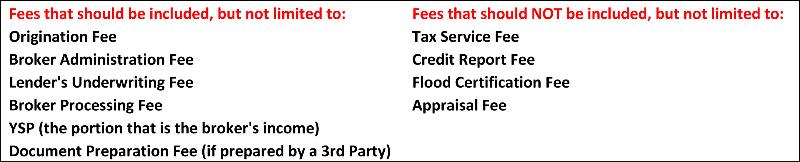
7. Broker does not include 3rd party fees in Line #3. Third party fees, including lender's fees [i.e., Tax Service Fee, Flood Certification Fee, Appraisal Fee (even if it is paid outside of closing), Credit Report Fee, FHA Upfront Mortgage Insurance Premium (MIP) Fee VA Funding Fee, and so forth], should be included in Line #3.
8. Broker does not disclose any and all seller paid items. All fees should be included on the GFE even if the seller is paying closing costs.
9. Broker does not include the transfer tax fees on the GFE in states where transfer tax is a requirement. The transfer tax fees must be disclosed in states where required. If state or local law is unclear or does not specifically attribute transfer tax to a seller or the borrower, the amount to be disclosed by the broker is governed by common practice or experience in the locality. Because not disclosing this fee is in the zero tolerance box, our wholesale lenders charge the broker if not disclosed upfront.
10. Broker does not include all income fees in Box 1 including the lender's underwriting fee. All broker income fees must be included in Box 1 along with the lender's underwriting fee. No additional fees can be added after the initial GFE.
Visit Library for Issuances

New Good Faith Estimate and HUD-1 Settlement Statement
RESPA - Final Rule and New RESPA Rule FAQs
Lenders Compliance Group is the first full-service, mortgage risk management firm in the country, specializing exclusively in mortgage compliance and offering a full suite of hands-on and automated services in residential mortgage banking.
Subscribe to:
Posts (Atom)