CREATORS OF THE COMPLIANCE TUNE-UP®

AARMR | ABA | ACAMS | ALTA | ARMCP | IAPP | IIA | MBA | MERS® | MISMO | NAMB

Showing posts with label HUD-1 Settlement Statement. Show all posts

Thursday, October 16, 2014

RESPA/TILA Integration - Part I: Overview and Loan Estimate (Includes Loan Estimate Table)

RESPA/TILA Integration – Part I: Overview and Loan Estimate
   Jonathan Foxx [*]


 WHITE PAPER

This first of a four-part series will introduce the RESPA/TILA Integration and treat the numerous features of the Loan Estimate. In the second part of the series, I will detail the features of the Closing Disclosure. The third part will be a detailed analysis of the Loan Estimate. The fourth part will provide an in depth scrutiny of the Closing Disclosure.

Accompanying this article is a Loan Estimate Table that may be used for certain itemized categories and action requirements. The table outlines the types of areas of interest in many of the routine requirements of the Loan Estimate process. In reviewing the table, notice how many of these categories in some respects reflect the pre-August 2015 disclosure process. Rather than a before-and-after, comparative analysis, the Loan Estimate Table provides the requirements of the post-August 2015 Rule itself.

Two Download Locations


In the other articles of this four-part series, I will provide charts, tables, form specimens, and annotations for applicable categories and action requirements relating to the RESPA-TILA Integration. The full series, and accompanying charts, tables, and form specimens, will also appear in National Mortgage Professional Magazine, commencing October 2014. 

Discussion

Let’s admit at the outset that having to explain to loan applicants the fees and boxes and pages of the Good Faith Estimate (GFE) is not for the faint of heart. The Truth in Lending Disclosure (TIL) remains a conundrum without peer: difficult to explain to a consumer in just a few words; inscrutable even to loan officers; and, blisteringly enigmatic often even to lenders. Both disclosures are somewhat archaic, examples of good intentions gone to the shadowy realm of Unintended Consequences.

Notwithstanding the foregoing debacle, there is the infamous HUD-1 Settlement Statement (HUD-1), infamous for its myriad codes, infamous for codes that should correlate or sometimes seem not to correlate to the GFE itself, infamous for mapping challenges to the loan origination system, and infamous for irksome consternation about where, what, and how to show certain fees!

A consumer’s distrust of the lender seems to increase with the duration of the explanation provided by the mortgage loan originator. If it takes more than a sentence or two to explain a disclosure’s contents, many consumers are already hesitating, wondering if there’s something they’re not being told! So, is there a way to provide a new kind of consumer disclosure that replaces the overly-encrusted, superannuated, periodically reconditioned, creaky, decades’ old twosome and settlement documents that have dominated the origination of residential mortgage loans for an entire generation of mortgage loan originators?

Into this maelstrom of implacable confusion steps the Consumer Financial Protection Bureau (“CFPB” or “Bureau”). The debate as to whether we need to replace the GFE, TIL, and settlement disclosures, into an overall, encompassing disclosure, is over and done. Behind us now are the many analyses, heat maps, comment periods, public outreach, focus groups, committee reviews, Interagency evaluations, extensive consumer and industry research, association position papers, quantitative studies, speeches, public relations, announcements, and presentations. Before us unfolds on August 1, 2015 a brand new set of disclosures – a combined set, as in new disclosure at the commencement of the loan origination and new disclosure at its closing – the former to be called Loan Estimate and the latter to be called Closing Disclosure.[i]

The new set has been dubbed “RESPA-TILA Integration,” since the consolidation requirements reflect the mandates of the Dodd-Frank Wall Street Reform and Consumer Protection Act (Dodd-Frank Act), which directed the Bureau to integrate the mortgage loan disclosures under TILA and RESPA Sections 4 and 5.[ii] For the balance of this article, I will refer to these provisions as the “RESPA-TILA Rule” or (“Rule”). Additionally, I will refer to the consolidated disclosures as “Integrated Disclosures.”

The Rule applies to most closed-end consumer mortgages. It does not apply to home equity lines of credit (HELOCs), reverse mortgages, or chattel-dwelling loans, such as mortgages secured by a mobile home or by a dwelling that is not attached to real property (i.e., land). The provisions also do not apply to loans made by persons who are not considered “creditors,” where such persons make five or fewer mortgages in a year. However, certain types of loans that are currently subject to TILA but not RESPA are subject to the Rule’s Integrated Disclosure requirements, including construction-only loans, loans secured by vacant land or by 25 or more acres, and credit extended to certain trusts for tax or estate planning purposes. So, creditors originating these types of mortgages must continue to use, as applicable, the GFE, TIL, and HUD-1 disclosures required under current law.

There is also a partial exemption for certain transactions associated with housing assistance loan programs for low- and moderate-income consumers. These creditors are exempt from the requirement to provide the RESPA settlement cost booklet, GFE, HUD-1, and application servicing disclosure statement requirements, and, thus, exempt from the requirements to provide a Loan Estimate, Closing Disclosure, and Special Information Booklet for these loans.

The RESPA/TILA Rule

I am sure that the question will be asked whether creditors may use the Integrated Disclosure on loans not covered by the Rule but subject to RESPA and TILA. The short answer is that using the Integrated Disclosures for such purposes is not prohibited on loans that are not covered by RESPA and TILA (i.e., mortgages associated with housing assistance loan programs for low- and moderate-income consumers). A creditor cannot use the new Integrated Disclosure forms instead of the GFE, TIL and HUD-1 forms for transactions that are covered by RESPA and TILA that require those disclosures (i.e., reverse mortgages).

With its usual flair for brevity, the Bureau’s proposal in July 2012 is a mere 1,099 pages.[iii] In November 2013, the final rule was issued, reaching the gargantuan proportions of 1,888 pages.[iv] Some of the seemingly boundless verbiage has thankfully been distilled to a 91 page guide, entitled TILA-RESPA Integrated Disclosure Rule, Small Entity Compliance Guide (“Guide”).[v] The most recent update to the Guide was issued in September 2014. The Guide touches on many features of the Rule and the implementation of the new disclosures; however, a thorough reading of the final rule is needed in order to comprehend the scope, application, and breadth of the Rule in effectuating its provisions. [vi] [vii] [viii]

Much of the Rule can be encapsulated in a single sentence, leaving aside all the details, as set forth by the Bureau:

The TILA-RESPA rule consolidates four existing disclosures required under TILA and RESPA for closed-end credit transactions secured by real property into two forms: a Loan Estimate that must be delivered or placed in the mail no later than the third business day after receiving the consumer’s application, and a Closing Disclosure that must be provided to the consumer at least three business days prior to consummation.[ix] (Emphases in original)

As in all consumer disclosure regulations, the compliance effective date and the operational recognition of that date are critical timing points. The new Integrated Disclosures must be provided by a creditor or mortgage broker that receives an application from a consumer for a closed-end credit transaction secured by real property on or after August 1, 2015. But creditors will still be required to use the GFE, TIL, and HUD-1 forms for applications received prior to August 1, 2015.

Operationally speaking, as the applications received prior to August 1, 2015 are consummated, withdrawn, or cancelled, the use of the GFE, TIL, and HUD-1 forms will no longer be used for most mortgage loans.[x]

But from a process perspective, this timing can get complicated quickly. Various restrictions take effect on the calendar date August 1, 2015, regardless of whether an application has been received on that date. For instance, take note of these restrictions:

Tuesday, July 17, 2012

Disclosure Integration, High Cost, and Counseling

On July 9, 2012, the CFPB issued its proposed integration of RESPA and TILA disclosures into the "integrated" forms, entitled "Loan Estimate" and "Closing Disclosure". These new forms are derived from the Good Faith Estimate (GFE), the Truth-in-Lending (TIL) Disclosure, and the HUD-1/1A Settlement Statement. This assemblage has been duly dubbed with the euphemism "integration".

Excluded from the forthcoming integration are reverse mortgages, home equity lines of credit (HELOCs), chattel dwelling loans, and de minimis originations consisting of loans made by creditors who make five or fewer otherwise covered loans per year.

I have covered the process of constructing these forms in several newsletters and articles, including HERE, and HERE.*

The CFPB is not expecting to finalize the integration before the end of this year. Comments are due November 6, 2012.

However, there is a comment deadline of September 7, 2012 - which will lead to rulemaking before January 2013 - regarding the extent to which the rule applies to loans previously exempted from RESPA or TILA and the further redefining of the term “finance charge” to include most costs associated with residential mortgage loans.

By its own admission, the CFPB has stated that the proposal to "broaden" the definition of a "finance charge" by adopting certain adjustments or accommodations in its HOEPA implementing regulations under Regulation Z, would "cause more loans to exceed the APR and points and fees triggers and be classified as high-cost mortgages under HOEPA."

The CFPB has also set forth proposed rules to implement Dodd-Frank amendments regarding high-cost mortgages and also to provide homeownership counseling provisions that would affect mortgage lending generally (with no exclusion for HELOCs).

The implications of these rules, taken together, are far reaching. I would suggest that you visit our Library for further information.

___________________________________________________
IN THIS ARTICLE
“Loan Estimate” and “Closing Disclosure”
Integration
High-Cost Mortgages
Homeownership Counseling
Library
___________________________________________________

“Loan Estimate” and “Closing Disclosure”

  • The Loan Estimate replaces the GFE and early TIL, while the Closing Disclosure replaces the HUD-1/1A and final TIL.

  • HUD's Special Information Booklet will still be required.

  • The CFPB's proposal would combine five pages (seven if typical appraisal and servicing disclosures were to be counted) of TILA/RESPA data into a three-page Loan Estimate, not counting the written list of available providers that must be separately provided if the creditor allows a consumer to shop for a settlement service.

  • The Closing Disclosure is five pages.

Integration

The integration not only provides an entirely new format but also reconciles certain existing differences between Regulation X, the implementing regulation of RESPA and Regulation Z, the implementing regulation of TILA.

Highlights

  • Redefines the term “application” by deleting the 7th component from the definition adopted by HUD, as outlined in its New RESPA Rule FAQs, as “any other information deemed necessary by the loan originator.”

  • Alters the coverage of the disclosure requirements so they would apply to home loans, except for the aforementioned exemptions.

  • Changes the timing and responsibility rules for providing closing disclosures.

Tuesday, July 12, 2011

HUD: Updates RESPA

On July 11, 2011, the Department of Housing and Urban Development (HUD) issued updates to the Real Estate Settlement Procedures Act (RESPA).
This is a final rule (Rule) which makes technical corrections and certain clarifying amendments to HUD's RESPA regulations promulgated by a final rule published on November 17, 2008.
The majority of the regulations promulgated by the November 17, 2008, and became applicable on January 1, 2010.
Effective Date: August 10, 2011.
Line-Webpage
SALIENT AMENDMENTS
Post Separator-2-LCG
Good Faith Estimate (GFE) and Intent to Proceed
The applicant borrower must express an intent to continue with the application process.
The Rule amends § 3500.7(a)(4) and (b)(4) to provide that the applicant borrower must indicate an intention to proceed with the loan covered by the GFE received by the applicant borrower from the lender or mortgage broker before the lender or mortgage broker may charge additional fees.
Line-Webpage
Good Faith Estimate (GFE)
Tolerances
Currently the applicable provision states that a loan originator is bound "within the tolerances provided in paragraph (e) of this section, to the settlement charges and terms listed on the GFE provided to the borrower, unless a [revised] GFE is provided prior to settlement consistent with this paragraph (f)."
However, the introductory paragraph inadvertently omits that the GFE does not remain binding indefinitely but expires 10 business days after the GFE is provided to the borrower if the borrower does not express an intent to continue with an application provided by the loan originator that provided the GFE, or expires after such longer period as may be specified by the loan originator pursuant to § 3500.7(c).
Although the expiration period of the GFE is clearly stated in paragraph (f)(4) of § 3500.7(f), HUD finds that clarity is enhanced by also adding this language to the introductory paragraph of § 3500.7(f).
Line-Webpage
Changed Circumstances
Currently the applicable provision addresses changed circumstances affecting settlement costs, provides that the revised GFE may increase charges for services listed on the GFE but only to the extent that the changed circumstances actually resulted in higher charges.
However, the currently the applicable provision, which addresses borrower-requested changes, inadvertently omits that the revised GFE may increase charges listed on the GFE only to the extent that changed circumstances affecting the loan, or the borrower's requested change, actually increased those charges.
This rule therefore adds language that clarifies this limitation.
Line-Webpage
Locked Interest Rate
HUD clarifies that whenever the borrower's interest rate is locked, a revised GFE must be provided to the borrower showing the revised interest rate-dependent changes and terms within 3 business days.
Line-Webpage
Construction Loans
In revising § 3500.7(f)(6) of RESPA, HUD is adding the word "construction" to the phrase "new home purchases" so that it reads "new construction home purchases."
HUD believes that the content of this paragraph is clear that new home purchases refers to purchases of newly constructed homes, not simply any home that is new to a borrower. This interpretation is supported by the preamble to the November 17, 2008, final rule in which this regulatory provision was discussed.
While HUD believes the meaning of paragraph (f)(6) is clear, to remove any possibility of ambiguity the word "construction" is inserted between the words "new" and "home purchases."
Line-Webpage
HUD-1 or HUD-1A Settlement Statements
Appendix: HUD-1 Instructions for Page 3
The instructions for the HUD-1, found at 73 FR 68243 of the November 2008 final rule, provide that the HUD-1 form is to be used as a statement of the actual charges and adjustments. If the borrower, or a person acting on behalf of the borrower, does not purchase a settlement service that was listed on the GFE (e.g., owner's title insurance), there should be no amount entered for that service in the corresponding line on Page 2 of the HUD-1, and the estimate of the charge from the GFE should not appear on the comparison chart on Page 3 of the HUD-1.
HUD has determined that the current instructions are not sufficiently clear on this point. Allowing loan originators to include on Page 3 of the HUD-1 charges from the GFE for settlement services that were not purchased could both induce loan originators to discourage consumers from purchasing settlement services (e.g., owner's title insurance) in order to gain padding in the 10 percent tolerance categories, and encourage loan originators to pad the 10 percent tolerance categories on the GFE with estimates of services that the consumer will not need in the transaction. HUD has previously addressed and clarified this issue in informal guidance.
Therefore, HUD is revising the first paragraph of the instructions for Page 3 of the HUD-1 to clarify that the amounts to be inserted in the comparison chart are those for the services that were purchased or provided as part of the transaction, and that no amount should be included on Page 2 of the HUD-1 for any service that was listed on the GFE, but which was not obtained in connection with the transaction.
Line-Webpage
LIBRARY
Law Library Image
HUD: Real Estate Settlement Procedures Act (RESPA)
Technical Corrections and Clarifying Amendments
Federal Register - Vol. 76, No. 132
Monday, July 11, 2011
Post Separator-2-LCG

Thursday, March 24, 2011

Loan Originator Compensation: Good Faith Estimate (GFE)

On March 18, 2011, the Department of Housing and Urban Development (HUD) issued its RESPA Roundup, this issue being devoted to completing the Good Faith Estimate (GFE)  in order to disclose loan originator compensation pursuant to the new TILA Loan Originator Compensation rule (Rule). [75 F.R. 58509 (September 24, 2010)]
HUD's guidance addresses the following issues:
(1) Mortgage broker transactions where the broker is compensated indirectly from the lender by means other than an amount that is computed based on the interest rate, such as by a flat fee or an amount that is based on any other computation;
(2) No cost transactions where the credit for the interest rate chosen covers third party settlement charges;
(3) Using a credit/charge calculation prior to completing Block 2 on the GFE; and
(4) Payments by lenders to borrowers to correct tolerance violations in wholesale transactions.
I will simplify the technical aspects of this HUD issuance, in order to clarify how to complete the GFE.

Post Separator-2-LCG
(1) Mortgage Broker Transactions
(Flat Fee Compensation)
Block 2 instructions state: "[f]or a mortgage broker, the credit or charge for the specific interest rate chosen is the net payment to the mortgage broker from the lender (i.e., the sum of all payments to the mortgage broker from the lender, including payments based on the loan amount, a flat rate, or any other computation, and in a table funded transaction, the loan amount less the price paid for the loan by the lender)."
Illustration: Flat Fee Compensation
Example:
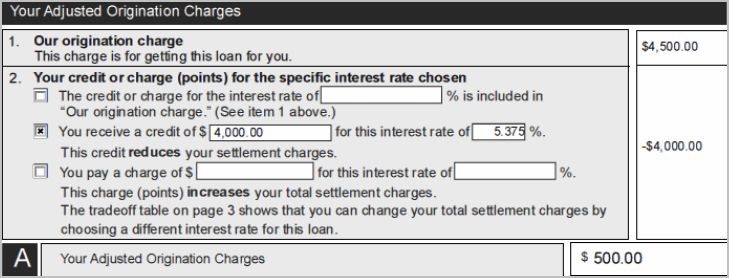
a) Flat Fee to Mortgage Broker is $4,000 (to be paid by the lender).
b) The lender charges $500 for processing and administrative fees. 
GFE: Block 1 reflects a charge of $4,500. (Block 2 has a credit of $4,000, adjusted origination charge of $500 in Block A.)

GFE-1-LOCompensation
Post Separator-2-LCG
(2) No Cost Transactions
(Interest Rate Covers Originator

or Third Party Settlement Charges)
Overview:
Only Originator Fees: Line A would show a zero (0) charge as the adjusted origination charge. 
Originator Fees and Third Party Charges: All third party fees must still be itemized and listed in Block 3 through Block 11 on the GFE. 
NOTE (1): Block 1 includes lender and mortgage broker compensation as well as all other charges that the lender and mortgage broker will receive. Thus, Block 1 provides total compensation to lender and mortgage broker.
NOTE (2): Block 2 is used for the credit or charge for the interest rate chosen. 
(A) If "no cost" refers to only the lender and mortgage broker's fees, Block 2 offsets Block 1 resulting in $0 on Line A.
(B) If "no cost" refers to both Block 1 and the third party settlement charges (itemized in Blocks 3-11), the credit in Block 2 covers Block 1 and Blocks 3 through 11, resulting in $0 for the sum of Lines A and B.
Example
No cost loan covering only lender and mortgage broker charges (i.e., not third party settlement charges). 
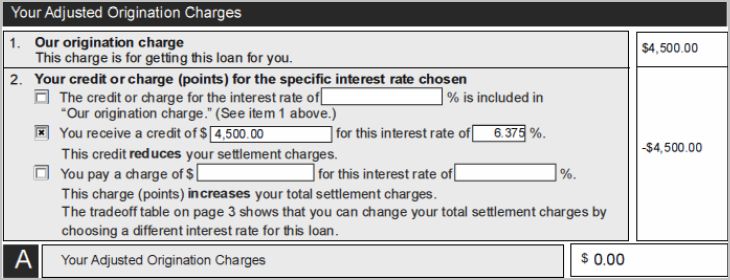
In the following GFE, the total compensation for the lender and mortgage broker is $4,500, as reflected in Block 1. Borrower is locked in an interest rate of 6.375% such that the credit for the interest rate chosen results in a credit of $4,500. Thus, Block A results in $0.

GFE-2-LOCompensation

Example
No cost loan covering lender, mortgage broker and third party settlement charges.
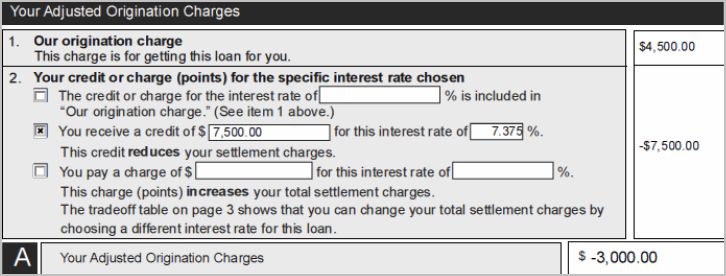
In the following GFE, the total compensation for both the lender and mortgage broker is $4,500, as reflected in Block 1. The borrower has locked in an interest rate of 7.375% such that the credit for the interest rate chosen results in a credit of $7,500. Block A results in a credit of $3,000 to offset the total of all third party charges in Block 3 through Block 11.

GFE-3-LOCompensationGFE-3A-LOCompensation

Post Separator-2-LCG
(3) Using a Charge or Credit Calculation
Prior to Completing Block 2 of the GFE 

Overview:
RESPA provides: "[w]hen the net payment to the mortgage broker from the lender is positive, there is a credit to the borrower and it is entered as a negative amount in Block 2 of the GFE. When the net payment to the mortgage broker from the lender is negative, there is a charge to the borrower and it is entered as a positive amount in Block 2 of the GFE." 
NOTE: the Rule prohibits a loan originator (as defined by the FRB) from receiving compensation directly from the consumer when it has received compensation from any person other than the consumer in connection with the transaction.
Example: Charge in Block 2
a) Principal balance is $250,000.
b) Lender charges $1,000 for processing and administrative fees.
c) Broker's compensation is $2,000, fully paid by the lender.
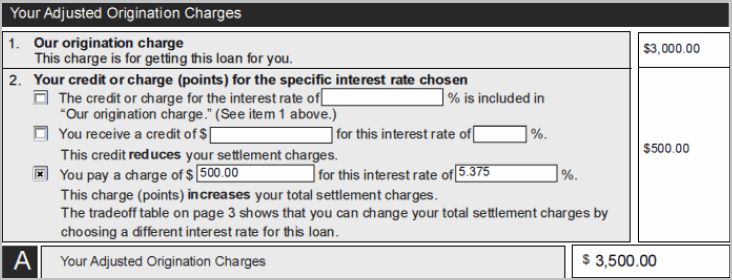
In the following GFE, the total origination charge in Block 1 is $3,000. The interest rate chosen a $2,000 credit. Pricing adjustments result in a $2,500 charge. The resulting $500 charge is placed in Block 2 and box three would be checked. The sum of Block 1 and Block 2 results in an adjusted origination charge in Line A of $3,500.

GFE-4-LOCompensation
Example: Credit in Block 2
a) Principal balance of $250,000.
b) Lender charges $1,000 for an origination fee.
c) Broker receives $2,000 in indirect compensation from the lender.

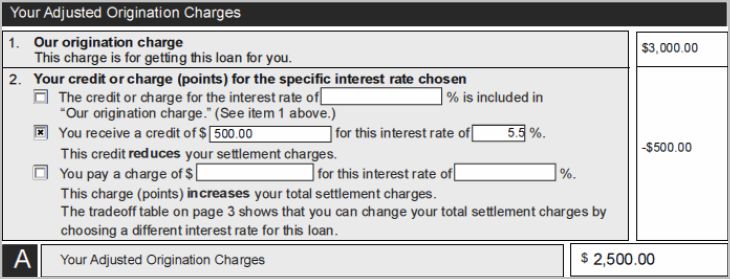
In the following GFE, the total origination charge in Block 1 is $3,000. The interest rate chosen has a $2,000 credit. Pricing adjustments result in a $1,500 charge. The resulting $500 credit is placed in Block 2 and box two would be checked. The sum of Block 1 and Block 2 results in an adjusted origination charge in Line A of $2,500.

GFE-5-LOCompensation
Post Separator-2-LCG
(4) Payments by Lenders to Borrowers for
Tolerance Violations in Wholesale Transactions
HUD restates the RESPA statute by emphasizing that regulations impose tolerance levels on charges disclosed on the GFE. Where actual charges to the borrower exceed these thresholds, mortgage brokers and lenders may cure to avoid a tolerance violation.
Advice given by HUD: timely and effective communication among the lender, its loan officers, and mortgage brokers to establish policies and procedures to ensure accurate calculation of compensation and credits in compliance with RESPA, as well as under the FRB compensation rule and any other applicable federal or state statute.
In other words, in HUD's view tolerance violations remain the burden to cure, though HUD provides no further guidance.

Post Separator-2-LCG
Some Observations
Changed Circumstances: The FRB's compensation rule will go into effect on April 1, 2011 and absent other factors cannot be considered a basis for a changed circumstance to revise the GFE pursuant to 24 C.F.R. §3500.7(f).
Volume Based Compensation: If a lender is basing its compensation to mortgage brokers on loan volume, as described in the new FRB compensation rule, it is nevertheless necessary to comply with RESPA Section 8 (12 U.S.C. 2607), which prohibits the payment of things of value or kickbacks in exchange for the referral of business to settlement service providers, including creditors.
Company Name Disclosed in Section F of the HUD-1: The name of the company originating the loan should be placed in Section F of the HUD-1. The name of any individual loan officer or mortgage broker is not disclosed.

Post Separator-2-LCG
Visit Library
Law Library Image
Compliance Guidance for RESPA's Good Faith Estimate:
FRB's MLO Compensation Rules
HUD - RESPA Roundup,
March 18, 2011

Monday, August 16, 2010

Good Faith Estimate: Top 10 Broker Mistakes

Since the introduction of the effective implementation date of the new Good Faith Estimate (GFE) on January 1, 2010, we have been working closely with our clients to assure proper disclosure compliance. During this time, we have documented literally hundreds of issues that have required resolution and guidance pertaining not only to the GFE but also the new HUD-1 Settlement Statement (HUD-1).

Even now, these many months into the use of the new GFE, we receive numerous requests from clients seeking a better understanding of this form's nuances and requirements.

Regarding proper implementation of the GFE and HUD-1, we have compiled a database of resolutions and guidelines for regulatory compliance, and will soon make it available to our clients in the first release of our online client website.

However, there are still gaps and we look to the Department of Housing and Urban Development (HUD) for further written clarifications.
There have been eight (8) updates to the New RESPA Rule FAQs (RESPA FAQs) since HUD issued the Final Rule on November 17, 2008: six were issued in 2009, and two were issued in 2010 - with the second (and most recent) issued on April 2, 2010. Although HUD issued a RESPA Roundup in July, that document provided virtually no GFE guidance.

Given that the last RESPA FAQs update was in early April, another update is long overdue. HUD should update the RESPA FAQs soon.

We thought we'd share with you some mistakes made by mortgage brokers and the positions taken by our wholesale lending clients in response to those errors. Obviously, our retail mortgage banker clients have different issues and disclosure concerns. Nevertheless, wholesale lending has certain issues quite unique to the origination and loan flow processes.

If you have any questions about this matter or would like assistance with mortgage compliance, please contact Jonathan Foxx.

Highlights

Top 10 GFE Mistakes Made By Brokers

1. Broker submits a 2009 GFE. The 2010 HUD-approved GFE is the only version acceptable to the lender. Obviously, this mistake was happening during the early transition period, but the percentage of occurrences was inordinately high at the time.

2. Broker submits a 2010 GFE without a complete Service Provider List. All GFEs must include a Service Provider List and must clearly indicate all services that the broker has chosen for the borrower if the broker is selecting the provider. If the borrower chooses from the service provider(s) or if the broker chooses the service provider(s) the 10% tolerance must be adhered to.

3. Broker includes the YSP in Line #1, but leaves Line #2 completely blank. Line 2 should always be the Gross YSP. The adjustment for what the broker wants to make as income and what the broker would like to credit the borrower is adjusted in Line 1.

Here's an example taken from our files:

Scenario-1

4. Broker includes the YSP in Line #2, but fails to include it in Line #1. The adjustment for what the broker wants to make as income and what the broker would like to credit the borrower is adjusted in Line 1.

Here's an example taken from our files:

Scenario-2

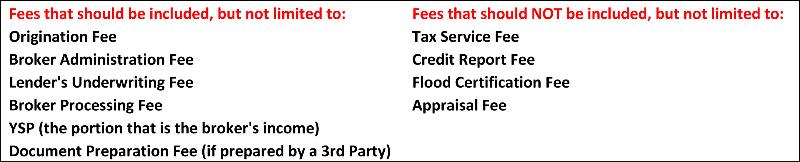
5. Broker does not disclose the lender's underwriting fee in Line #1. The lender's underwriting fee should be included in Line #1.

6. Broker leaves Line #1 completely blank or is calculated incorrectly. Line #1 should include all income fees for the broker and lender.

Here's an outline taken from our files:

Chart-GFE-Outline-3

7. Broker does not include 3rd party fees in Line #3. Third party fees, including lender's fees [i.e., Tax Service Fee, Flood Certification Fee, Appraisal Fee (even if it is paid outside of closing), Credit Report Fee, FHA Upfront Mortgage Insurance Premium (MIP) Fee VA Funding Fee, and so forth], should be included in Line #3.

8. Broker does not disclose any and all seller paid items. All fees should be included on the GFE even if the seller is paying closing costs.

9. Broker does not include the transfer tax fees on the GFE in states where transfer tax is a requirement. The transfer tax fees must be disclosed in states where required. If state or local law is unclear or does not specifically attribute transfer tax to a seller or the borrower, the amount to be disclosed by the broker is governed by common practice or experience in the locality. Because not disclosing this fee is in the zero tolerance box, our wholesale lenders charge the broker if not disclosed upfront.

10. Broker does not include all income fees in Box 1 including the lender's underwriting fee. All broker income fees must be included in Box 1 along with the lender's underwriting fee. No additional fees can be added after the initial GFE.

Visit Library for Issuances

Law Library Image

New Good Faith Estimate and HUD-1 Settlement Statement
RESPA - Final Rule and New RESPA Rule FAQs

Lenders Compliance Group is the first full-service, mortgage risk management firm in the country, specializing exclusively in mortgage compliance and offering a full suite of hands-on and automated services in residential mortgage banking.

Friday, January 29, 2010

New RESPA Reform Rule - Overview

by Jonathan Foxx

Jonathan Foxx, former Chief Compliance Officer of two publicly traded financial institutions, is the President and Managing Director of Lenders Compliance Group.

As published in the January 2010 Edition of National Mortgage Professional Magazine.

[>> Printable Version]

In 2008, the Department of Housing and Urban Development (HUD) issued both technical and substantive amendments to the rule that implements RESPA.[i] The technical changes took effect on January 16, 2009 and substantive changes have taken effect on January 1, 2010.

Recently, I provided a brief analysis of the new Good Faith Estimate (GFE).[ii] In this article I will offer some procedural guidance that incorporates several substantive changes that took effect on January 1, 2010. This analysis is meant as an overview of those changes.[iii]

Notably, the federal regulatory agencies will now begin examining for compliance with the new substantive provisions of the new RESPA Reform Rule on January 1, 2010.[iv]

Among other things, substantial changes have been made to:

  • Good Faith Estimate (GFE)
  • HUD-1 Settlement Statement (HUD-1)
  • HUD-1A Settlement Statement (HUD-1A)
  • Settlement Cost Booklet[v]

To facilitate the understanding of this article and the new RESPA Reform Rule, visit HUD’s RESPA section.

My firm’s website Library contains all of the documents listed above, the Final Rule, all New RESPA FAQs updates, as well as RESPA Appendices A and C, respectively, Instructions for completing the HUD-1/1A, and Instructions for completing the Good Faith Estimate, and the revised Settlement Cost Booklet.

I will consider the five following RESPA revisions:[vi]

  1. New Good Faith Estimate Form
  2. Binding Good Faith Estimate
  3. Tolerances on Settlement Costs
  4. HUD-1/1A Settlement Statement
  5. Settlement Cost Booklet

New Good Faith Estimate form[vii]

As of January 1, 2010, lenders and mortgage brokers[viii] must provide a standard Good Faith Estimate (GFE) form to a borrower within three business days[ix] of receipt of an application for a mortgage loan. The new GFE compares settlement costs and loan terms from various loan originators. Areas covered by the GFE include:

  • a summary of loan terms and a summary of estimated settlement charges
  • key dates (i.e., expiration dates of the interest rate and settlement charges)
  • settlement charges disclosed as subtotals for eleven (11) cost categories
  • a table explaining which charges can change at settlement
  • a trade-off table showing the relationship between the interest rate and the settlement charges
  • a chart for comparing the costs and terms of loans offered by different originators

First Page of GFE

The first page of the GFE discloses identifying information such as the name and address of the “loan originator” which includes the lender or the mortgage broker originating the loan. The “purpose” section indicates what the GFE is about and directs the borrower to the Truth in Lending disclosures and HUD’s Website for more information. The borrower is informed that only the borrower can shop for the best loan and that the borrower should compare loan offers using the shopping chart on the third page of the GFE.

The “important dates” section requires the loan originator to state the expiration date for the interest rate for the loan provided in the GFE as well as the expiration date for the estimate of other settlement charges and the loan terms not dependent upon the interest rate.

While the interest rate stated on the GFE is not required to be honored for any specific period of time, the estimate for the other settlement charges and other loan terms must be honored for at least ten (10) business days from when the GFE is provided.

  • The form must state how many calendar days within which the borrower must go to settlement once the interest rate is locked (i.e., rate lock period). The form also requires disclosure of how many days prior to settlement the interest rate would have to be locked, if applicable.
  • The “summary of your loan” section requires disclosure of the loan amount; loan term; initial interest rate; initial monthly payment for principal, interest, and any mortgage insurance; whether the interest rate can rise, and if so, the maximum rate to which it can rise over the life of the loan, and the period of time after which the interest rate can first change; whether the loan balance can rise if the payments are made on time, and if so, the maximum amount to which it can rise over the life of the loan; whether the monthly amount owed for principal, interest, and any mortgage insurance can rise even if payments are made on time, and if so, the maximum amount to which the monthly amount owed can ever rise over the life of the loan; whether the loan has a prepayment penalty, and if so, the maximum amount it could be; and, whether the loan has a balloon payment, and if so, the amount of such payment and in how many years it will be due.
  • The “escrow account information” section requires the loan originator to indicate whether the loan does or does not have an escrow account to pay property taxes or other property related charges. In addition, this section also requires the disclosure of the monthly amount owed for principal, interest, and any mortgage insurance.
  • The bottom of the first page includes subtotals for the adjusted origination charges and charges for all other settlement charges listed on page two, along with the total estimated settlement charges.

Second Page of GFE

The second page of the GFE requires disclosure of all settlement charges. It provides for the estimate of total settlement costs in eleven categories discussed below. The adjusted origination charges are disclosed in “Block A” and all other settlement charges are disclosed in “Block B.” The amounts in the blocks are to be added to arrive at the “total estimated settlement charges” which is required to be listed at the bottom of the page.

Block A - Disclosure of Adjusted Origination Charge

Block A addresses disclosure of origination charges, which include all lender and mortgage broker charges. The “adjusted origination charge” results from the subtraction of a “credit” from the “origination charge” or the addition of a “charge” to the origination charge.

Block 1 – the origination charges, which includes lender processing and underwriting fees and any fees paid to a mortgage broker.

Note: This block requires the disclosure of all charges that all loan originators involved in the transaction will receive for originating the loan (excluding any charges for points). A loan originator may not separately charge any additional fees for getting the loan, such as application, processing or underwriting fees. The amount in Block 1 is subject to zero tolerance (i.e., the amount cannot change at settlement). (See “Tolerances” below.)

Block 2 – a “credit” or “charge” for the interest rate chosen:

Note: Differentiation is made between transactions involving a mortgage broker and transactions that do not involve a mortgage broker.

Transaction Involving a Mortgage Broker. Block 2 requires disclosure of a “credit” or charge (points) for the specific interest rate chosen. The credit or charge for the specific interest rate chosen is the net payment to the mortgage broker (i.e., the sum of all payments to the mortgage broker from the lender, including payments based on the loan amount, a flat rate or any other compensation, and in a table funded transaction, the loan amount less the price paid for the loan by the lender).

When the net payment to the mortgage broker from the lender is positive, there is a “credit” to the borrower and it is entered as a negative amount. [For example, if the lender pays a yield spread premium (YSP) to a mortgage broker for the loan set forth in the GFE, the payment must be disclosed as a “credit” to the borrower for the particular interest rate listed on the GFE (reflected on the GFE at Block 2, checkbox 2). The term “yield spread premium” is not featured on the GFE or the HUD-1 Settlement Statement.]

Note: Points paid by the borrower for the interest rate chosen must be disclosed as a “charge” (reflected on the GFE at Block 2, third checkbox). A loan cannot include both a charge (points) and a credit (yield spread premium).

Transaction Not Involving a Mortgage Broker. For a transaction without a mortgage broker, a lender may choose not to separately disclose any credit or charge for the interest rate chosen for the loan in the GFE. If the lender does not include any credit or charge in Block 2, it must check the first checkbox in Block 2 indicating that “The credit or charge for the interest rate you have chosen is included in ‘our origination charge’ above.” Only one of the boxes in Block 2 may be checked: a credit and charge cannot occur together in the same transaction.

Block B - Disclosure of Charges for All Other Settlement Services

Block B totals the sums for all settlement services (other than the origination charges).

Block 3 – service providers selected by the lender (i.e., appraisal, flood certification fees)

Block 4 – title service fees and the cost of lender’s title insurance

Block 5 – owner’s title insurance

Block 6 – other required services for which the consumer may shop

Block 7 – government recording charges

Block 8 – transfer tax charges

Block 9 – initial deposit for escrow account

Block 10 – daily interest charges

Block 11 – homeowner’s insurance charges

Third Page of GFE

The third page of the GFE includes the following information:

  • Tolerance Chart: identifies the charges that can change at settlement (See “Tolerances” below.)
  • Trade-Off Table: requires the loan originator to provide information on the loan described in the GFE and at the loan originator’s option, information about alternative loans (i.e., lower settlement charges but a higher interest rate, lower interest rate but higher settlement charges)
  • Shopping Chart: allows the consumer to fill in loan terms and settlement charges from other lenders or brokers to use to compare loans
  • Disclosure: language indicating that some lenders may sell the loan after settlement, but any fees the lender receives in the future cannot change the borrower’s loan or the settlement charges.

Binding Good Faith Estimate[x]

With limited exceptions, the loan originator will be bound to the settlement charges and loan terms listed on the GFE. For the interest rate, the loan originator will be required to indicate on the GFE the period during which a rate is available. After that period, the interest rate and other rate related charges, the adjusted origination charges, and the per diem interest can change until the interest rate is locked.

For settlement charges and all other loan terms, the loan originator will be required to honor the estimated settlement charges and loan terms for at least 10 business days from the date the GFE is provided. The charges and terms in the GFE will be binding, unless a revised GFE is provided to the borrower prior to settlement based on “changed circumstances” as defined in the rule (see below). NOTE: if a lender accepts a GFE issued by a mortgage broker, the lender is subject to the loan terms and settlement charges listed in the GFE, unless a revised GFE is issued prior to settlement.

Changed Circumstances are:

  • Acts of God, war, disaster or other emergency
  • Information particular to the borrower or transaction that was relied on in providing the GFE that changes or is found to be inaccurate after the GFE has been provided
  • New information particular to the borrower or transaction that was not relied on in providing the GFE
  • Other circumstances particular to the borrower or transaction, including boundary disputes, the need for flood insurance or environmental problems

Changed circumstances do not include: borrower’s name, borrower’s monthly income, property address, estimate property value, mortgage loan amount, and any information contained in any credit report obtained by the loan originator prior to providing the GFE (unless the information changes or is found to be inaccurate after the GFE has been provided). Also, market price fluctuations by themselves do not constitute changed circumstances.

Changed circumstances affecting settlement costs are those circumstances that result in increased costs for settlement services such that the charges at settlement would exceed the tolerances or limits on those charges established by the regulations.

Changed circumstances affecting the loan are those circumstances that affect the borrower’s eligibility for the loan. For example, if underwriting and verification indicate that the borrower is ineligible for the loan provided in the GFE, the loan originator would no longer be bound by the original GFE. In such cases, if a new GFE is to be provided, the loan originator must do so within three business days of receiving information sufficient to establish changed circumstances. The loan originator must document the reason that a new GFE was provided and must retain documentation of any reasons for providing a new GFE for no less than three years after settlement.

None of the information collected by the loan originator prior to issuing the GFE may later become the basis for a “changed circumstance” upon which it may offer a revised GFE, unless:

1) it demonstrates that there was a change in the particular information; or

2) the information was inaccurate; or

3) it did not rely on that particular information in issuing the GFE.

A loan originator has the burden of demonstrating non-reliance on the collected information, but may do so through various means (for example, through a documented record in the underwriting file or an established policy of relying on a more limited set of information in providing GFEs).

NOTE: if a loan originator issues a revised GFE based on information previously collected in issuing the original GFE and “changed circumstances,” it must document the reasons for issuing the revised GFE, such as its non-reliance on such information or the inaccuracy of such information.

Tolerances on settlement costs[xi]

Established “tolerances” or limits are placed on the amount actual settlement charges can vary at closing from the amounts stated on the Good Faith Estimate. Three tolerance categories of settlement charges are disclosed. At settlement, if the charges exceed the charges listed on the GFE by more than the permitted tolerances, the loan originator must cure the tolerance violation, at settlement or within 30 calendar days after settlement, by reimbursing to the borrower the amount by which the tolerance was exceeded.

Tolerance Categories

1. Zero tolerance category. This category of fees is subject to a zero tolerance standard. The fees estimated on the GFE may not be exceeded at closing. These fees include:

  • the loan originator’s own origination charge, including processing and underwriting fees
  • the credit or charge for the interest rate chosen (i.e., yield spread premium or discount points) while the interest rate is locked
  • the adjusted origination charge while the interest rate is locked
  • state/local property transfer taxes

2. Ten percent tolerance category. For this category of fees, while each individual fee may increase or decrease, the sum of the charges at settlement may not be greater than ten (10%) percent above the sum of the amounts included on the GFE. These fees include:

  • loan originator required settlement services, where the loan originator selects the third-party settlement service provider
  • loan originator required services, title services, required title insurance and owner’s title insurance when the borrower selects a third-party provider identified by the loan originator
  • government recording charges

3. No tolerance category. This category of fees is not subject to any tolerance restriction. The amounts charged for the following settlement services included on the GFE can change at settlement and the amount of the change is not limited. These fees include:

  • loan originator required services where the borrower selects his or her own third-party provider
  • title services, lender’s title insurance and owner’s title insurance when the borrower selects his or her own provider
  • initial escrow deposit
  • daily interest charges
  • homeowner’s insurance

HUD-1/1A Settlement Statement[xii]

The revised HUD-1/1A Settlement Statement form provides a reference between the HUD-1/1A and the relevant line from the GFE.[xiii] (Inadvertent or technical errors on the HUD-1/1A will not be deemed to be a violation of RESPA, if a revised HUD-1/1A is provided to the borrower within 30 days of settlement.)

Key Enhancements

There are no substantive changes to the first page of the HUD-1/1A form. However, there are changes to the second page of the form to facilitate comparison between the HUD-1/1A and the GFE, as indicated above. Each designated line on the second page of the revised HUD-1/1A includes a reference to the relevant line from the GFE.

  • No Cost Loans. Where “no cost” refers only to the loan originator’s fees (see Section L, subsection 800 of the HUD-1 form), the amounts shown for the “origination charge” and the “credit or charge for the interest rate chosen” should offset, so that the “adjusted origination charge” is zero. Where “no cost” encompasses loan originator and third-party fees, all third-party fees must be itemized and listed in the borrower’s column on the HUD-1/1A. These itemized charges must be offset with a negative adjusted origination charge (Line 803) and recorded in the columns.
  • Comparisons. The revised HUD-1 includes a new third page (second page of the HUD-1A) that allows borrowers to compare the loan terms and settlement charges listed on the GFE with the terms and charges listed on the closing statement. The first half of the third page includes a comparison chart that sets forth the settlement charges from the GFE and the settlement charges from the HUD-1 to allow the borrower to easily determine whether the settlement charges exceed the charges stated on the GFE.[xiv]
  • As indicated above, inadvertent or technical errors on the settlement statement are not deemed to be a violation of Section 3500.4 of RESPA if a revised HUD-1/1A is provided to the borrower within 30 calendar days after settlement.[xv]
  • The second half of the third page sets forth the loan terms for the loan received at settlement in a format that reflects the summary of loan terms on the first page of the GFE, but with additional loan related information that would be available at closing. A note at the bottom of the page indicates that the borrower should contact the lender if the borrower has questions about the settlement charges or loan terms listed on the form.
  • Section 3500.8(b) of RESPA (“Charges to be stated”) and the instructions for completing the HUD-1/1A Settlement Statement provide that the loan originator shall transmit sufficient information to the settlement agent to allow the settlement agent to complete the “loan terms” section. (The loan originator must provide the information in a format that permits the settlement agent to enter the information in the appropriate spaces on the HUD-1/1A, without having to refer to the loan documents.)

Settlement Cost Booklet[xvi]

A loan originator is required to provide the borrower with a copy of the Settlement Cost Booklet, entitled “Shopping for Your Home Loan,” at the time a written application is submitted, or no later than three business days after the application is received. (If the application is denied before the end of the three-business-day period, the loan originator is not required to provide the booklet.) If the borrower uses a mortgage broker, the broker rather than the lender, must provide the booklet. The booklet does not need to be provided for refinancing transactions, closed-end subordinate lien mortgage loans, and reverse mortgage transactions, or for any other federally related mortgage loan not intended for the purchase of a one-to-four family residential property.


[i] 73 Fed. Reg. 68204 (Nov. 17, 2008).

[ii] Regulatory Compliance Outlook, National Mortgage Professional Magazine, December 2009, Volume 1, Issue 8,

[iii] For detailed information, review the following Appendices from the RESPA regulation: Appendix A – Instructions for completing the HUD-1 and HUD-1A; Appendix C – Instructions for completing the Good Faith Estimate (GFE).

[iv] Lenders are responsible for the disclosures provided by mortgage brokers and, therefore, should implement procedures to assure that mortgage brokers with whom they do business comply with the new RESPA requirements.

[v] HUD issued the revised Settlement Cost Booklet on December 15, 2009. Entitled “Shopping for Your Home Loan,” the new booklet must be used with the new GFE and HUD–1.

[vi] Portions of this overview incorporate guidance from OTS: Consumer Affair Laws and Regulations, Section 1320.1 (12/2009)

[vii] The GFE must be completed in accordance with the Instructions set forth in Appendix C of 24 CFR Part 3500.

[viii] The RESPA Reform Rule changed the definition of “mortgage broker” to mean a person or entity (not an employee of a lender) that renders origination services and serves as an intermediary between a lender and a borrower in a transaction involving a federally related mortgage loan, including such person or entity that closes the loan in its own name and table funds the transaction. The definition will also apply to a loan correspondent approved under 24 CFR 202.8 for Federal Housing Administration (FHA) programs. The definition would also include an “exclusive agent” who is not an employee of the lender.

[ix] Weekdays, except Sundays and specified, legal Holidays.

[x] See: 24 CFR 3500.7(f)

[xi] See: 24 CFR 3500.7(e) and (i)

[xii] See: 24 CFR 3500.8

[xiii] No settlement statement is required for home equity plans subject to the Truth in Lending Act and Regulation Z.

[xiv] If any charges at settlement exceed the charges listed on the GFE by more than the permitted tolerances, the loan originator may cure the tolerance violation by reimbursing to the borrower the amount by which the tolerance was exceeded. A borrower will be deemed to have received timely reimbursement if the financial institution delivers or places the payment in the mail within 30 calendar days after settlement.

[xv] See: 24 CFR 3500.4: Reliance upon Rule, Regulation or Interpretation by HUD

[xvi] Op. Cit. 5

Monday, January 4, 2010

New Good Faith Estimate

by Jonathan Foxx

Jonathan Foxx, former Chief Compliance Officer of two publicly traded financial institutions, is the President and Managing Director of Lenders Compliance Group.

As published in the December 2009 Edition of National Mortgage Professional Magazine.

The Department of Housing and Urban Development (HUD) published a final regulation on November 17, 2008. This final regulation made substantial changes to Regulation X – the implementing regulation of the Real Estate Settlement Procedures Act (RESPA). Among other things, HUD has made substantial changes to the:

· Good Faith Estimate (GFE)

· HUD–1 Settlement Statement (HUD-1)

· HUD–1A Settlement Statement, and

· Settlement Cost Booklet.

This article will highlight certain features of the new Good Faith Estimate.[1] The next article will highlight changes to the HUD-1Settlement Statement.

Implementation Date: January 1, 2010 [2]

The new GFE is 3 pages in length and contains more information than the previous GFE.

  • Main sections of the new GFE:

General headings (originator and borrower information) – Page 1

On the top of page one you will see the General headings information. The left hand side gathers information about the originator, including name, address, phone number, and email address. The right hand side gathers information about the borrowers, including name and address. This section also includes the date that the GFE is prepared.

Purpose (See “Shopping for your loan”)

Shopping for your loan

The “Purpose” and “Shopping for your loan” sections, containing standardized language from HUD. These sections explain to the borrower the purpose of the GFE and how to use it to shop for the loan that is best for that borrower.

Important dates

This section contains dates that are important to the borrower and lender.

Line #1, the originator provides the date (and time, if necessary) through which the disclosed interest rate information is available. NOTE: This is not intended to be an interest rate lock.

Line #2, the originator provides the date through which all settlement service charges disclosed on the GFE are available. HUD requires this date to be at least 10 business days from the date of the GFE, in order to give the borrower time to shop around for the best mortgage.

Line #3, the originator provides information about the rate lock. After the rate has been locked, the borrower will have a stated number of days to go to settlement in order to receive the locked interest rate.

Line #4, the originator lists the number of days before settlement that the interest rate must be locked.

Summary of your loan

This section includes information about the initial loan amount, loan term, initial interest rate, and periodic (i.e., monthly) payment amount.

This section also includes specific “yes or no” questions with regard to whether the interest rate, loan balance, and payment amounts can increase during the life of the loan.

There are specific “yes or no” questions with regard to whether the loan has a prepayment penalty or a balloon payment.

NOTE: If the answer to any of these questions is “yes,” then the new GFE requires additional information about that feature.

There are many calculations in this area that have not been a part of previous RESPA requirements before (i.e., new monthly payment at first interest rate change date, or maximum monthly payment for a variable rate loan). Review carefully.

Escrow account information

The Escrow section discloses if the originator requires an escrow account to be set up to pay such items as hazard insurance, real estate taxes, and so forth. NOTE: The monthly payment amount disclosed here includes only principal, interest, and any mortgage insurance, but does not include taxes and insurance (escrows).

Summary of your settlement charges

This section contains a summary of (A) the adjusted original charge, (B) charges for all other settlement services, and (A + B) the total estimated settlement charges. Detailed information about the charges appears on page 2. The amounts are summarized on page 1 for the convenience of the borrower.

Understanding your estimated settlement charges – Page 2

• Your Adjusted Origination Charge

This subsection consists of blocks.

Block #1: the loan originator discloses all the charges that the loan originator will receive, except for any charges for the specific interest rate chosen (the points). [3]

Block #2: discloses the credit or charge (points) for the specific interest rate chosen. [4]

Transactions not involving a broker. There are 2 choices:

(1) Lender discloses the points or yield spread premium as part of the origination charge in Block #1. If the lender chooses this approach, then in Block #2, the lender should check the box that says, “The credit or charge for the interest rate of ____% is included in ‘Our origination charge.’ (See item 1 above)”

(2) Lender discloses the points or yield spread premium as a separate line item in Block #2. If the lender chooses this approach, then in Block #2, the lender should follow the instructions for transactions involving brokers.

Transactions involving a broker. For transactions involving brokers, brokers do not have the option of using the first check box in Block #2 (to indicate that the credit or charge for the interest rate is included in the origination charge). Brokers must check either the second or the third check box under Block #2.

(1) If there is a yield spread premium being paid, check the box that says, “You receive a credit of $________ for this interest rate of ____%. This credit reduces your settlement charges.”

NOTE: The amount of the credit is listed as a negative number.

(2) If points are paid to the lender, check the box that says, “You pay a charge of $ _____ for this interest rate of _____%. This charge (points) increases your total settlement charges.”

NOTE: The amount of the charge is listed as a positive number.

NOTE: At the bottom of this subsection is a line designated as Line A – “Your Adjusted Origination Charge.” The amount disclosed here is the sum of the “Our origination charge” and the credit or charge for the specific interest rate chosen.

• Your Charges for All Other Settlement Charges

This subsection consists of blocks.

Block #3: the fees disclosed are those fees for which the loan originator chooses the service provider. The individual services and the charges for those services are disclosed and totaled in the right hand column.

Block #4: is for title services and lender’s title insurance. The lender’s title insurance premium is included in this total.

Block #5: includes the owner’s title insurance fees, regardless of who pays for it.

Block #6: is for the required services for which the borrower can choose the service provider. The borrower can choose a service provider from a list that the loan originator may provide, or the borrower can shop for a provider on his/her own. [5]

Block #7: discloses the total of the government recording charge.

Block #8: discloses the total of the transfer taxes.

Block #9: discloses the initial deposit for the escrow account (if applicable).

Block #10: discloses the amount of daily interest charges from the date of settlement until the first day of the next month of the first day of the normal mortgage payment cycle. NOTE: Also discloses the per diem charges, the number of days for interest charges, and the estimated date of settlement.

Block #11: discloses the types and amounts of homeowners insurance that will be required to be paid by settlement and totaled in the right hand column.

NOTE: At the end of this subsection is a line designated as B – “Your Charges for All Other Settlement Charges.” The amount disclosed here is the total of all the charges under “Your Charges for All Other Settlement Charges.” Lines A and B are totaled together to disclose the “Total Estimated Settlement Charges.”

Understanding which charges can change at settlement – Page 3

This section gives information to the borrower to help the borrower understand what to expect for final charges on the HUD–1 Settlement Statement. There are no completion fields in the Understanding section; therefore, it is important to place each fee in the appropriate category.

Charges fall into one of 3 categories:

1. Charges that cannot increase at settlement

2. The total of these charges can increase up to 10% at settlement

3. These charges can change at settlement.

The loan originator is bound by the initial GFE and the tolerances described in the Understanding which charges can change at settlement section. There are a limited number of circumstances under which a revised GFE may be given. The revised RESPA rules refer to this situation as a “changed circumstance.” If a changed circumstance allows for re–disclosure of the GFE, then the charges from the re–disclosed GFE will be used when comparing the GFE charges with the HUD–1 charges. This comparison is found on page 3 of the new HUD-1. [6]

Using the tradeoff table

The table in this section is meant to help the borrower compare the transaction disclosed on the GFE with similar transactions:

The same loan with lower settlement charges but a higher interest rate.

The same loan with a lower interest rate but higher settlement charges.

NOTE: Loan originators have the option of completing this section.

Using the shopping chart

The shopping chart section is meant to give the borrower the ability to compare the information from this GFE with the information from the GFEs of other loan originators.

The “This loan” column is completed by the loan originator. Columns labeled “Loan 2,” “Loan 3,” and “Loan 4” would be completed by the borrower by hand as the borrower shops around with other loan originators.

If your loan is sold in the future

This section informs the borrower that the lender may sell the loan after settlement.


[1] For more detailed information, please review the following Appendix from the RESPA regulation: Appendix C – Instructions for completing the Good Faith Estimate (GFE)

[2] Lenders can choose to implement the GFE and HUD-1 earlier than January 1, 2010

[3] All of these various charges (i.e., origination fee, application fee, underwriting fee, etc.) – and their impact on APR and Section 32 – are all lumped together into the “origination charge” for purposes of disclosure on the GFE and the HUD-1.

[4] Completed in different ways, depending upon whether a broker is involved in the transaction.

[5] If the loan originator does provide a list of service providers, the loan originator is held accountable for the accuracy of the disclosed charges.

[6] The only fees that may change are fees that were affected by the changed circumstance.