Several years ago, our firm, Lenders Compliance Group, provided unique guidance to the mortgage division of a bank.* The bank wished to build a special origination platform for its mortgage brokers. At that time, the prevailing regulations required disclosure of the Yield Spread Premium (YSP), and the bank wanted to give their Third Party Originators (TPOs) an opportunity to close in their own name, with their own funds, and, among other things, by-pass disclosure of the YSP. In building the platform for the bank, many features were needed to implement these relationships in accordance with federal and state law, as well as safety and soundness metrics. This all took place at a time when a 3% fee cap on broker revenue was not even a glimmer in the eyes of legislators or regulators, and Elizabeth Warren[i] had yet to promote the creation of the Consumer Financial Protection Bureau (CFPB).
As Shakespeare wrote in The Tempest, “What’s past is prologue.”
Since the early part of this year, many lenders are building a new origination channel. The proximate cause for the new channel is found in the Final Rule pertaining to the Ability-to-Repay guidelines and the requirements of a Qualified Mortgage (Rule).[ii]
The new channel is meant specifically for brokers who hope to by-pass a 3% cap on loan amounts above $100,000, the new CFPB requirement that substantially and principally affects broker TPOs.[iii] The loans covered by the Rule are first lien and junior lien mortgage loans that are closed-end mortgage loans secured by a dwelling, including home purchase, refinance and home equity loans. (Excluded loans are HELOCs; Timeshares; Reverses; Bridges with a term of 12 months or less and loans to purchase a new dwelling where the consumer plans to sell another dwelling within 12 months; Vacant Lot loans; Loan Modifications not subject to the "refinancing" provisions under TILA; and Business Loans.)[iv]
In particular, many brokers usually seek to charge fees between 2% and 3% per loan transaction; however, as of January 10, 2014,[v] any excess above 3% in total points and fees virtually guarantees that such loans, originated by brokers, will not be eligible for treatment as a Qualified Mortgage (QM). The result of the Final Rule and specifically the 3% cap is to create an incentive for many brokers to morph into a new kind of correspondent, termed the “Mini-Correspondent.” The new origination channel developed by some wholesale lenders is aptly called the “Mini-Correspondent Channel.”
One of us, Jonathan Foxx, has written extensively – both in magazine articles and newsletters – about the Ability-to-Repay guidelines (ATR), the Qualified Mortgage, and the Non-Qualified Mortgage (viz., which he has titled the “NQM”). For additional details and guidance, please read those publications.[vi]
In this article, we are going to explore two interrelated issues. First, we will discuss the 3% cap, its implementation and placement within the QM framework, and the way it affects the originations of the mortgage broker. To do that, we will provide the QM framework into which the 3% cap is situated. Secondly, we will discuss the structure of and certain requirements relating to a mini-correspondent TPO. Bear in mind that this new type of TPO is taking place in a dynamic regulatory environment and loan origination market; therefore, aspects of our observations may change, due to a regulatory response, or other material factors, that pertain to originating loans through this new channel.
Two Classes of Qualified Mortgages
Essentially, the Rule creates two types of QMs, one of which provides a safe harbor from liability and another which does not provide a safe harbor, but does offer a rebuttable presumption of compliance with the Rule. Obviously, the former is preferred, though the latter is not without its merits.
The safe harbor is only available if the creditor complies with all aspects of the Rule, including, at minimum, all the ATR guidelines, and where the Annual Percentage Rate (APR) on a first lien loan must be within 1.5 percentage points of the “average prime offer rate” (APOR) as of the date the interest rate is set (viz., the APR on a junior lien must be within 3.5 percentage points of the APOR).[vii] If the APR threshold is exceeded, the creditor has a rebuttable presumption of compliance.
The distinction between the safe harbor and rebuttable presumption is very significant. With the safe harbor, a lender obtains a conclusive presumption of compliance and may refute a claim that it violated the Rule, such as not complying with the ATR guidelines. But if the lender obtains only a rebuttable presumption of compliance, a claim can be litigated on the basis of a creditor not making a “reasonable” and “good faith” determination of the borrower’s ability to repay, irrespective of a lender’s complying fully with various aspects of the Rule, such as the ATR guidelines.
The ATR test promulgated by the Rule consists of eight factors. Neither the safe harbor nor the rebuttable presumption is available to a lender solely because a loan is underwritten to the ATR test’s guidelines. The ATR factors require the lender to underwrite and verify (1) current or reasonably expected income or assets, other than the value of the dwelling, (2) current employment status (viz., if the creditor is relying on employment income), (3) monthly payment, (4) monthly payment on any “simultaneous loan” of which the creditor is (or should be) aware, (5) mortgage-related obligations, (6) current debt obligations (including alimony, palimony, and child support), (7) monthly Debt-to-Income (DTI) ratio or residual income, and (8) borrower credit history. It should be noted that the ATR test itself does not place limits on points and fees.
Qualified Mortgage and the 3% Cap
As mentioned above, a QM with an APR that does not exceed the APOR thresholds receives a safe harbor from liability (i.e., compliance with the ATR guidelines). If the APOR thresholds are exceeded, this means that the loan is a higher-priced QM, and, as such, receives the rebuttable presumption of compliance. In effect, the two classes of QM constitute a prime and non-prime market, with the prime entitled to safe harbor and the non-prime entitled to a rebuttable presumption.[viii]
But there are several challenges that a lender must overcome in order to use the safe harbor defense, one of which is the 3% cap. The Rule excludes from the points and fees 3% cap any compensation paid, per transaction, by a mortgage broker to an employee of the mortgage broker and compensation paid by a creditor to its loan officers. Compensation paid by a creditor to a loan originator other than an employee of the creditor (i.e., paid to a broker by a creditor on a lender paid transaction) is included in the 3% cap along with other upfront charges paid by the consumer to the creditor or its affiliates.[ix] Furthermore, the 3% cap includes certain fees paid to affiliates, mortgage originator compensation paid directly or indirectly by the consumer, and amounts imposed by secondary market investors and passed through to borrowers to compensate for credit risk. When these "points and fees" are factored into the loan origination costs, many loans will exceed the 3% limit.[x]

LENDERS COMPLIANCE GROUP® is the country's first full-service mortgage risk management firms in the United States, devoted to offering a full suite of services in residential mortgage banking, respectively, to banks and nonbanks, independent mortgage professionals, and mortgage servicers. We also provide state-of-the-art mortgage quality control auditing and loan analytics.
Showing posts with label FHA Sponsoring Mortgagees. Show all posts
Showing posts with label FHA Sponsoring Mortgagees. Show all posts
Monday, September 16, 2013
Monday, January 10, 2011
FHA: Connects to the NMLSR
FHA-approved mortgagees and their employees must comply with the NMLS registration requirements of the states and entities with jurisdiction over their activities, and must register in accordance with the guidelines set forth by the NMLS.
Additionally, Sponsoring Third Party Originators are now required to ensure that their Sponsored Third Party Originators obtain and maintain an NMLS unique identifier (NMLS ID), as is required by the states and entities with jurisdiction over their activities and in accordance with the registration guidelines set forth by the NMLS.
Please also note that under the Helping Families Save Their Homes Act of 2009 (Pub.L. 111-22), the failure of an FHA-approved lender to comply with requirements of the Safe Act (12 U.S.C. 5101-5116) and applicable state law is cause for withdrawal of FHA lender approval or loss of authorization to participate in FHA lending programs.
HUD expects mortgagees to comply with applicable federal and state requirements governing NMLS licensing and registration. For more information on your state's NMLS requirements and implementation plans, you can visit the NMLS Resource Center.
HUD will capture NMLS IDs at a number of points in the lender approval and loan origination processes, which we have indicated below.
Read Below for Compliance Deadlines.

DATA CAPTURE OF NMLS IDENTIFIERS

APPLICATION FOR OR RENEWAL OF FHA LENDER APPROVAL
HUD will collect the NMLS company ID:
- From lenders seeking approval to participate in FHA programs via a new field in the "Application for Federal Housing Administration Lender Approval" (Form HUD-92001-A). The revised Form HUD-92001-A is expected to be released soon and available on HUD's document website.
- From lenders seeking to renew their FHA lender approval via the completion of a new field in the renewal screens in FHA Connection. Changes to the renewal screens in FHA Connection were released on October 4, 2010.
Completion of these new fields will become mandatory upon their release for those institutions that possess an NMLS company ID.

SPONSORING THIRD PARTY ORIGINATORS
HUD will collect the NMLS company ID of Sponsored Third Party Originators:
From Sponsoring Third Party Originators, by their completing the Sponsored Originator Maintenance screen in FHA Connection.

LOAN PROCESSING AND UNDERWRITING
Mortgagees will be required to complete the following new fields on the FHA Connection case number assignment screen, as appropriate:
1) Loan Officer: the NMLS ID of the loan officer who took the application from the applicant.
We expect this information to be used, among other things, to observe and enforce compliance with loan officer licensing requirements. Disclosure compliance regarding this data will likely be included in HUD's quality assurance examinations.
2) Sponsored Third Party Originator loans: the Sponsored Third Party Originator's company name and Taxpayer Identification Number (if applicable).
HUD will use the information to provide the Sponsoring Third Party Originators with Neighborhood Watch performance data for their Sponsored Third Party Originators. We expect the information to be used by HUD to assist in ensuring that participants in FHA loan transactions comply with the eligibility requirements governing participation in FHA programs.
Compliance Dates
Until March 31, 2011: entry of the name and NMLS ID of a loan officer is optional.
On and after April 1, 2011: the information must be entered in accordance with the following guidelines:
-The loan officer's first and last name are required, and
-If registered in NMLS, the loan officer's NMLS ID is required.
Here's a screen shot: 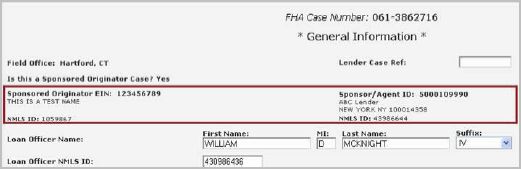
FHA Case Number Screen - General Information

HUD/VA ADDENDUM TO UNIFORM RESIDENTIAL LOAN APPLICATION
(HUD 92900-A)
Changes have been made to form HUD 92900-A, "HUD/VA Addendum to Uniform Residential Loan Application," to capture the company name, Taxpayer Identification Number and NMLS ID (if applicable) of a Sponsored Third Party Originator company.
Sponsoring Third Party Originator mortgagees may obtain the revised form at HUD's document website.
HUD 92900-A (9/2010): must be used for all loan applications taken by a Sponsored Third Party Originator.
HUD 92900-A (5/2008): may be used for loan originations not involving a sponsored originator until January 1, 2011.

Visit Library for Issuance

FHA Capture of Nationwide Mortgage Licensing System and Registry (NMLS) Information
Mortgagee Letter 2011-04
January 5, 2011

LENDERS COMPLIANCE GROUP is the first full-service, mortgage risk management firm in the country, specializing exclusively in mortgage compliance and offering a full suite of hands-on and automated services in residential mortgage banking.


Subscribe to:
Posts (Atom)