CREATORS OF THE COMPLIANCE TUNE-UP®

AARMR | ABA | ACAMS | ALTA | ARMCP | IAPP | IIA | MBA | MERS® | MISMO | NAMB

Showing posts with label FHA Single Family. Show all posts

Tuesday, April 30, 2013

FHA: Mortgagee Review Board - Administrative Actions

Periodically, we review with you the types of administrative actions taken by HUD's Mortgagee Review Board (MRB).
The review of the MRB's published administrative actions should be considered a teaching moment for all FHA approved mortgagees, inasmuch as the MRB is empowered to enforce its administrative sanctions through, among other things, reprimand, probation, suspension or withdrawal of approval and/or underwriting authority, cease-and-desist orders, and civil money penalties.
On April 11, 2013 HUD published the administrative actions taken by the Mortgagee Review Board (MRB) against certain FHA mortgagees. The period covered in the issuance is January 1, 2012 to September 30, 2012.
In this article, we provide an outline of the kinds of violations and respective sanctions that the MRB recently sustained.
_____________________________________________________
IN THIS ARTICLE
A Word to the Wise
Rule of Thumb
Administrative Actions
Library
_____________________________________________________
A Word to the Wise Word
In representing clients before the MRB, we can vouch for the exhaustive due diligence that is virtually mandated, the considerable costs involved, the experienced legal counsel and requisite regulatory compliance expertise that is needed, and the significant adverse impact on an FHA lender's ability to conduct or even continue in business.
It's easy to get lulled into a sense of false confidence by thinking that some violations are minor. But if the MRB gets involved, those minor violations will become a part of the causes for administrative action, and even in some instances the proximate cause of the administrative action.
Nothing should be considered a "minor" violation, when originating HUD/FHA mortgage loans.
It is instructive to note the causes for the administrative action brought against an FHA-approved mortgagee.
Ignorance is a futile defense, when it comes to the causes that can affirmatively contribute to disciplinary action.
_____________________________________________________
Rule of Thumb Rule
The MRB is not sympathetic to a mortgagee that violates HUD/FHA requirements which are, or are expected to be, within the mortgagee's control.
Violations that are not, or not expected to be, in the mortgagee's control provide the MRB with a more nuanced basis upon which to provide some leniency.
_____________________________________________________
Administrative Actions
VIOLATION:
Failed to notify the Department that it was the subject of multiple state regulatory actions and sanctions, and submitted false certifications to HUD in connection with its annual renewal of eligibility documentation for its fiscal years ending in 2009, 2010 and 2011.
ACTION: Civil money penalty in the amount of $75,000.
VIOLATION:
Failed to perform quality control functions in compliance with HUD/FHA requirements, failed to meet the requirements for participation in the FHA mortgage insurance program, failed to ensure the correct mortgagee identification number was used when originating FHA-insured mortgage loans, failed to adequately document the source of and/or adequacy of funds used for closing, failed to correctly calculate and document the mortgagor's income, failed to verify the stability of the mortgagor's income, failed to ensure the mortgagor was eligible for an FHA-insured mortgage loan, failed to ensure the property met HUD's eligibility requirements, failed to comply with TOTAL Scorecard requirements, failed to comply with HUD's property flipping requirements, failed to provide construction documents required for property eligibility and/or high ratio financing resulting in over-insured mortgages, failed to ensure that the maximum mortgage amount was correctly calculated, resulting in over-insured mortgages, failed to ensure that data submitted to HUD systems was accurate, and charged mortgagors unallowable fees.
ACTION:
Notice of Administrative Action immediately and permanently withdrawing the FHA approval.
VIOLATION: Failed to obtain adequate documentation of the income used to qualify a borrower, failed to resolve discrepancies and/or conflicting information before submitting loans for FHA mortgage approval, and failed to ensure mortgagors were not charged fees that were excessive and/or unreasonable for the services performed.
ACTION:
Settlement Agreement that required civil money penalties in the amount of $17,000, to indemnify HUD/FHA for its losses with respect to two FHA-insured loans, and to refund borrowers for excessive origination fees.
VIOLATION:
Submitted or caused to be submitted false information to HUD in relation to 63 mortgagee record changes, failed to reconcile its portfolio data and allowed HUD records to incorrectly identify the mortgagee as the holder of 97 FHA-insured mortgage loans, and submitted false information to HUD on 133 claims for FHA insurance benefits and, in 90 instances, claimed benefits for ineligible holders of record.
ACTION: Settlement Agreement that, among other things, required a civil money penalty in the amount of $1.2 million and to complete mortgage record changes to facilitate the payment of certain FHA insurance claims.

Monday, January 10, 2011

FHA: Connects to the NMLSR

On January 5, 2011, HUD-FHA issued Mortgagee Letter 2011-04, which notifies mortgagees that HUD will begin collecting the unique identifiers assigned by the Nationwide Mortgage Licensing System and Registry (NMLS) to individuals and entities participating in the origination of loans submitted for insurance by the FHA.

FHA-approved mortgagees and their employees must comply with the NMLS registration requirements of the states and entities with jurisdiction over their activities, and must register in accordance with the guidelines set forth by the NMLS.

Additionally, Sponsoring Third Party Originators are now required to ensure that their Sponsored Third Party Originators obtain and maintain an NMLS unique identifier (NMLS ID), as is required by the states and entities with jurisdiction over their activities and in accordance with the registration guidelines set forth by the NMLS.

Please also note that under the Helping Families Save Their Homes Act of 2009 (Pub.L. 111-22), the failure of an FHA-approved lender to comply with requirements of the Safe Act (12 U.S.C. 5101-5116) and applicable state law is cause for withdrawal of FHA lender approval or loss of authorization to participate in FHA lending programs.

HUD expects mortgagees to comply with applicable federal and state requirements governing NMLS licensing and registration. For more information on your state's NMLS requirements and implementation plans, you can visit the NMLS Resource Center.

HUD will capture NMLS IDs at a number of points in the lender approval and loan origination processes, which we have indicated below.

Read Below for Compliance Deadlines.

Line-Webpage

DATA CAPTURE OF NMLS IDENTIFIERS

Line-Webpage

APPLICATION FOR OR RENEWAL OF FHA LENDER APPROVAL

HUD will collect the NMLS company ID:

  • From lenders seeking approval to participate in FHA programs via a new field in the "Application for Federal Housing Administration Lender Approval" (Form HUD-92001-A). The revised Form HUD-92001-A is expected to be released soon and available on HUD's document website.
  • From lenders seeking to renew their FHA lender approval via the completion of a new field in the renewal screens in FHA Connection. Changes to the renewal screens in FHA Connection were released on October 4, 2010.

Completion of these new fields will become mandatory upon their release for those institutions that possess an NMLS company ID.

Line-Webpage

SPONSORING THIRD PARTY ORIGINATORS

HUD will collect the NMLS company ID of Sponsored Third Party Originators:

From Sponsoring Third Party Originators, by their completing the Sponsored Originator Maintenance screen in FHA Connection.

Line-Webpage

LOAN PROCESSING AND UNDERWRITING

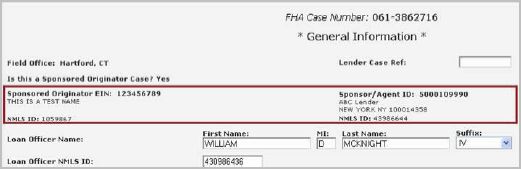
Mortgagees will be required to complete the following new fields on the FHA Connection case number assignment screen, as appropriate:

1) Loan Officer: the NMLS ID of the loan officer who took the application from the applicant.
We expect this information to be used, among other things, to observe and enforce compliance with loan officer licensing requirements. Disclosure compliance regarding this data will likely be included in HUD's quality assurance examinations.

2) Sponsored Third Party Originator loans: the Sponsored Third Party Originator's company name and Taxpayer Identification Number (if applicable).
HUD will use the information to provide the Sponsoring Third Party Originators with Neighborhood Watch performance data for their Sponsored Third Party Originators. We expect the information to be used by HUD to assist in ensuring that participants in FHA loan transactions comply with the eligibility requirements governing participation in FHA programs.

Compliance Dates

Until March 31, 2011: entry of the name and NMLS ID of a loan officer is optional.

On and after April 1, 2011: the information must be entered in accordance with the following guidelines:

-The loan officer's first and last name are required, and

-If registered in NMLS, the loan officer's NMLS ID is required.

Here's a screen shot:
Case Number-NMLS
FHA Case Number Screen - General Information

Line-Webpage

HUD/VA ADDENDUM TO UNIFORM RESIDENTIAL LOAN APPLICATION
(HUD 92900-A)

Changes have been made to form HUD 92900-A, "HUD/VA Addendum to Uniform Residential Loan Application," to capture the company name, Taxpayer Identification Number and NMLS ID (if applicable) of a Sponsored Third Party Originator company.

Sponsoring Third Party Originator mortgagees may obtain the revised form at HUD's document website.

HUD 92900-A (9/2010): must be used for all loan applications taken by a Sponsored Third Party Originator.

HUD 92900-A (5/2008): may be used for loan originations not involving a sponsored originator until January 1, 2011.

Line-Webpage

Visit Library for Issuance

Law Library Image
FHA Capture of Nationwide Mortgage Licensing System and Registry (NMLS) Information
Mortgagee Letter 2011-04
January 5, 2011

Post Separator-2-LCG

LENDERS COMPLIANCE GROUP is the first full-service, mortgage risk management firm in the country, specializing exclusively in mortgage compliance and offering a full suite of hands-on and automated services in residential mortgage banking.

Friday, January 7, 2011

FHA: Updates Quality Control Requirements

On January 5, 2011, HUD-FHA issued Mortgagee Letter 2011-02, which clarifies quality control requirements relating to several important areas: (1) due to recent changes to the lender eligibility criteria for participation in FHA programs (i.e., "Helping Families Save Their Homes Act of 2009" (HFSH Act)); (2) "Continuation of FHA Reform: Strengthening Risk Management through Responsible FHA-approved Lenders" (Final Rule FR 5356-F-02); and, (3) Mortgagee Letter 2010-20.

Additionally, this Mortgagee Letter clarifies Quality Control requirements for servicing transfers and loan sales, reporting of fraud and material deficiencies, and the required timeframes for mortgagees to review rejected applications.

Especially if you are a Sponsoring Third Party Originator, we urge you to revise your Quality Plan immediately and implement the requirements contained in Mortgagee Letter 2011-02.

Effective: Immediately

Line-Webpage

SPONSORING THIRD PARTY ORIGINATORS

Beginning January 1, 2011, FHA will neither approve applications for approval as a loan correspondent, nor monitor lenders acting in such capacity for the purpose of the origination of loans submitted for FHA insurance. All lending entities performing in the capacity of a loan correspondent will thereafter be referred to as Sponsored Third Party Originators.

Consequently, all FHA-approved mortgagees will be responsible for performing quality control reviews of their Sponsored Third Party Originators.

The procedures used to review and monitor Sponsored Third Party Originators must be included in a mortgagee's FHA-approved Quality Control Plan.

Therefore, the Quality Control Plan must be reviewed and, where required, revised with respect to the review of loans originated and sold to the mortgagee by each of its Sponsored Third Party Originators.

  • Mortgagees must determine the appropriate sample amount of each Sponsored Third Party Originator's loans to review based on volume, past experience, and other factors specified by the Department in Paragraph 7-6(C) of HUD Handbook 4060.1, REV-2.
  • Sponsors must document the methodology used to review Sponsored Third Party Originators, the results of each review, and any corrective actions taken as a result of their review findings.

A report of the Quality Control review and follow-up that includes the review findings and actions taken, and the procedural information (such as the percentage of loans reviewed, basis for selecting loans, and who performed the review), must be retained by the mortgagee for a period of two years.

Line-Webpage

EARLY PAYMENT DEFAULTS

In addition to the loans selected for routine quality control reviews, mortgagees must review all loans that are originated or underwritten by their company and that are originated by their Sponsored Third Party Originators that go into default within the first six payments (referred to as early payment defaults). (Handbook 4060.1, REV-2 defines early payment defaults as loans that become 60 days past due within the first six payments.)

  • Mortgagees must perform reviews of early payment defaults within 45 days from the end of the month the loan is reported as 60 days past due.
  • The Early Payment Default review report and follow-up, including review findings and any actions taken, along with procedural information (as specified in HUD Handbook 4060.1 Rev.-2, Paragraph 7-6 (E)), must be retained by the mortgagee for a period of two years.

Line-Webpage

SALES AND TRANSFER OF LOANS

Mortgagees are responsible for determining whether the Mortgage Change Record was reported accurately to HUD via the FHA Connection on servicing transfers or sales of loans. Mortgagees' Quality Control Plans must contain a requirement to ensure the review of all Mortgage Change Records for accuracy, as follows:

For cases involving the transfer of legal rights to service FHA-insured loans:

  • The transferee must report the change of legal rights to service to HUD The transferor should verify that the change of legal rights to service has been reported, and that all details contained in the report are accurate.

For cases involving the holder's sale of loans:

  • The holder (seller) must report the sale of loans to HUD The buyer must confirm that the sale of loans has been reported, and that all details contained in the report are accurate.

Line-Webpage

REPORTING OF FRAUD OR MATERIAL DEFICIENCIES

If a mortgagee discovers potential fraud or other serious material deficiencies, it must be immediately reported to the HUD via the Neighborhood Watch Early Warning System (see: Handbook 4060.1 Rev.-2, Paragraph 7-3 (J)).

  • Management is expected to review and respond accordingly to each instance of fraud or other serious material deficiency, indicating what steps if any have been taken to cure and/or resolve these violations.
  • All corrective actions taken in response to instances of fraud or other serious material deficiencies should be reported to the Department via the Neighborhood Watch Early Warning System.
  • Mortgagees must monitor all loans they originate, underwrite or service for potential fraud or serious material deficiencies throughout the lifecycle of the loans.

Line-Webpage

REJECTED APPLICATIONS

Rejected applications must be reviewed within 90 days from the end of the month in which the decision was made.

Line-Webpage

Visit Library for Issuance

Law Library Image
Quality Control Requirements for Direct Endorsement Lenders
Mortgagee Letter 2011-02
January 5, 2011

Post Separator-2-LCG

LENDERS COMPLIANCE GROUP is the first full-service, mortgage risk management firm in the country, specializing exclusively in mortgage compliance and offering a full suite of hands-on and automated services in residential mortgage banking.

Tuesday, December 21, 2010

FHA: Quality Control for TPOs

By Jonathan Foxx

Jonathan Foxx, former Chief Compliance Officer of two publicly traded financial institutions, is the President and Managing Director of Lenders Compliance Group, the first full-service, mortgage risk management firm in the country.

Line-Webpage

Today, the Department of Housing and Urban Development (HUD) published a Comment Request, in a Notice entitled Quality Control Requirements for Direct Endorsement Lenders.

Mortgagee Letter 2010-20, issued on June 11, 2010, outlined some of the most important revisions that HUD-FHA has made to its single family loan origination program and contained the long-awaited guidance regarding the implementation of its Final Rule. That Final Rule adopted changes pertaining to the approval of lenders by the Federal Housing Administration (FHA). (Issuance)

In my article, entitled FHA Issues Guidance for Lender Approvals (July 2010, National Mortgage Professional Magazine), I discussed the many changes that would be required pursuant to Mortgagee Letter 2010-20. (Article)

Please visit our Archive for relevant posts.

As of January 1, 2011, mortgagees that were previously approved as Loan Correspondents will only be able to participate as Third Party Originators (TPOs) in FHA-insured mortgage transactions if the conditions outlined in 24 CFR 202.8 are met.

Per 24 CFR 202.8 (3), DE lenders which sponsor TPOs are responsible for the actions of third party originators or mortgagees in originating loans or mortgages, unless applicable law or regulation requires specific knowledge on the part of the party to be held responsible.

Consequently, DE lenders will be responsible for conducting quality control on TPO originations of FHA-insured mortgage loans, and ensuring that their QC plan is expanded to contain this oversight provision.

Comment Period Deadline: February 22, 2011
Contact Information in Federal Register.

Line-Webpage

Overview

On and after January 1, 2011, Loan Correspondents (i.e., Third-Party Originators, so-called "TPO"s) will only be permitted to continue participation in FHA programs by establishing a sponsorship relationship with an FHA-approved Direct Endorsement mortgagee.

HUD will hold the DE mortgagee responsible for compliance with FHA requirements in all aspects of an FHA loan transaction, whether performed by the DE mortgagee or by its sponsored TPO (unless applicable law or regulation governing the violations in question require specific knowledge on the part of the party to be held responsible).

Quality control is a core feature of HUD's verification and validation procedures. It is a regulatory compliance requirement that must be implemented in accordance with specified guidelines.

It is, therefore, critical that a DE mortgagee set forth and clearly delineate policies, procedures, approval guidelines, quality control requirements, and many other features of FHA and regulatory compliance, with respect to their sponsored TPOs.

All our clients that have TPO relationships now have their policies and procedures in place to support these new FHA relationship requirements.

ACTION: If your organization has TPO relationships, but has not drafted policies and procedures to comply with Mortgagee Letter 2010-20, we urge you to do so immediately.

Line-Webpage

Highlights

The Notice is soliciting comments from members of the public and affected agencies concerning the proposed collection of information to:

(1) Evaluate whether the proposed collection is necessary for the proper performance of the functions of the agency, including whether the information will have practical utility;

(2) Evaluate the accuracy of the agency's estimate of the burden of the proposed collection of information;

(3) Enhance the quality, utility, and clarity of the information to be collected; and

(4) Minimize the burden of the collection of information on those who are to respond, including the use of appropriate automated collection techniques or other forms of information technology (i.e., permitting electronic submission of responses).

Line-Webpage

Visit Library for Issuance

Law Library Image
FHA: Quality Control Requirements for Direct Endorsement Lenders; Notice of Proposed Information Collection: Comment Request
Federal Register: 75/244
December 21, 2010

Line-Webpage

LENDERS COMPLIANCE GROUP is the first full-service, mortgage risk management firm in the country, specializing exclusively in mortgage compliance and offering a full suite of hands-on and automated services in residential mortgage banking.

Wednesday, September 22, 2010

FHA: Issues FHA Connection Update for Sponsored TPOs

In my article, entitled FHA Issues Guidance for Lender Approvals (July 2010, National Mortgage Professional Magazine), I discussed the many changes that would be required pursuant to Mortgagee Letter 2010-20.

This ML, issued on June 11, 2010, outlines some of the most important revisions that HUD-FHA has made to its single family loan origination program and contained the long-awaited guidance regarding the implementation of its Final Rule. That Final Rule adopted changes pertaining to the approval of mortgage lenders by the Federal Housing Administration (FHA) that are designed to strengthen FHA by improving its management of risk.

If your organization has not drafted and begun implementing policies and procedures to comply with Mortgage Letter 2010-20, I highly urge you to do so immediately.

After December 31, 2010, loan correspondents (i.e., Third-Party Originators, so-called "TPO"s) will only be permitted to continue participation in FHA programs by establishing a sponsorship relationship with an FHA-approved mortgagee. Indeed, loan correspondents will no longer have access to non-public FHA systems, beginning January 1, 2011 (i.e., FHA Connection). Only FHA-approved mortgagees will be permitted to order FHA case numbers from the FHA Connection. HUD will provide future guidance, with respect to the processing of case numbers ordered prior to the January 1, 2011.

Mortgagee Letter 2010-33 has been expected. It describes the system enhancements to FHA Connection, providing notice to mortgagees who are sponsors ("Sponsoring Mortgagees') of sponsored third party originators ("Sponsored Originators") of new FHA Connection data submission requirements as was announced in Mortgagee Letter 2010-20.

For transactions originated by an FHA-approved loan correspondent, mortgagees should follow the current process through December 31, 2010.

FHA Connection enhancements will be implemented on October 4, 2010, and sponsoring mortgagees must begin complying with the new data entry requirements on that date.

_____________________________________

Highlights

EFFECTIVE DATES

On or After October 4, 2010

  • All required sponsored origination data fields must be completed on assigned case numbers assigned.
  • Sponsoring mortgagees will no longer enter their 10 digit FHA ID in the FHA Connection as the loan originator for loans involving a sponsored originator, as previously advised in Mortgagee Letter 2010-20, as a temporary workaround pending this system enhancement release.
  • For mortgagees using B2G (FHA Connection Business to Government) that are unable to modify their systems to accommodate the transmission of the Employer Identification Number (EIN) by October 4, 2010, the FHA Connection Case Number Assignment screen must be used to order a case number for sponsored originator transactions.
  • The modified HUD/VA Addendum to the Uniform Residential Loan Application (92900-A) is required for all applications.

Until January 1, 2011

  • For loan originations not involving a sponsored originator, FHA mortgagees may use the prior version of the 92900-A (dated 5/2008) until January 1, 2011.

As of January 1, 2011

  • The FHA-approved loan correspondent program will no longer be available, and B2G mortgagees must comply with new systems requirements to support collection of sponsored originator data. Only FHA-approved entities will have direct access to FHA Connection.

SYSTEM AND SCREEN CHANGES

  • New Sponsored Originator Maintenance Screen Modified Case Number Assignment Screen
  • Modified Case Transfer Screen
  • Modified Insurance Application and HECM Insurance Application Screens
  • Modified Case Query Screen
  • Viewing Sponsored Originator Performance in Neighborhood Watch
  • FHA TOTAL Scorecard Changes

FORM CHANGE AND NEW SIGNATURE COMPLIANCE

HUD/VA Addendum to Uniform Residential Loan Application (92900-A)

  • Modified on page 3 to capture necessary information for sponsored originators, as follows:
    • Loan Origination Company - Entity's Legal Name of the originating mortgagee
    • Loan Origination Company Tax ID -- Employer Identification Number issued by the Internal Revenue Service (IRS)
    • NMLS ID of the Loan Origination Company - The unique identifier of the company, if licensed with NMLS
  • For those loans originated by a sponsored originator, the sponsoring mortgagee must enter its name and address in block 15 on pages 1 and 3. Directly below block 15 on page 3 are the new fields the mortgagee must enter for capturing the sponsored origination information described above.
  • The revised form 92900-A (dated 9/2010) must be used for all loan applications taken by a sponsored originator on or after October 4, 2010.
  • For loan originations not involving a sponsored originator, FHA mortgagees may use the prior version of the 92900-A (dated 5/2008) until January 1, 2011.

Uniform Residential Loan Application

  • On the Universal Residential Loan Application (URLA), the actual interviewer's name, signature and telephone number must appear on page 4, regardless of who employs the interviewer (e.g., a sponsored originator).
  • While common practice in the industry is for the interviewer to also sign page 1 of the 92900-A, if a sponsored originator is involved, it is now required that the sponsoring mortgagee must sign and date page 1 of the URLA.

_____________________________________

Visit Library for Issuance

Law Library Image

FHA Connection Enhancements to Support
Sponsored Third Party Originations (Sponsored Originations)

Mortgagee Letter 2010-33, September 21, 2010

LENDERS COMPLIANCE GROUP is the first full-service, mortgage risk management firm in the country, specializing exclusively in mortgage compliance and offering a full suite of hands-on and automated services in residential mortgage banking.

Friday, September 3, 2010

FHA: New Credit Score and LTV Guidelines

On July 15, 2010, HUD issued a notice seeking comment on three initiatives that HUD proposed would contribute to the restoration of the Mutual Mortgage Insurance Fund (MMIF) capital reserve account. We provided a brief outline and a copy of that issuance in our Compliance Update, FHA: Proposes to Revise Underwriting Guidelines (7/16/10).

Today, September 3, 2010, HUD announced that it has completed its review and considered public comments. The issuance does not cover all three initiatives, but is limited to implementation of HUD's proposal to introduce a minimum credit score threshold and reduce the maximum LTV. The remaining two initiatives, involving (1) capping seller concessions, and (2) tightening manual underwriting guidelines, will be dealt with in a forthcoming issuance.

Effective Date: October 4, 2010

_________________________________________

Highlights

Credit Score and LTV Chart

The following chart outlines the changes in New Loan-to-Value and Credit Score requirements:

Minimum Credit Score

Borrowers will be required to have a minimum decision credit score of no less than 500 to be eligible for FHA financing.

LTV Requirements

The LTV for FHA-insured mortgage loans (purchase and refinance) will be limited to 90 percent for borrowers with a decision score between 500 and 579. Maximum FHA-insured financing (typically, 96.5 percent LTV for purchase transactions and 97.75 percent for rate and term refinance transactions) will continue to be available for borrowers with credit scores at or above 580.

Temporary Exemption for Refinances

FHA is providing a special, temporary allowance to permit higher LTV mortgage loans for borrowers with lower decision credit scores, so long as they involve a reduction of existing mortgage indebtedness pursuant to FHA program adjustments announced in HUD Mortgagee Letter 2010-23.

In accordance with Mortgagee Letter 2010-23, the current mortgage lender will need to agree to accept a short pay off, accepting less than the full amount owed on the original mortgage in order to satisfy the outstanding debt.

This exemption is applicable only to borrowers with credit scores between 500 to 579. Further, the exemption is applicable only to refinance transactions originated pursuant to Mortgagee Letter 2010-23 and closed on or before December 31, 2012.

___________________________________________

Visit Library for Issuance

Law Library Image

FHA Risk Management Initiatives:
New Loan-to-Value and Credit Score Requirements

Federal Register, Vol. 75, No. 171
September 3, 2010

___________________________________________

Lenders Compliance Group is the first full-service, mortgage risk management firm in the country, specializing exclusively in mortgage compliance and offering a full suite of hands-on and automated services in residential mortgage banking.

Monday, August 9, 2010

FHA Launches “Underwater” Refinances

On August 6, 2010, the Department of Housing and Urban Development (HUD) issued Mortgagee Letter 2010-23, which announced the FHA Short Refinance program.

Available on September 7, 2010, the loan product will enable lenders to provide additional refinancing options to homeowners who owe more than their home is worth – or “underwater.” The FHA Short Refinance will continue to be available until December 31, 2012.

The Federal Housing Administration (FHA) will offer certain non-FHA borrowers, who are current on their existing mortgage and whose lenders agree to write off at least ten (10%) percent of the unpaid principal balance of the first mortgage, the opportunity to qualify for a new FHA-insured mortgage.

To be eligible for a new loan, homeowners must owe more on their mortgage than their home is worth and be current on their existing mortgage. Homeowners must qualify for the new loan under standard FHA underwriting requirements and have a credit score equal to or greater than 500. The property must be the homeowner's primary residence.

The borrower's existing first lien holder must agree to write off at least 10% of the unpaid principal balance, bringing the borrower's combined loan-to-value ratio to no greater than 115%. The existing loan to be refinanced must not be an FHA-insured loan, and the refinanced FHA-insured first mortgage must have a loan-to-value ratio of no more than 97.75%.

U.S. Department of Treasury will provide incentives to existing second lien holders who agree to full or partial extinguishing of the liens. To be eligible, servicers must execute a Servicer Participation Agreement (SPA) with Fannie Mae, in its capacity as financial agent for the United States, on or before October 3, 2010.

HUD estimates that between 500,000 and 1,500,000 borrowers will refinance using these enhancements and the net economic benefits will be between $11.774 and $35.322 billion.

Highlights

Eligibility

Participation is voluntary and requires the consent of lien holders. In order for a loan to be eligible, the following conditions must be met:

1. The homeowner must be in a negative equity position;

2. The homeowner must be current on the existing mortgage to be refinanced;

3. The homeowner must occupy the subject property (1-4 units) as their primary residence;

4. The homeowner must qualify for the new loan under standard FHA underwriting requirements and possess a "FICO based" decision credit score greater than or equal to 500;

5. The existing loan to be refinanced must not be a FHA-insured loan;

6. The existing first lien holder must write off at least 10 percent of the unpaid principal balance;

7. The refinanced FHA-insured first mortgage must have a loan-to-value ratio of no more than 97.75 percent;

8. Non-extinguished existing subordinate mortgages must be re-subordinated and the new loan may not have a combined loan-to-value ratio greater than 115 percent;

9. For loans that receive a "refer" risk classification from TOTAL Mortgage Scorecard (TOTAL) and/or are manually underwritten, the homeowner's total monthly mortgage payment, including the first and any subordinate mortgage(s), cannot be greater than 31 percent of gross monthly income and total debt, including all recurring debts, cannot be greater than 50 percent of gross monthly income;

10. FHA mortgagees are not permitted to use premium pricing to pay off existing debt obligations to qualify the borrower for the new loan;

11. FHA mortgagees are not permitted to make mortgage payments on behalf of the borrowers or otherwise bring the existing loan current to make it eligible for FHA insurance; and

12. The existing loan to be refinanced may not have been brought current by the existing first lien holder, except through an acceptable permanent loan modification as described below.

Salient Features of Program

  • Principal Write Off
  • Calculating Mortgage
  • Underwriting Requirements
  • Current Mortgage
  • Acceptable Credit History
  • Combined Loan-to-Value Ratio
  • Permissible Secondary Financing
  • Borrower Certification
  • Mortgage Type and ADP Codes
  • Second Lien Extinguishment and Servicer Incentive

Visit Library for Issuance

Law Library Image

FHA Refinance of Borrowers in Negative Equity Positions
Mortgagee Letter 2010-23
August 6, 2010

Lenders Compliance Group is the first full-service, mortgage risk management firm in the country, specializing exclusively in mortgage compliance and offering a full suite of hands-on and automated services in residential mortgage banking.

Sunday, July 25, 2010

FHA Issues Guidance for Lender Approvals

by Jonathan Foxx

Jonathan Foxx, former Chief Compliance Officer of two publicly traded financial institutions, is the President and Managing Director of Lenders Compliance Group, the first full-service, mortgage risk management firm in the country.

As published in the July 2010 Edition of National Mortgage Professional Magazine.

Download Article-1A

On June 11, 2010, the Department of Housing and Urban Development (HUD) issued Mortgagee Letter 2010-20,[1] which provided the long-awaited guidance regarding the implementation of its Final Rule.[2] The Final Rule adopted changes pertaining to the approval of mortgage lenders by the Federal Housing Administration (FHA) that are designed to strengthen FHA by improving its management of risk.

This Final Rule, among other things, has increased the net worth requirement for FHA-approved mortgagees and also provided for elimination of the FHA approval process for loan correspondents. Loan correspondents will no longer be approved participants in FHA programs, but they will continue to have the opportunity to participate in FHA programs as third-party originators (TPOs) through sponsorship by FHA-approved mortgagees, as is currently the case, or through application to be approved as an FHA-approved mortgagee.

In eliminating the FHA's approval of loan correspondents, FHA-approved mortgagees assume full responsibility to ensure that a sponsored loan correspondent adheres to the FHA's loan origination and processing requirements.

Increased Net Worth Requirements: Two Phases

HUD is phasing in the increased net worth mandates through 2013.

Phase One

The first stage of Phase One has already passed, since all new applicants for FHA approval, beginning on May 20, 2010, must now possess a net worth of at least $1,000,000. And the net worth must consist of at least 20 percent (20%) in liquid assets (i.e., cash or cash equivalent).

The second stage, which begins on May 20, 2011, is a little tricky, since a metric is introduced using a Small Business Administration statute in order to bifurcate lender approval criteria. On and after that date, a standard will be applied using the Table of Small Business Size Standards for a small business, as defined by the Small Business Administration at 13 CFR 121.201, Sector 52 (Finance and Insurance), Subsector 522 (Credit Intermediation and Related Activities).[3]

  • Effective May 20, 2011, lenders that exceed the size standards as provided in the above-cited statute must possess a net worth of at least $1,000,000, of which no less than 20 percent (20%) must be liquid assets (i.e., cash or cash equivalent).[4]
  • Effective May 20, 2011, lenders that meet the size standards as provided in the above-cited statute must possess a net worth of at least $500,000, of which no less than 20 percent (20%) must be liquid assets (i.e., cash or cash equivalent).

The most recent August 2008 Table of Small Business Size Standards, published through the Small Business Administration, indicates the following thresholds:

clip_image002

A size standard is the largest that a concern can be and still qualify as a small business for Federal Government programs.[5] From the table above, it should be noted that SBA’s current requirements for classification as a small business, as set forth in this Subsector, are less than $7 million in annual receipts for non-depository institutions and less than $175 million in assets for depository institutions.[6]

Phase Two

Phase Two begins on May 20, 2013 and affects the category of participation in FHA programs. Identify the institution’s participation to determine the net worth thresholds:

  • Single Family Programs. Minimum net worth of not less than $1,000,000 plus an additional net worth of one percent (1%) of the total volume in excess of $25 million of FHA single family insured mortgages originated, underwritten, purchased, or serviced during the prior fiscal year, up to a maximum required net worth of $2.5 million. Not less than 20 percent (20%) of a mortgagee’s required net worth must be liquid assets (i.e., cash or cash equivalent).
  • Participation in Multifamily Programs with Engagement in Mortgage Servicing. Minimum net worth of not less than $1,000,000 plus an additional net worth of one percent of the total volume in excess of $25 million of FHA multifamily insured mortgages originated, underwritten, purchased, or serviced during the prior fiscal year, up to a maximum required net worth of $2.5 million. Not less than 20 percent of a mortgagee’s required net worth must be liquid assets (i.e., cash or cash equivalent).
  • Participation in Multifamily Programs without Engagement in Mortgage Servicing. Minimum net worth of not less than $1,000,000 plus an additional net worth of one half of one percent of the total volume in excess of $25 million of FHA multifamily insured mortgages originated, underwritten, or purchased during the prior fiscal year, up to a maximum required net worth of $2.5 million. Not less than 20 percent of a mortgagee’s required net worth must be liquid assets (i.e., cash or cash equivalent).
  • Participation in Single Family and Multifamily Programs. The higher net worth requirements for single family mortgagees.

Evidencing net worth is now requiring a higher due diligence review process, since all mortgagees (i.e., supervised, investing, and non-supervised), with the exception of government mortgagees, are required to submit audited financial statements as a condition of their approval or renewal.

Download Article-1A

Loan Correspondent Approval for Single Family Programs

Approvals

Effective May 20, 2010, FHA no longer accepts any new applications for loan correspondent approval. FHA will complete the processing of loan correspondent applications received prior to that date for those entities. If an application for loan correspondent approval was received by FHA on or after May 20, 2010, the application and fee will be returned to the applicant.

Loan correspondents approved and in good standing will be permitted to retain their approval through December 31, 2010. For loan correspondents with fiscal years ending on or after December 31, 2009, and that were required to renew their FHA approval prior to May 20, 2010, FHA will rely on the submission of the prior year’s audited financial statements for the renewal of loan correspondent approval.[7]

Therefore, loan correspondents whose fiscal years ended on or before December 31, 2009 had to submit the Yearly Verification Report, the applicable recertification fee, and audited financials. Loan correspondents whose fiscal year ends after December 31, 2009 are required to submit the Yearly Verification Report and the applicable recertification fee, but not audited financials.

After December 31, 2010, loan correspondents (i.e., Third-Party Originators, so-called “TPO”s) will only be permitted to continue participation in FHA programs by establishing a sponsorship relationship with an FHA-approved mortgagee. Indeed, loan correspondents will no longer have access to non-public FHA systems, beginning January 1, 2011 (i.e., FHA Connection). Only FHA-approved mortgagees will be permitted to order FHA case numbers from the FHA Connection. HUD will provide future guidance, with respect to the processing of case numbers ordered prior to the January 1, 2011.[8]

Originations

HUD will hold FHA-approved mortgagees responsible for compliance with FHA requirements in all aspects of an FHA loan transaction, whether performed by the approved mortgagee or by its sponsored TPO (unless applicable law or regulation governing the violations in question require specific knowledge on the part of the party to be held responsible). It is, therefore, critical that sponsoring FHA-approved mortgagees set forth and clearly delineate policies, procedures, approval guidelines, quality control requirements, and many other features of FHA and regulatory compliance, with respect to their sponsored TPOs.[9]

  • Approved as of May 20, 2010: may continue to originate mortgage loans insured by FHA through the end of the calendar year.
  • Non-approved originators (and expired approvals) - sponsored: permitted to participate through sponsorship by an FHA-approved Direct Endorsement mortgagee. An FHA-approved mortgagee may permit its sponsored TPO to perform all origination and processing tasks related to an FHA loan transaction (except for FHA Connection access). Sponsoring FHA-approved mortgagees will determine the “exact origination and processing duties their sponsored third party originators may perform.”[10]
  • An approved mortgagee may permit a sponsored TPO to originate Home Equity Conversion Mortgages (HECMs), provided that the sponsored third party originator adheres to all other HECM origination requirements.
  • Because of updates that HUD must make to its data systems, sponsoring mortgagees will enter their 5 digit FHA ID in FHA Connection as the loan originator for sponsored TPO loans; that is, for the time being all loan originations from sponsored TPOs will appear in FHA’s systems as a retail origination of the sponsoring mortgagee. (HUD hopes to have their data systems updated by September 30, 2010.)
  • FHA-approved mortgagees will not be permitted to use a Direct Lending branch office identification number to order case numbers for loans originated by sponsored TPO, because this identification number can only be used to originate direct-to-consumer loans obtained by the FHA-approved mortgage through the Internet and Call Centers.
  • Underwriting and approvals will be performed by an FHA-approved mortgagee for all loans originated by sponsored TPOs. Once approved by the sponsoring FHA-approved mortgagee, a loan must close in the name of the sponsoring underwriting mortgagee.[11] Finally, HUD officials fielded several questions regarding the current prohibition on closing an FHA-insured loan in the name of a TPO. The Department’s representatives acknowledged that HUD cannot change the prohibition on TPOs closing in their own names unless and until Congress amends the National Housing Act. As you may know, H.R. 5072, the FHA Reform Act of 2010, would accomplish this goal. This piece of legislation was recently passed in the House of Representatives and currently awaits deliberation in the Senate.
  • HUD will hold FHA-approved mortgagees responsible for compliance with FHA requirements in all aspects of an FHA loan transaction, whether performed by the approved mortgagee or by its sponsored third party originator, unless applicable law or regulation governing the violations in question require specific knowledge on the part of the party to be held responsible. HUD expects that FHA-approved mortgagees will pursue sponsoring relationships with responsible originators, and that approved mortgagees will diligently monitor and evaluate the activities and performance of those they sponsor. The Department will continue to carefully review and evaluate FHA-approved mortgagees’ activities and performance, and will take appropriate action to enforce its requirements when violations occur.

Loan Performance

  • Neighborhood Watch will post data for all loans originated via a sponsored TPO, and will be made available only to FHA-approved mortgagees for the purpose of evaluating sponsored TPO origination trends and performance

Third Party Fees

  • HUD will review all fees charged to a consumer by both FHA-approved lenders and TPOs and will hold the lender accountable for all of the fees charged, including those charged imposed by a TPO. Acceptable fees will be those that appear to be reasonable, common, and customary for the geographic area.[12]
  • Broker consulting fees, which are charged by a broker, must be paid outside of closing from the consumer’s own funds, and must be compliant with RESPA guidelines.[13]

Employment Requirements

FHA’s employment requirements for approved mortgagees and lenders are outlined in Chapter 2 of Handbook 4060.1, Rev. 2. FHA-approved mortgagees shall ensure that sponsored third party originators involved in FHA loan transactions adhere to all applicable federal, state, and local requirements governing their FHA loan origination and processing activities.

HUD will no longer monitor TPOs and will not impose restrictions on employment. Therefore, sponsored TPO employees can be paid on a W-2 or 1099 basis, and can have dual employment (i.e., mortgage originator as well as real estate agent). Also, there will be no “brick and mortar” requirements for sponsored TPOs.[14]

As a reminder to currently approved mortgagees and lenders, HUD prohibits HECM mortgage originators from also engaging in the sale or solicitation of other financial or insurance products. FHA-approved mortgagees must carefully evaluate the specific guidelines governing the programs and activities in which they wish to participate, as well as relevant state and local laws and regulations governing such activities.

Download Article-1A

Principal-Authorized Agent Relationships

Principal-Authorized Agent relationships can now only be entered into by two FHA-approved mortgagees, both of which must possess unconditional Direct Endorsement approval. This relationship, and the respective roles of the parties involved, must be documented accurately and accordingly in FHA Connection. Additional time is needed to support such documentation in FHA Connection. Due to impending system changes necessary to support and validate Principal-Authorized Agent transactions, FHA is issuing a regulatory waiver that will delay implementation of this provision until January 1, 2011.[15]

  • For Forward mortgages, the principal can have either unconditional DE or unconditional HECM approval. The authorized agent must have unconditional DE approval.
  • For HECM mortgages, the principal can have either unconditional DE or unconditional HECM approval. The authorized agent must have unconditional HECM approval.
  • The Principal in these relationships must originate the loan and the Authorized Agent must underwrite the loan.
  • The loan may close in either the name of the Principal or the Authorized Agent, and either party may submit the loan for insurance endorsement.

Areas Approved for Business (AAFB)

FHA-approved mortgagees may underwrite sponsored TPO loans in any state in which they are permitted by the state to do so, and in which sponsored TPOs are permitted to conduct mortgage origination activities. Hence, an FHA-approved mortgagee’s wholesale AAFB consists of all states in which it sponsors a mortgage originator that meets the applicable requirements for loan origination of that state and in which the mortgagee is permitted by the state to underwrite mortgage loans and sponsor mortgage originators.[16]

HUD will provide more detailed requirements for the submission of sponsored third party originator loans in a subsequent Mortgagee Letter. That Mortgagee Letter will include instructions for data submission and the process for ordering and transferring FHA case numbers for loans originated by sponsored third party originators.

New Form 92900-A: Addendum to the URLA

HUD intends to amend Form 92900-A (Addendum to the Uniform Residential Loan Application) in order to obtain information related to sponsored TPOs.[17] The new form will add additional boxes for a TPO’s legal name, tax identification number, and Nationwide Mortgage Licensing System Registry (“NMLSR”) number for the company (if applicable). A date of mid-September 2010 is anticipated for implementation of the new form.

Download Article-1A

If you have any questions about this matter or would like assistance with mortgage compliance, please contact Jonathan Foxx, Managing Director, or call 516-442-3456.


[1] Mortgagee Letter 2010-20, June 11, 2010, Implementation of Final Rule FR 5356-F-02, “Federal Housing Administration: Continuation of FHA Reform-Strengthening Risk Management through Responsible FHA-Approved Lenders”

[2] April 20, 2010 at 75 FR 20718, with technical correction published on May 4, 2010 at 75 FR 23582.

[3] Under the final regulations, small businesses are those that meet the size standard for their industry classification established by the Small Business Administration at 13 C.F.R. § 121.201 Sector 52 (Finance and Insurance), Subsector 522 (Credit Intermediation and Related Activities). Non-small businesses are those lenders and mortgagees that exceed this size standard. Id. at 20,734 [citing new Section 202.5(n)(iii)].

[4] Under the final regulations, small businesses are those that meet the size standard for their industry classification established by the Small Business Administration at 13 C.F.R. § 121.201 Sector 52 (Finance and Insurance), Subsector 522 (Credit Intermediation and Related Activities). Non-small businesses are those lenders and mortgagees that exceed this size standard. Id. at 20,734 [citing new Section 202.5(n)(iii)].

[5] U. S. Small Business Administration Table of Small Business Size Standards Matched to North American Industry Classification System Codes, August 22, 2008, p29 (Data – 2007)

[6] Op.cit. 1, Footnote (2)

[7] See Mortgagee Letter 2009-01: Loan correspondents must submit the online annual certification and the annual renewal fee or be subject to administrative action leading to the possible withdrawal of their FHA approval.

[8] Industry Conference Call, June 29, 2010: hosted by HUD to summarize the new regulatory changes and the corresponding guidance provided in Mortgagee Letter 2010-20.

[9] Additionally, FHA’s employment requirements for approved mortgagees and lenders, as outlined in Chapter 2 of Handbook 4060.1, Rev. 2, requires FHA-approved mortgagees to ensure that sponsored TPOs involved in FHA loan transactions adhere to all applicable federal, state, and local requirements governing their FHA loan origination and processing activities.

[10] Op.cit. 1, p 4

[11] The current prohibition on closing in a TPO’s name cannot be changed until Congress amends the National Housing Act. The FHA Reform Act of 2010 (HR 5072), which was recently passed in the House and currently awaits deliberation in the Senate, would accomplish this goal.

[12] Op.cit. 8

[13] Op.cit. 8

[14] Op.cit. 8

[15] Op.cit. 8

[16] Mortgagees will order case numbers for any state in which they are approved to underwrite an FHA loan. Until system modifications are made, mortgagees will need to enter their 5 digit ID in the Sponsor field in FHA Connection’s case number assignment screen.

[17] Op.cit. 8

Friday, July 16, 2010

FHA Proposes to Revise Underwriting Guidelines

Overview

On July 15, 2010, the Federal Housing Administration (FHA) published a notice in the Federal Register to revise its underwriting guidelines for Single Family loan originations and elicited comments from the public. The notice (hereafter "Proposal") would tighten only those portions of its underwriting guidelines that have been found to present an excessive level of risk to both homeowners and FHA.

FHA proposes to:

  • Reduce the amount of closing costs a seller may pay on behalf of a home buyer purchasing a home with FHA-insured mortgage financing for the purposes of calculating the maximum mortgage amount. This proposed cap on ''seller concessions'' (i.e., also known as "seller contributions") will minimize FHA exposure to the risk of adverse selection.
  • Introduce a credit score threshold as well as reduce the maximum loan-to-value (LTV) for borrowers with lower credit scores, who represent a higher risk of default and mortgage insurance claim.
  • Tighten underwriting standards for mortgage loan transactions that are manually underwritten. These transactions have resulted in high mortgage insurance claim rates and present an unacceptable risk of loss.

Comment Due Date: August 16, 2010

If you have any questions about this matter or would like assistance with mortgage compliance, please contact Jonathan Foxx, Managing Director or call 516-442-3456 x 100.

Highlights

Reduction of Seller Concession

HUD's existing policy regarding concessions is found in Handbook 4155.1, section 2.A.3 and Handbook 4155.2, section 4.8, which define seller concessions and provide that any concessions exceeding 6 percent must be treated as inducements to purchase, resulting in a reduction in the FHA mortgage amount. This notice proposes to reduce the 6 percent limitation defined in the Handbooks to 3 percent.

New LTV Ratio and Credit Score Requirements

FHA is proposing to introduce a minimum decision credit score of no less than 500 to determine eligibility for FHA financing and reduce the maximum LTV for all borrowers with decision credit scores of less than or equal to 579.

Maximum FHA-insured financing (96.5 percent LTV for purchase transactions and 97.75 percent LTV for rate and term refinance transactions) would be available only to borrowers with credit scores at or above 580. All borrowers with decision credit scores between 500 and 579 would be limited to 90 percent LTV.

Manual Underwriting

Manual U-W

On all manually underwritten mortgage loans, borrowers will be required to have minimum cash reserves equal to one monthly mortgage payment, which includes principal, interest, taxes, and insurance(s). Maximum housing and debt-to-income ratios will be set at 31 percent and 43 percent, respectively. Borrowers with credit scores of 620 or higher may exceed the qualifying ratios of 31/43 percent, not to exceed 35/45 percent provided that they are able to meet at least one of the compensating factors stated in the Proposal.

To exceed the qualifying ratios of 35/45 percent, not to exceed 37/47 percent, borrowers must meet at least two compensating factors, as stated in the Proposal. Any other compensating factors are not acceptable. Mortgage lenders cannot use compensating factors to address unacceptable credit. While this notice does not address the interplay of the housing and debt-to-income ratios, FHA is seeking comment on how to serve borrowers with housing ratios above the threshold and debt-to-income ratios below the threshold (i.e., 36/36 percent).

Visit Library for Issuance

Law Library Image

Risk Management Initiatives: Reduction of Seller Concessions,
New Loan-to-Value, and Credit Score Requirements

FR: Vol. 75, No. 135, 7/15/10