CREATORS OF THE COMPLIANCE TUNE-UP®

AARMR | ABA | ACAMS | ALTA | ARMCP | IAPP | IIA | MBA | MERS® | MISMO | NAMB

Showing posts with label Mortgage Fraud Trends. Show all posts

Friday, August 23, 2013

Mortgage Fraud: Data Confirms Spike in 2006-2007

The Financial Crimes Enforcement Network (FinCEN) has released an analysis of Mortgage Fraud SAR Filings in Calendar Year 2012. The report was issued on August 20, 2013. This publication updates FinCEN’s prior Mortgage Loan Fraud (MLF) assessments examines Suspicious Activity Report (SAR) filings from January through December 2012 (CY 2012).
The report provides new information on the volume of SAR filings, geographic locations of subjects, and other filing trends in CY 2012. Tables covering non-geographic aspects are compared with filings from corresponding periods in2011. A section provides updated statistics on foreclosure rescue-related SARs during 2012, and filers’ voluntary use of the new FinCEN SAR e-filing report for voluntary mortgage fraud reporting through March 31, 2013.
This article offers an outline of the FinCEN report. Please visit our Library to download it.

IN THIS ARTICLE
MLF SAR Filings by Year SAR Received, 2001-2012
Mortgage Loan Fraud (MLF) SARs
Time Elapsed from Activity Date to Reporting Date
Number of Mortgage Loan Fraud SAR Filings by Year
with and without the Term “Repurchase” in Narrative
Mortgage Loan Fraud SAR Subjects - Top 20 States and Territories
Foreclosure Rescue Scams
Number of Mortgage Loan Fraud SAR Filings by Year
with Term “Foreclosure Rescue” in Narrative, 2003-2012
__________________________________________________________________________

MLF SAR Filings by Year SAR Received, 2001-2012
Chart-1-MLFSAR-2001-2012

FinCEN’s data on suspected mortgage fraud shows that reports declined 25% in 2012  (from 92,561 to 69,277) as compared to the previous year. The past three years of suspected mortgage fraud suspicious activity reports (MLF SARs), if counted by the date they were received by FinCEN, accounted for approximately 46% of the past decade’s mortgage fraud SARs.
We take this to mean that filing increases or decreases are not necessarily indicative of overall increases or decreases in MLF activities over a bracketed period, as the volume of SAR filings in any given period does not directly correlate to the number or timing of suspected fraudulent incidents in that period.
However, one of the inherent features of mortgage fraud is that the suspicious activity associated with it is often only recognized and reported years after loan origination, after a review of origination documents is prompted by a loan default, repurchase demand, or other factors. As a result, many mortgage fraud SARs are filed much later than the date that the suspicious activity actually began. Thus, in 2012, 57% of SARs reported mortgage loan fraud (MLF) activities that started more than 5 years before the SAR was filed.

Thursday, May 10, 2012

The SAR catches a RAT

Can a SAR catch a RAT?
In its just released review of Suspicious Activity Report (SAR) trends, tips, and issues, FinCEN included a brief, but illustrative statement about how a SAR filing eventually led to an indictment obtained in a "Cash Back" Mortgage Fraud Scheme.
It is interesting to take note of this example of how proper application of FinCEN's Anti-Money Laundering requirements for residential mortgage lenders and originators may lead to reducing mortgage fraud.
Let's look at some good compliance and investigative work and find out how the SAR caught a RAT.*
________________________________
IN THIS ARTICLE
Smelling a RAT
The Scheme
The Mark
SARs to the Rescue
Bilking a Bank
________________________________
Smelling a RAT
The case had its origins in a review of SARs conducted by a specialized mortgage fraud task force. The task force then launched an investigation that led to charges against two individuals.
The defendants were charged with engaging in a scheme to defraud mortgage lenders in connection with residential real property purchases.
Not only was the SAR a critical component of uncovering the perpetrators, but also a would-be filed Currency Transaction Report (CTR) on one of the individuals further caused concern, triggering yet another SAR filing, because in addition to the SAR that initiated the case, the second SAR reported how the defendant became "very upset" when he learned that a CTR would be filed because of a series of transactions.
The Scheme
Here's how the scheme worked:
(1) One of the defendants acted as the recruiter, finding various individuals, including straw and nominal purchasers, to purchase more than 15 residential real estate properties.
(2) The recruiter orchestrated the purchase transactions while the second defendant, a mortgage broker, brokered the mortgage loans through his mortgage company.
(3) Although the buyers provided the mortgage broker with legitimate personal information, this defendant made false representations on the loan applications in regard to income, employment, and intent to occupy the residences.
The Mark
But there's more.
The criminal complaint described in detail the defendants' efforts to defraud lenders through the straw buyers, including controlling all aspects of the purchases and the accounts.
The indictment in the case charged that fraudulent or false representations were made in obtaining 100% mortgage financing, including misstatements about the purchasers' monthly income, intent to occupy the property, and existing liabilities.
In each transaction, the purchase price was above (!) the true market price of the property.
An amount approximately equal to the difference between the purchase price and the true market price was then diverted as "cash back" at the close of each escrow to a bank account for a corporation.
SARs to the Rescue
As part of the scheme, these credits, which ranged from almost $42,000 to more than $137,000, were concealed from the mortgage lenders by the mortgage broker.
The mortgage broker, through his control over the corporation's bank account, used the fraudulently obtained funds for various purposes, including extensive cash withdrawals.
The SARs uncovered the perpetrators, as follows:
(1) A SAR review team identified a SAR filed on an associate of one of the defendants.
(2) Because the SAR listed mortgage loan fraud as the suspected violation type, the team referred the SAR to a mortgage fraud task force. The filer noted that the associate apparently misrepresented information on loan applications that were not performing. Also noted was the fact that the second defendant had acted as the loan agent and broker of record on the loans.
(3) Through research, the institution found that the associate had purchased several additional properties, with mortgage loans that totaled at least $450,000 for each purchase. The same title company closed all sales involved in the fraud.
(4) Eventually investigators found several additional SARs, including one with a nine page narrative describing activity on more than 17 individuals and businesses associated with the scheme.
(5) Investigators included many of the details described in the SARs in a criminal complaint and in the indictment charging both defendants with fraud.
Bilking a Bank
The losses caused by the defendants' conduct exceeded $2,500,000.
The defendants pleaded guilty to mail fraud and structuring currency transactions with a financial institution to evade the filing of CTRs.
________________________________
* Jonathan Foxx is the President & Managing Director of Lenders Compliance Group

Monday, November 14, 2011

New Mortgage Servicing Practices

On August 10, 2010, the New York State Banking Department issued new regulations that address the business practices of mortgage loan servicers and establish additional consumer protections for homeowners.

Part 419 of the Superintendent's Regulations, which went into effect on October 1, 2010, were a follow-up to the adoption of Part 418 in July 2009, which established standards and procedures for the registration of mortgage loan servicers in New York. The regulations implement certain provisions of the Mortgage Lending Reform Law enacted in 2008 to address the foreclosure crisis and establish greater consumer protections for subprime and high-cost home loans.

Recently, Benjamin M. Lawsky, the Superintendent of Financial Services of New York's Department of Financial Services and Banking Department, announced that the Department had entered into two agreements with certain servicers to implement new servicing practices. The Department considers these new servicing requirements to be landmark changes, and they form the basis of the new Mortgage Servicing Practices.

In the first instance, Superintendent Lawsky announced on September 1, 2011 that Goldman Sachs Bank, Ocwen Financial Corp, and Litton Loan Servicing LP agreed to adhere to the new Mortgage Servicing Practices. The agreement, entitled "Agreement on Mortgage Servicing Practices," was required by the Department as a condition to allowing Ocwen's acquisition of Litton, the Goldman Sachs mortgage servicing subsidiary. With the Litton acquisition, Ocwen's mortgage servicing entity, Ocwen Loan Servicing, LLC becomes the 12th largest servicer in the nation. The servicer has 60 days from the date of the acquisition to implement the provisions and requirements of the Mortgage Servicing Practices.

In the second instance, Superintendent Lawsky announced on November 10, 2011 that Morgan Stanley and its mortgage servicer Saxon, American Home Mortgage Servicing, and Vericrest Financial had agreed to the new Mortgage Servicing Practices.

The changes are substantial and clearly the Department is committed to enforcing them. Maybe you would suggest other changes. In any event, these servicing requirements will benefit both the consumer and the mortgage industry.

It is likely that these new Mortgage Servicing Practices will become a model in other states.

The following is a brief review of these new practices.
OVERVIEW
The Department has consumer protection concerns relating to practices "highlighted in the media" that have been prevalent in the mortgage servicing industry generally, including but not limited to, (1) the practice of "Robo-signing," (2) referring to affidavits in foreclosure proceedings that falsely attest that the signer has personal knowledge of the facts presented therein and/or were not notarized in accordance with state law; (3) weak internal controls and oversight that may have compromised the accuracy of foreclosure documents; (4) unfair and improper practices in connection with loss mitigation, including improper denials of loan modifications; and, (5) imposition of improper fees by servicers, among others.
OUTLINE OF PRACTICES
-Document Execution and Accuracy of Documentation
-Ownership of Note, Foreclosures
-Quality Assurance and Audits
-Oversight of Third Party Vendors
-Staffing
-Training
-Notices, Single Point of Contact and Modifications for Transferred Servicing Files
-Borrower Communication
-Independent Evaluation of Loan Modification Denials
-Restrictions on Dual Tracking
-Application of Payments
-Servicing Fees
-Force-Placed Insurance
-Compliance with Federal and State Law
PROHIBITED PRACTICES
  • "Robo-signing," where servicer staff signed affidavits stating they reviewed loan documents when they had not actually done so.
  • Weak internal controls and oversight that compromise the accuracy of foreclosure documents.
  • Referring borrowers to foreclosure at the same time as those borrowers are attempting to obtain modifications of their mortgages or other loss mitigation.
  • Improper denials of loan modifications.
  • Failing to provide borrowers with access to a single customer service representative, resulting in delays or failure of the loss mitigation process.
  • Imposition of improper fees by servicers.
SPECIFIC CHANGES
1) End Robo-signing and impose staffing and training requirements that will prevent Robo-signing.
2) Require servicers to withdraw any pending foreclosure actions in which filed affidavits were Robo-signed or otherwise not accurate.
3) End "dual tracking", for instance referring a borrower to foreclosure while the borrower is pursuing loan modification or loss mitigation, and prohibit foreclosures from advancing while denial of a borrower's loan modification is under an independent review, which is also required by the agreements.
4) Provide a dedicated single point of contact representative for all borrowers seeking loss mitigation or in foreclosure so borrowers are able to speak to the same person who knows their file every time they call.
5) Require servicers to ensure that any force-placed insurance be reasonably priced in relation to claims incurred, and prohibit force-placing insurance with an affiliated insurer.
6) Impose more rigorous pleading requirements in foreclosure actions to ensure that only parties and entities possessing the legal right to foreclose can sue borrowers.
7) For borrowers found to have been wrongfully foreclosed, require servicers to ensure that their equity in the property is returned, or, if the property was sold, compensate the borrower.
8) Impose new standards on servicers for application of borrowers' mortgage payments to prevent layering of late fees and other servicer fees and use of suspense accounts in ways that compounded borrower delinquencies and defaults.
9) Require servicers to strengthen oversight of foreclosure counsel and other third party vendors, and impose new obligations on servicers to conduct regular reviews of foreclosure documents prepared by counsel and to terminate foreclosure attorneys whose document practices are problematic or who are sanctioned by a court.

Thursday, September 29, 2011

Mortgage Fraud Report: Upward Trend

The Financial Crimes Enforcement Network (FinCEN) has reported in its Second Quarter 2011 Analysis of mortgage loan fraud suspicious activity reports (MLF SARs) that financial institutions filed 29,558 MLF SARs in the second quarter of 2011 up from 15,727 MLF SARs reported in the same quarter of 2010.
The report, issued on September 28, 2011, shows the continuation of the upward trend in mortgage fraud.
A large majority of the MLF SARs examined in the second quarter involved mortgages closed during the height of the real estate bubble.
In other words, these SARs are filed on activity that occurred more than two years ago. Many SARs are being filed because financial institutions are uncovering fraud as they sift through defaulted mortgages.
Upward Spike
The upward spike in second quarter MLF SAR numbers is directly attributable to mortgage repurchase demands and special filings generated by several institutions. Omitting these particular submissions, 2011 Q2 MLF SAR numbers would be down 3% from the prior year.
FinCEN noted that 81% of the MLF SARs filed during the quarter involved suspicious activities that occurred before 2008, and 63% involved suspicious activities that occurred four or more years ago. For both 2011 Q2 and 2010 Q2 filings, a majority of reported activities took place between 2006 and 2008.
The report contains a section on reported mortgage fraud activities 90 or fewer days old, with emphasis on so-called "debt elimination" scams, identity theft, Social Security Number (SSN) fraud, and false statements.
2011 Q2 Sample SAR Statistics
Suspicious Activities Described by Filers
Chart-MLF-2Q-2011-1
The FinCEN report shows the following areas of fraud:
  • Misrepresenting income, occupancy, debts assets
  • Debt elimination scams
  • Scams involving the fraudulent use of social security numbers
  • Identity theft
  • False statements and false documents
  • Fraud involving short sales and appraisals
  • Forged rescission of notice of default
  • Advance fee scams
  • Buy and bail schemes
  • Money laundering
Mortgage Loan Fraud SAR Filings
Relative to All SAR Filings
FinCEN-MLF-Update-Q2-2011-2
In 2011 Q2, filers submitted 29,558 Mortgage Loan Fraud SARs (MLF SARs), an 88% increase over the previous year.
The total number of all SARs filed in 2011 Q2 increased by 16%.
And 15% of all SARs filed in 2011 Q2 indicated MLF as an activity characterization, up from 9% in 2010 Q2.
Visit Library for Issuance
Law Library Image
FinCEN: Mortgage Loan Fraud Update
 
Suspicious Activity Report Filings  
In 2nd Quarter 2011
 
September 28, 2011

Wednesday, March 30, 2011

FinCEN: 2010 Mortgage Fraud Report

On March 28, 2011, FinCEN issued its Mortgage Loan Fraud Update (Report) for the period January 1, 2010 to December 31, 2010.
This update to FinCEN's prior Mortgage Loan Fraud (MLF) studies looks at Suspicious Activity Report (SAR) filings in CY 2010, with a particular emphasis on the 4th Quarter of CY 2010 (Q4). It provides new information on reporting activities, geographic locations, and other filing trends in Q4 and CY 2010. 
As in previous updates, this update also includes tables and illustrations of various geographies that compare Q4 and CY 2010 filings based on the dates on which the suspicious activities are reported to have begun.
A review of the full year data shows the number of suspicious activity reports (SARs) involving mortgage loan fraud (MLF) increased 4 percent in 2010 to 70,472 compared with 67,507 MLF SARs filed in 2009.
The report also shows that the growth rate of MLF SARs began to slow over the last two to three years. Looking at just the 2010 fourth quarter, filers submitted 18,759 MLF SARs, a 1 percent decrease from the 18,884 filings over the same period in 2009.
FinCEN also reported that all types of SARs filed by depository institutions in 2010 fell 3 percent to 697,389 compared with 720,309 SARs filed by depository institutions in 2009. 
However, the total number of SARs filed in 2010 by all types of financial institutions covered by the Bank Secrecy Act grew nearly 4 percent to 1.3 million SARs up from 1.9 million filed in 2009.
Post Separator-2-LCG
Trend
Since 2001, the number of MLF SARs filed has shown a consistent upward trend, albeit at a slower rate of growth in recent years.
Trend-SARs (2001-2010)
Post Separator-2-LCG
Bankruptcy
The Report found that references to bankruptcy have steadily increased over time in MLF SAR filings. In 2010, 6 percent of all MLF SARs contained a key term related to bankruptcy in the SAR narrative, compared to 1 percent in 2006 and 2007.
In 2010, mortgage loan fraud was cited in 54 percent of all SARs referencing bankruptcy fraud, up from 42 percent in 2009. Some MLF SARs specified the type of bankruptcy filing, most frequently Chapter 7, which was cited in 27 percent of 2010 reports citing both bankruptcy and MLF.
Post Separator-2-LCG
Flopping
Flopping occurs when a foreclosed property is sold at an artificially low price to a straw buyer, who quickly sells the property at a higher price and pockets the difference. Anecdotal feedback on this practice from law enforcement and industry sources suggests that the volume of related MLF SARs is much lower than the actual number of suspected flopping incidents. The increasingly dated activities reported on SARs suggests a lack of emphasis on this type of current activity.
Filers in their SARs also called attention to debt elimination scams as one of the emerging practices. 
Debt elimination scams were cited in nearly 1,300 MLF SARs in 2010. In these SARs, filers noted subjects sending a variety of documents or bogus payment methods to financial institutions, in attempts to eliminate or satisfy mortgage obligations. SAR filers over the course of 2010 explicitly referenced "flopping" in 112 SARs last year. This compares with relatively stable occurrences of suspicious activity involving broker price opinions and short sales in 2010.
Flopping-SARs (2010)-B
Post Separator-2-LCG
5 Highest MSAs Per Capita - MLF SAR Filings
The Report contains data of state, county, and metropolitan statistical area (MSA) by total number of and per capita filings of MLF SARs.
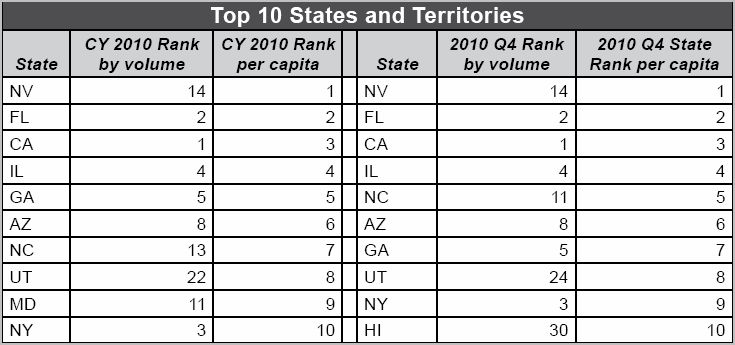
Nevada had the highest number of MLF SARs per capita in 2010, followed by Florida, California, Illinois, and Georgia.
The 5 MSAs with the highest per capita filings of MLF SARs in 2010 were Miami; Las Vegas; San Jose, CA; Riverside, CA; and Los Angeles.
The 5 counties with the highest number of MLF SARs per capita were Miami-Dade, Gwinnett in Georgia, Broward and Orange in Florida, and Nassau in New York.
SARs-TOP 10 (2010)
In both CY 2010 and 2010 Q4, California and Florida were the highest ranked states based on total numbers of subjects, followed by New York and Illinois. These four states consistently had the highest rankings every quarter of 2010.
For both the quarter and year, Nevada had the highest number of MLF subjects per capita, followed by Florida, California, and Illinois.
This was a change from 2010 Q3, when Florida was 1st in MLF subjects per capita and Nevada 3rd. In addition, Hawaii jumped in the Q4 rankings to 10th in MLF subjects per capita, up from 13th in Q3 and 26th in Q2.
Post Separator-2-LCG
"Other" Suspicious Activity
Nearly half of the filings involved debt elimination scams, while 13 percent included misrepresentation of income or employment.
Another 13 percent were for Social Security number misuse and 9 percent loan modification fraud.
Other-SARs (2010)
Post Separator-2-LCG
Visit Library
Law Library Image
FinCEN: Mortgage Loan Fraud Update
SARs from January 1, 2010 to December 31, 2010
Issued: March 28, 2011