CREATORS OF THE COMPLIANCE TUNE-UP®

AARMR | ABA | ACAMS | ALTA | ARMCP | IAPP | IIA | MBA | MERS® | MISMO | NAMB

Showing posts with label Mortgage Fraud Report. Show all posts

Friday, August 23, 2013

Mortgage Fraud: Data Confirms Spike in 2006-2007

The Financial Crimes Enforcement Network (FinCEN) has released an analysis of Mortgage Fraud SAR Filings in Calendar Year 2012. The report was issued on August 20, 2013. This publication updates FinCEN’s prior Mortgage Loan Fraud (MLF) assessments examines Suspicious Activity Report (SAR) filings from January through December 2012 (CY 2012).
The report provides new information on the volume of SAR filings, geographic locations of subjects, and other filing trends in CY 2012. Tables covering non-geographic aspects are compared with filings from corresponding periods in2011. A section provides updated statistics on foreclosure rescue-related SARs during 2012, and filers’ voluntary use of the new FinCEN SAR e-filing report for voluntary mortgage fraud reporting through March 31, 2013.
This article offers an outline of the FinCEN report. Please visit our Library to download it.

IN THIS ARTICLE
MLF SAR Filings by Year SAR Received, 2001-2012
Mortgage Loan Fraud (MLF) SARs
Time Elapsed from Activity Date to Reporting Date
Number of Mortgage Loan Fraud SAR Filings by Year
with and without the Term “Repurchase” in Narrative
Mortgage Loan Fraud SAR Subjects - Top 20 States and Territories
Foreclosure Rescue Scams
Number of Mortgage Loan Fraud SAR Filings by Year
with Term “Foreclosure Rescue” in Narrative, 2003-2012
__________________________________________________________________________

MLF SAR Filings by Year SAR Received, 2001-2012
Chart-1-MLFSAR-2001-2012

FinCEN’s data on suspected mortgage fraud shows that reports declined 25% in 2012  (from 92,561 to 69,277) as compared to the previous year. The past three years of suspected mortgage fraud suspicious activity reports (MLF SARs), if counted by the date they were received by FinCEN, accounted for approximately 46% of the past decade’s mortgage fraud SARs.
We take this to mean that filing increases or decreases are not necessarily indicative of overall increases or decreases in MLF activities over a bracketed period, as the volume of SAR filings in any given period does not directly correlate to the number or timing of suspected fraudulent incidents in that period.
However, one of the inherent features of mortgage fraud is that the suspicious activity associated with it is often only recognized and reported years after loan origination, after a review of origination documents is prompted by a loan default, repurchase demand, or other factors. As a result, many mortgage fraud SARs are filed much later than the date that the suspicious activity actually began. Thus, in 2012, 57% of SARs reported mortgage loan fraud (MLF) activities that started more than 5 years before the SAR was filed.

Thursday, August 23, 2012

Mortgage Fraud and SARs

On August 16, 2012, the Financial Crimes Enforcement Network (FinCEN) issued an Advisory to highlight activity related to mortgage loan fraud, especially as it pertains to Residential Mortgage Lenders and Originators (RMLOs). The issuance serves to further clarify suspicious financial activity that may require filing Suspicious Activity Reports (SARs).*

The issuance consolidates certain information from previously issued FinCEN reports, and contains examples of common fraud schemes and potential "red flags" for activity related to mortgage loan fraud.

This Advisory, which consolidates certain information from previously issued FinCEN reports, contains examples of common fraud schemes and potential Red Flags for activity related to mortgage loan fraud. Furthermore, the data gathered supports the efforts of the Financial Fraud Enforcement Task Force (FFETF), the Treasury's broader initiative to ensure that U.S. financial institutions are not used as conduits for illicit activity, as well as the OIG's mortgage fraud initiatives of FinCEN and the Department of Housing and Urban Development (HUD).

IN THIS ARTICLE

Types of Mortgage Loan Fraud
Possible Red Flags
Suspicious Activity Reporting
Contacting FinCEN
Library
____________________________________________________________
Types of Mortgage Loan Fraud

Based on the Advisory and previous mortgage fraud reports issued by FinCEN, the following list identifies certain types of mortgage loan fraud. These are primarily based upon schemes and scams frequently reported or described in SARs or identified by law enforcement authorities.

Occupancy Fraud
Occurs when borrowers, to obtain favorable loan terms, claim that subject properties will be their primary residences instead of vacation homes or investment properties. It also occurs when subjects apply for loans for properties that others, such as family members, will actually occupy.

Income Fraud
Includes both overstating income to qualify for larger mortgages and understating income to qualify for hardship concessions and modifications.

Appraisal Fraud
Includes both overstating home value to obtain more money from a sale of property or cash-out refinancing, and understating home value in connection with a plan to purchase a property at a discount to market value.

Employment Fraud
Includes misrepresenting whether, where, and for how long borrowers have been employed; whether borrowers are unemployed or collecting unemployment benefits; and whether borrowers are independent contractors or business owners.

Liability Fraud
Occurs when borrowers fail to list significant financial liabilities, such as other mortgages, car loans, or student loans, on mortgage loan applications. Without complete liability information, lenders cannot accurately assess borrowers' ability to repay debts.

Debt Elimination Schemes
Involves the use of fake legal documents and alternative payment methods to argue that existing mortgage obligations are invalid or illegal, or to purport to extinguish mortgage balances. Individuals orchestrating debt elimination schemes typically charge borrowers a fee for these debt elimination "services."

Foreclosure Rescue Scams
Targets financially distressed homeowners with fraudulent offers of services or advice aimed at stopping or delaying the foreclosure process. Some of these scams require homeowners to transfer title - or make monthly mortgage payments - to the purported "rescuer," rather than the real holder of the mortgage. Some foreclosure rescue scams require homeowners to pay fees before receiving "services," and are known as "advance fee" schemes.

Social Security Number (SSN) Fraud and Other Identify Theft
Includes the use of an SSN or other government identification card or number that belongs to someone other than the applicant in a loan application. Identity Theft includes broader use of another's identity or identifiers (beyond an SSN) to obtain a mortgage or perpetrate a "fraud for profit" scheme.

Thursday, September 29, 2011

Mortgage Fraud Report: Upward Trend

The Financial Crimes Enforcement Network (FinCEN) has reported in its Second Quarter 2011 Analysis of mortgage loan fraud suspicious activity reports (MLF SARs) that financial institutions filed 29,558 MLF SARs in the second quarter of 2011 up from 15,727 MLF SARs reported in the same quarter of 2010.
The report, issued on September 28, 2011, shows the continuation of the upward trend in mortgage fraud.
A large majority of the MLF SARs examined in the second quarter involved mortgages closed during the height of the real estate bubble.
In other words, these SARs are filed on activity that occurred more than two years ago. Many SARs are being filed because financial institutions are uncovering fraud as they sift through defaulted mortgages.
Upward Spike
The upward spike in second quarter MLF SAR numbers is directly attributable to mortgage repurchase demands and special filings generated by several institutions. Omitting these particular submissions, 2011 Q2 MLF SAR numbers would be down 3% from the prior year.
FinCEN noted that 81% of the MLF SARs filed during the quarter involved suspicious activities that occurred before 2008, and 63% involved suspicious activities that occurred four or more years ago. For both 2011 Q2 and 2010 Q2 filings, a majority of reported activities took place between 2006 and 2008.
The report contains a section on reported mortgage fraud activities 90 or fewer days old, with emphasis on so-called "debt elimination" scams, identity theft, Social Security Number (SSN) fraud, and false statements.
2011 Q2 Sample SAR Statistics
Suspicious Activities Described by Filers
Chart-MLF-2Q-2011-1
The FinCEN report shows the following areas of fraud:
  • Misrepresenting income, occupancy, debts assets
  • Debt elimination scams
  • Scams involving the fraudulent use of social security numbers
  • Identity theft
  • False statements and false documents
  • Fraud involving short sales and appraisals
  • Forged rescission of notice of default
  • Advance fee scams
  • Buy and bail schemes
  • Money laundering
Mortgage Loan Fraud SAR Filings
Relative to All SAR Filings
FinCEN-MLF-Update-Q2-2011-2
In 2011 Q2, filers submitted 29,558 Mortgage Loan Fraud SARs (MLF SARs), an 88% increase over the previous year.
The total number of all SARs filed in 2011 Q2 increased by 16%.
And 15% of all SARs filed in 2011 Q2 indicated MLF as an activity characterization, up from 9% in 2010 Q2.
Visit Library for Issuance
Law Library Image
FinCEN: Mortgage Loan Fraud Update
 
Suspicious Activity Report Filings  
In 2nd Quarter 2011
 
September 28, 2011

Wednesday, March 30, 2011

FinCEN: 2010 Mortgage Fraud Report

On March 28, 2011, FinCEN issued its Mortgage Loan Fraud Update (Report) for the period January 1, 2010 to December 31, 2010.
This update to FinCEN's prior Mortgage Loan Fraud (MLF) studies looks at Suspicious Activity Report (SAR) filings in CY 2010, with a particular emphasis on the 4th Quarter of CY 2010 (Q4). It provides new information on reporting activities, geographic locations, and other filing trends in Q4 and CY 2010. 
As in previous updates, this update also includes tables and illustrations of various geographies that compare Q4 and CY 2010 filings based on the dates on which the suspicious activities are reported to have begun.
A review of the full year data shows the number of suspicious activity reports (SARs) involving mortgage loan fraud (MLF) increased 4 percent in 2010 to 70,472 compared with 67,507 MLF SARs filed in 2009.
The report also shows that the growth rate of MLF SARs began to slow over the last two to three years. Looking at just the 2010 fourth quarter, filers submitted 18,759 MLF SARs, a 1 percent decrease from the 18,884 filings over the same period in 2009.
FinCEN also reported that all types of SARs filed by depository institutions in 2010 fell 3 percent to 697,389 compared with 720,309 SARs filed by depository institutions in 2009. 
However, the total number of SARs filed in 2010 by all types of financial institutions covered by the Bank Secrecy Act grew nearly 4 percent to 1.3 million SARs up from 1.9 million filed in 2009.
Post Separator-2-LCG
Trend
Since 2001, the number of MLF SARs filed has shown a consistent upward trend, albeit at a slower rate of growth in recent years.
Trend-SARs (2001-2010)
Post Separator-2-LCG
Bankruptcy
The Report found that references to bankruptcy have steadily increased over time in MLF SAR filings. In 2010, 6 percent of all MLF SARs contained a key term related to bankruptcy in the SAR narrative, compared to 1 percent in 2006 and 2007.
In 2010, mortgage loan fraud was cited in 54 percent of all SARs referencing bankruptcy fraud, up from 42 percent in 2009. Some MLF SARs specified the type of bankruptcy filing, most frequently Chapter 7, which was cited in 27 percent of 2010 reports citing both bankruptcy and MLF.
Post Separator-2-LCG
Flopping
Flopping occurs when a foreclosed property is sold at an artificially low price to a straw buyer, who quickly sells the property at a higher price and pockets the difference. Anecdotal feedback on this practice from law enforcement and industry sources suggests that the volume of related MLF SARs is much lower than the actual number of suspected flopping incidents. The increasingly dated activities reported on SARs suggests a lack of emphasis on this type of current activity.
Filers in their SARs also called attention to debt elimination scams as one of the emerging practices. 
Debt elimination scams were cited in nearly 1,300 MLF SARs in 2010. In these SARs, filers noted subjects sending a variety of documents or bogus payment methods to financial institutions, in attempts to eliminate or satisfy mortgage obligations. SAR filers over the course of 2010 explicitly referenced "flopping" in 112 SARs last year. This compares with relatively stable occurrences of suspicious activity involving broker price opinions and short sales in 2010.
Flopping-SARs (2010)-B
Post Separator-2-LCG
5 Highest MSAs Per Capita - MLF SAR Filings
The Report contains data of state, county, and metropolitan statistical area (MSA) by total number of and per capita filings of MLF SARs.
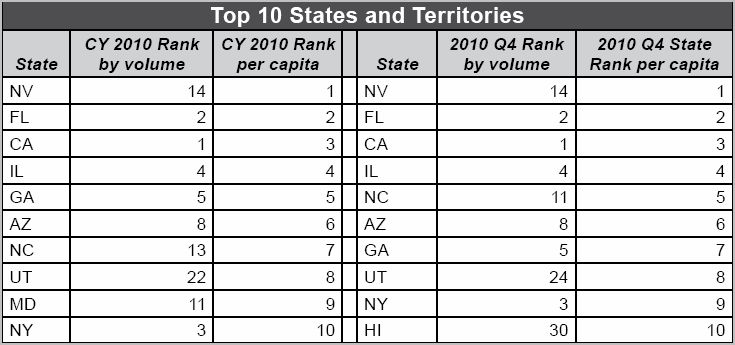
Nevada had the highest number of MLF SARs per capita in 2010, followed by Florida, California, Illinois, and Georgia.
The 5 MSAs with the highest per capita filings of MLF SARs in 2010 were Miami; Las Vegas; San Jose, CA; Riverside, CA; and Los Angeles.
The 5 counties with the highest number of MLF SARs per capita were Miami-Dade, Gwinnett in Georgia, Broward and Orange in Florida, and Nassau in New York.
SARs-TOP 10 (2010)
In both CY 2010 and 2010 Q4, California and Florida were the highest ranked states based on total numbers of subjects, followed by New York and Illinois. These four states consistently had the highest rankings every quarter of 2010.
For both the quarter and year, Nevada had the highest number of MLF subjects per capita, followed by Florida, California, and Illinois.
This was a change from 2010 Q3, when Florida was 1st in MLF subjects per capita and Nevada 3rd. In addition, Hawaii jumped in the Q4 rankings to 10th in MLF subjects per capita, up from 13th in Q3 and 26th in Q2.
Post Separator-2-LCG
"Other" Suspicious Activity
Nearly half of the filings involved debt elimination scams, while 13 percent included misrepresentation of income or employment.
Another 13 percent were for Social Security number misuse and 9 percent loan modification fraud.
Other-SARs (2010)
Post Separator-2-LCG
Visit Library
Law Library Image
FinCEN: Mortgage Loan Fraud Update
SARs from January 1, 2010 to December 31, 2010
Issued: March 28, 2011