CREATORS OF THE COMPLIANCE TUNE-UP®

AARMR | ABA | ACAMS | ALTA | ARMCP | IAPP | IIA | MBA | MERS® | MISMO | NAMB

Showing posts with label Suspicious Activity Reports. Show all posts

Friday, August 23, 2013

Mortgage Fraud: Data Confirms Spike in 2006-2007

The Financial Crimes Enforcement Network (FinCEN) has released an analysis of Mortgage Fraud SAR Filings in Calendar Year 2012. The report was issued on August 20, 2013. This publication updates FinCEN’s prior Mortgage Loan Fraud (MLF) assessments examines Suspicious Activity Report (SAR) filings from January through December 2012 (CY 2012).
The report provides new information on the volume of SAR filings, geographic locations of subjects, and other filing trends in CY 2012. Tables covering non-geographic aspects are compared with filings from corresponding periods in2011. A section provides updated statistics on foreclosure rescue-related SARs during 2012, and filers’ voluntary use of the new FinCEN SAR e-filing report for voluntary mortgage fraud reporting through March 31, 2013.
This article offers an outline of the FinCEN report. Please visit our Library to download it.

IN THIS ARTICLE
MLF SAR Filings by Year SAR Received, 2001-2012
Mortgage Loan Fraud (MLF) SARs
Time Elapsed from Activity Date to Reporting Date
Number of Mortgage Loan Fraud SAR Filings by Year
with and without the Term “Repurchase” in Narrative
Mortgage Loan Fraud SAR Subjects - Top 20 States and Territories
Foreclosure Rescue Scams
Number of Mortgage Loan Fraud SAR Filings by Year
with Term “Foreclosure Rescue” in Narrative, 2003-2012
__________________________________________________________________________

MLF SAR Filings by Year SAR Received, 2001-2012
Chart-1-MLFSAR-2001-2012

FinCEN’s data on suspected mortgage fraud shows that reports declined 25% in 2012  (from 92,561 to 69,277) as compared to the previous year. The past three years of suspected mortgage fraud suspicious activity reports (MLF SARs), if counted by the date they were received by FinCEN, accounted for approximately 46% of the past decade’s mortgage fraud SARs.
We take this to mean that filing increases or decreases are not necessarily indicative of overall increases or decreases in MLF activities over a bracketed period, as the volume of SAR filings in any given period does not directly correlate to the number or timing of suspected fraudulent incidents in that period.
However, one of the inherent features of mortgage fraud is that the suspicious activity associated with it is often only recognized and reported years after loan origination, after a review of origination documents is prompted by a loan default, repurchase demand, or other factors. As a result, many mortgage fraud SARs are filed much later than the date that the suspicious activity actually began. Thus, in 2012, 57% of SARs reported mortgage loan fraud (MLF) activities that started more than 5 years before the SAR was filed.

Wednesday, June 5, 2013

Anti-Money Laundering Program: Testing

I learned recently some rather extraordinary news: my firm is currently the only mortgage risk management firm in the country offering testing of a Residential Mortgage Lenders and Originator’s (RMLO’s) Anti-Money Laundering Program.* This situation struck me as exceedingly odd, inasmuch as testing is a statutory requirement.
Testing annually is recommended, but not later than every eighteen months. In this first year, most companies are testing prior to the Financial Crimes and Enforcement Network’s (FinCEN’s)statute’s anniversary date in August. An audit of the procedures detailed in an RMLO’s policy and procedures must be conducted either an internal auditor, in accordance with FinCEN guidelines, or, in accordance with FinCEN guidelines, by an independent external auditor.
How is it that we are the first mortgage risk management firm to offer the independent auditing requirement? Maybe, even at this late date, the industry itself is still trying to absorb the AML compliance implementation, while struggling to integrate a multitude of other new regulations.
Many residential mortgage industry participants have run the Elizabeth Kubler Ross spectrum of denial to acceptance at a pace that leaves in its wake the sentiments of high dudgeon, middling dudgeon, intermediate dudgeon, towering dudgeon, lofty dudgeon - and, finally, recognition that the tide of change is actually upon us!
I have tried to make it clear in previous articles, that the AML program is quite different than other policy statements and procedures!

For two of my analyses on this matter, read my articles entitled Anti-Money Laundering Program - Preparation is Protection (8/2012), or Anti-Money Laundering Debuts for Nonbank Mortgage Companies (3/2012).
Over the years, we have conducted AML audits for banks. Now we conduct them for nonbanks and their Suspicious Activity Report (SAR) filing compliance. Soon enough, I expect another cottage industry to arise, chock full of firms that will promote such external auditing, bringing about yet another feeding frenzy!
In this article, I will offer some of the basics to AML testing for RMLOs, so that you have a high-level set of bullets that may offer some insight into the audit process. There are many moving features to such an audit. In constructing your own procedures, be aware that the time to learn about how to properly test and report audit results is most certainly not during an examination.
_____________________________________________________
IN THIS ARTICLE
Elements of Testing
Internal or External Auditing
Library
_____________________________________________________
We recommend that an AML audit for RMLOs should contain, at the least, the following elements:
Entrance Interview
We require an entrance interview for all AML program audits. The meeting is held with company’s officials, compliance personnel, and support staff is conducted to (1) discuss the company’s lender profile, (2) specify procedures to be followed by the company in the course of the engagement, (3) answer any questions regarding the auditor’s evaluation process.
Audit responses to Prior Year Consulting and Regulatory Examination Reports (if applicable) We are in the first year of the AML program. However, each year afterward, the review will ask for the prior year's reports, including any regulatory reports. This part of the review cannot be side-stepped, because it acts as a baseline, further enhanced by an evaluation of corrective action responses. The reviewer's first actions may include back-testing to see if corrective actions were implemented. Any continuation of a compliance failure that previously was subject to corrective action should cause the review to mark down the results.
Issue and Review Document Request
Every audit must contain a document request. The extent that a company can comply with the document request is in itself a sign of the company's ability to implement the AML program's requirements. It is expected that a company will provide the documents needed promptly, in legible condition, and in their entirety. Failure to provide certain documents causes an adverse finding.
Conduct Anti-Money Laundering (AML) Risk Assessment
The review must go through a series of risk assessment analytics in order to determine that the company is fulfilling its AML program requirements. These series can be quite extensive, depending on the company's size, complexity, and risk profile.

Friday, May 17, 2013

FinCEN: Accountant and Elder Abuse

We have been keeping track of FinCEN's SAR Activity Review – Trends, Tips & Issues virtually from its inception.
In its just issued May 2013 report, FinCEN provides new information regarding two areas of importance:
1) The Suspicious Activity Report (SAR) filing patterns related to elder financial exploitation before and after the publication of FinCEN's Advisory to Financial Institutions on Filing Suspicious Activity Reports Regarding Elder Financial Exploitation ("Advisory"), in February 2011, and
2) An analysis of trends related to SAR filings involving accountants and involving insider abuse within depository institutions.
In this newsletter, I would like to provide you with some insights regarding each of these areas of concern reviewed in the FinCEN report, with a brief review of elder abuse trends and a much more extensive review of suspicious financial activity involving accountants.*
_______________________________________________________
Elder Abuse - Trends
Accountant Abuse - The Gatekeeper
Sampling the Data
Separating the Wheat from the Chaff
Accountants Abuse - Trends
Conclusion
Library
_______________________________________________________
Elder Abuse - Trends
A comparison of the filing rates pre- and post-advisory of SARs with narratives containing the two key search phrases “elder financial exploitation” and “elder financial abuse,” shows a very significant increase in relevant filings post-Advisory.
Between March 1, 2011, and August 31, 2012, filers submitted 7,651 total SARs, a 382 percent increase from the 12-month period prior to the release of the Advisory during which filers completed 1,589 relevant SARs. Post-Advisory filing trends showed continued increases in filing incidences. 
SARs generally reported patterns of financial exploitation perpetrated by a relative or caregiver against elderly victims. Narratives most frequently described the perpetrator coercing or cajoling the victim into completing financial transactions that benefited the perpetrator at the expense of the victim.
There are reported instances where the perpetrator reportedly abused a power of attorney over the victim’s account.
Furthermore, so-called "sweetheart scams" were on the rise. A “sweetheart scam” involves the fraudster feigning romantic intentions towards a victim, thus gaining the victim’s affection. The perpetrator then uses the goodwill engendered to defraud the victim. This fraud may impact the victim’s financial accounts and/or identity security, and may even cause the victim to unwittingly facilitate financial fraud against others on the perpetrator’s behalf.
An increased trend in elder financial abuse was noted in the 18 month period after the issuance of the Advisory. Depository Institutions filed 6,026 elder financial exploitation-related SARs in this period. FinCEN determined that institution filers identified “abuse by a relative or caregiver” as the most reported months post-Advisory.
Chart-A-SAR Review-5-2013
Monthly post-Advisory filing numbers indicate that filers continued to increase their submissions of SARs related to elder financial exploitation more than a year and a half after issuance of the Advisory. FinCEN reports that this trend suggests that many filers have incorporated FinCEN’s elder financial exploitation guidance into their AML monitoring programs. Sample narratives showed filers checked “Other” most often as the characterization of suspicious activity when describing suspicious transactions involving elderly customers.
Most narratives described the perpetrator engaged in identity theft, misuse of position or self-dealing, check kiting, counterfeit checks, or embezzlement/theft, to defraud elderly victims. Many SAR narratives revealed that filers were careful to assess suspicious transactions, often questioning an elderly customer if his transactions appeared out of character. These precautions usually spared the filer and the customer any significant losses.
_______________________________________________________

Thursday, February 14, 2013

Anti-Money Laundering–Red Flags and the SAR Narrative

Even though AML compliance for nonbanks has been in effect since August 13, 2012, many Residential Mortgage Lenders and Originators (RMLO) still seem to have considerable difficulty in two specific areas: how to determine when a Suspicious Activity Report (SAR) should be filed, and which suspicious activity events or features may trigger the SAR filing requirement.
In one article, entitled Anti-Money Laundering Debuts for Nonbanks, I unpack the AML Program in a way that will provides some familiarity with the AML Compliance scope, while perhaps also making its implementation a bit less daunting than it might otherwise seem to be.
In another article, entitled Anti-Money Laundering Program: Preparation is Protection, I outlined many of the so-called Red Flags and other triggering events. In addition, I offered a way to construct a SAR narrative - the description to FinCEN about the alleged suspicious activity - that, based on years of experience auditing and implement AML compliance on behalf of our clients, best meets FinCEN's expectations of an informative statement.
To give you an idea of the size and complexity of a well-constructed AML Program, my firm’s AML Program is well over fifty pages – which consists of a policy statement and numerous appendices for applicable procedures. This should give you some idea of the depth and detail needed for properly implementing AML compliance. The absence of or any inaccuracies in required program components may indicate a defective policy and procedures – the very tools needed to assist in detecting and preventing money laundering or other illegal activities conducted through mortgage banking conduits.
So, a word of caution is due: do not take the chance of buying an abbreviated or defective AML Program, in the hope of merely satisfying the “basic” FinCEN requirements. Obtaining a boilerplate document with your company’s name on it is regressive, and it is a tactic that Examiners are now regularly criticizing in adverse findings.
These days, regulators are fully aware of this ‘short cut’ to compliance. An insufficient AML Program may cause adverse examination findings. Indeed, in some cases, template-driven policy and procedures may cause Examiners to escalate their regulatory review of an RMLO’s anti-money laundering implementation.
AML compliance is a specialized area of mortgage compliance, necessitating genuine, practical, hands-on, regulatory compliance and experiential knowledge, and an AML Program must reflect precise policies and procedures that not only implement the SAR regulations but also conform to a company’s way of doing business.
Therefore, an AML Program is one policy statement and set of procedures where the purchase price should not be an operative consideration. Caveat Emptor!
This is why I want to further outline the descriptive process of completing the SAR narrative, emphasizing a simple method I call The 5 W's and the How, and I will also provide details regarding both so-called Red Flags and triggering events. So, even if a company has a skimpy or defective AML policy and procedures, at least those who implement AML Compliance may be offered some rudimentary guidelines to consider in the practical experience of actually filing a SAR.
_________________________________________________________
IN THIS ARTICLE
The 5 W's and the How
Triggering Events
Documentation Red Flags
Applicant Red Flags
RMLO's Employee Red Flags
Library Resources
_________________________________________________________
The 5 W's and the How
If I were to choose the central feature of the SAR, I would select the SAR narrative.
Each SAR requires a narrative to be provided by the SAR filer.
Over time, my firm has compiled numerous examples of common patterns of suspicious activities from our audit and due diligence reviews. Based on our experience and FinCEN’s own stated guidance, we believe that there are five interrogative categories to be considered when writing a SAR narrative: who? what? when? where? and why?

Monday, November 5, 2012

FinCEN: SAR Narrative, PowerPoint, and Mortgage Loan Fraud

On September 18, 2012 FinCEN held an Informational Webinar regarding the new FinCEN Suspicious Activity Report (SAR).
The corresponding, full PowerPoint presentation of the recorded version of this Webinar is available HERE.
For those interested in actually viewing the Webinar, HERE is the link to the FinCEN webpage.
Recently, FinCEN issued two important reports (available in our Library): 
- SAR Activity Review – Trends, Tips & Issues (Issue 22)
- Mortgage Loan Fraud Update - Suspicious Activity Report Filings in 2nd Quarter 2012 
The first report offers significant insight and guidance in monitoring suspicious activity, and the second report provides important insights regarding SAR filings related to mortgage loan fraud. For years we have worked with our bank clients on auditing their SAR filings and AML compliance, and I can vouch for the practical advantages of reading these on-going FinCEN reports to enhance your risk management responsibilities.
_____________________________________________________
IN THIS ARTICLE
SAR Narrative: "5 W's and the How"
Mortgage Loan Fraud - Statistics and Charts
Foreclosure Rescue Scams on the Rise
California: Highest 2012-Q2 Foreclosure Rescue SARs
_____________________________________________________
SAR Narrative: "5 W's and the How"
In the recent SAR Activity Review, sections are provided that outline the basic aspects toward filing a SAR. In particular, the section  on writing an effective SAR Narrative is important to consider.
FinCEN rightly states that the narrative "is a critical part of the SAR because it is where the filer can summarize and provide a more  detailed description of the activity being reported." For that reason, it is essential that the narrative be clear, complete and thorough.
This section of the FinCEN report offers the "5 W's" that I have written about extensively as a way to develop the SAR narrative. (See, for instance, my magazine article, Anti-Money Laundering Program - Preparation is Protection, August 2012.)
Our clients have learned  how to use this narrative method. The FinCEN report does not mention the "How" narrative that I have advocated - and which I will discuss below. In my view, the Anti-Money Laundering Program should have an appendix devoted exclusively to the SAR Narrative procedures, especially outlining  the "5 W's and the How" method of writing it.
The narrative must be clear, complete and thorough and the method I advocate is an effective means toward accomplishing these  goals.
FinCEN's outline is rather brief, so I will provide a much more extensive set of action steps for you to follow.
The following are the "5 W's" method provided by FinCEN, after which I will add some remarks about narrating the "How".
Who is conducting the suspicious activity?
While one section of the SAR form calls for specific suspect information, the narrative should be used to further describe the suspect or suspects, including occupation, position or title within the business, and the nature of the suspect’s business(es). If more than one individual or business is involved in the suspicious activity, identify all suspects and any known relationships amongst them in the Narrative Section.
While detailed suspect information may not always be available (i.e., in situations involving non-account holders), such information should be included to the maximum extent possible. Addresses for suspects are important: filing institutions should note not only the suspect’s primary street addresses, but also, other known addresses, including any post office box numbers and apartment numbers when applicable. Any identification numbers associated with the suspect(s) other than those provided earlier are also beneficial, such as passport, alien registration, and driver’s license numbers.
What instruments or mechanisms are being used to facilitate the suspect transaction(s)?
An illustrative list of instruments or mechanisms that may be used in suspicious activity includes, but is not limited to, wire transfers, letters of credit and other trade instruments, correspondent accounts, casinos, structuring, shell companies, bonds/notes, stocks, mutual funds, insurance policies, travelers checks, bank drafts, money orders, credit/debit cards, stored value cards, and/or digital currency business services. Specific suspect identifying information is provided in the relevant Suspicious Activity Report for RMLO filings.
In addition, a number of different methods may be employed for initiating the negotiation of funds such as the Internet, phone access, mail, night deposit box, remote dial-up, couriers, or others. In summarizing the flow of funds, always include the source of the funds (origination) that lead to the application for, or recipient use of, the funds (as beneficiary).
In documenting the movement of funds, identify all account numbers at the financial institution affected by the suspicious activity and when possible, provide any account numbers held at other institutions and the names/locations of the other financial institutions, including MSBs and foreign institutions involved in the reported activity.
When did the suspicious activity take place?
If the activity takes place over a period of time, indicate the date when the suspicious activity was first noticed and describe the duration of the activity. Filers will often provide a tabular presentation of the suspicious account activities (transactions in and out).
While this information is useful and should be retained, do not insert objects, tables, or pre-formatted spreadsheets when filing a SAR.
These items may not convert properly when keyed in or merged into the SAR System. Also, in order to better track the flow of funds, individual dates and amounts of transactions should be included in the narrative rather than just the aggregated amount.

Thursday, August 23, 2012

Mortgage Fraud and SARs

On August 16, 2012, the Financial Crimes Enforcement Network (FinCEN) issued an Advisory to highlight activity related to mortgage loan fraud, especially as it pertains to Residential Mortgage Lenders and Originators (RMLOs). The issuance serves to further clarify suspicious financial activity that may require filing Suspicious Activity Reports (SARs).*

The issuance consolidates certain information from previously issued FinCEN reports, and contains examples of common fraud schemes and potential "red flags" for activity related to mortgage loan fraud.

This Advisory, which consolidates certain information from previously issued FinCEN reports, contains examples of common fraud schemes and potential Red Flags for activity related to mortgage loan fraud. Furthermore, the data gathered supports the efforts of the Financial Fraud Enforcement Task Force (FFETF), the Treasury's broader initiative to ensure that U.S. financial institutions are not used as conduits for illicit activity, as well as the OIG's mortgage fraud initiatives of FinCEN and the Department of Housing and Urban Development (HUD).

IN THIS ARTICLE

Types of Mortgage Loan Fraud
Possible Red Flags
Suspicious Activity Reporting
Contacting FinCEN
Library
____________________________________________________________
Types of Mortgage Loan Fraud

Based on the Advisory and previous mortgage fraud reports issued by FinCEN, the following list identifies certain types of mortgage loan fraud. These are primarily based upon schemes and scams frequently reported or described in SARs or identified by law enforcement authorities.

Occupancy Fraud
Occurs when borrowers, to obtain favorable loan terms, claim that subject properties will be their primary residences instead of vacation homes or investment properties. It also occurs when subjects apply for loans for properties that others, such as family members, will actually occupy.

Income Fraud
Includes both overstating income to qualify for larger mortgages and understating income to qualify for hardship concessions and modifications.

Appraisal Fraud
Includes both overstating home value to obtain more money from a sale of property or cash-out refinancing, and understating home value in connection with a plan to purchase a property at a discount to market value.

Employment Fraud
Includes misrepresenting whether, where, and for how long borrowers have been employed; whether borrowers are unemployed or collecting unemployment benefits; and whether borrowers are independent contractors or business owners.

Liability Fraud
Occurs when borrowers fail to list significant financial liabilities, such as other mortgages, car loans, or student loans, on mortgage loan applications. Without complete liability information, lenders cannot accurately assess borrowers' ability to repay debts.

Debt Elimination Schemes
Involves the use of fake legal documents and alternative payment methods to argue that existing mortgage obligations are invalid or illegal, or to purport to extinguish mortgage balances. Individuals orchestrating debt elimination schemes typically charge borrowers a fee for these debt elimination "services."

Foreclosure Rescue Scams
Targets financially distressed homeowners with fraudulent offers of services or advice aimed at stopping or delaying the foreclosure process. Some of these scams require homeowners to transfer title - or make monthly mortgage payments - to the purported "rescuer," rather than the real holder of the mortgage. Some foreclosure rescue scams require homeowners to pay fees before receiving "services," and are known as "advance fee" schemes.

Social Security Number (SSN) Fraud and Other Identify Theft
Includes the use of an SSN or other government identification card or number that belongs to someone other than the applicant in a loan application. Identity Theft includes broader use of another's identity or identifiers (beyond an SSN) to obtain a mortgage or perpetrate a "fraud for profit" scheme.

Thursday, August 16, 2012

Anti-Money Laundering Program–Preparation is Protection

The Financial Crimes Enforcement Network (FinCEN), a bureau of the Department of the Treasury, recently finalized regulations (Final Rule) requiring non-bank Residential Mortgage Lenders and Originators (RMLOs) to establish an Anti-Money Laundering Program (AML Program) and file Suspicious Activity Reports (SARs), as FinCEN requires of other types of financial institutions.[i]

FinCEN issued these regulations defining non-bank residential mortgage lenders and originators as loan or finance companies for the purpose of requiring them to establish AML Programs and report suspicious activities under the Bank Secrecy Act (BSA).

The effective compliance date for the Final Rule is August 13, 2012.[ii]

For additional background information, this article may be read in conjunction with my March 2012 article in this publication, entitled Anti-Money Laundering Debuts for Nonbanks.[iii]

FinCEN may impose civil monetary penalties for non-compliance with its regulations, including a penalty for each suspicious activity reporting violation, so compliance with the SAR regulations should be considered mandatory on the part of responsible management.[iv]

BSA authorizes the Treasury to issue regulations requiring financial institutions, including any “loan or finance company” to keep records and file reports that are deemed to have “a high degree of usefulness in criminal, tax, or regulatory investigations or proceedings, or in the conduct of intelligence or counterintelligence activities, including analysis, to protect against international terrorism.”

In the supplementary information to the Final Rule, the term loan or finance company “can reasonably be construed to extend to any business entity that makes loans to or finances purchases on behalf of consumers and businesses. Some loan and finance companies extend personal loans and loans secured by real estate, mortgages and deeds of trust, including home equity loans.”

The following constitutes these categorical definitions recognized by FinCEN:

Loan or Finance Company – A person engaged in activities that take place wholly or in substantial part within the United States in one or more of the capacities listed below, whether or not on a regular basis or as an organized business concern. This includes but is not limited to maintenance of any agent, agency, branch or office within the United States. The term “loan or finance company” shall include a sole proprietor acting as a loan or finance company, and shall not include: a bank, a person registered with and functionally regulated or examined by the SEC or the CFTC, any GSE regulated by the FHFA, any federal or state agency or authority administering mortgage or housing assistance, fraud prevention or foreclosure prevention programs, or an individual employed by a loan or finance company or financial institution. A loan or finance company is not a financial institution as defined in these regulations.

Residential Mortgage Lender – The person to whom the debt arising from a residential mortgage loan is initially payable on the face of the evidence of indebtedness or, if there is no such evidence of indebtedness, by agreement, or to whom the obligation is initially assigned at or immediately after settlement. The term “residential mortgage lender” shall not include an individual who finances the sale of the individual’s own dwelling or real property.

Residential Mortgage Originator – The person accepting a residential mortgage loan application, or offers or negotiates terms of a residential mortgage loan.

Residential Mortgage Loan – The loan that is secured by a mortgage, deed of trust or other equivalent consensual security interest on:

· A residential structure that contains 1-4 units, including (if used as a residence) an individual condominium unit, cooperative unit, mobile home or trailer; or
· Residential real estate upon which such a structure is constructed or intended to be constructed.

FinCEN interprets the term “loan or finance company” under the BSA to include any non-bank residential mortgage lenders and originators (i.e., “mortgage companies,” mortgage bankers or lenders,” and “mortgage brokers”) in the residential mortgage business sector.

In this article, I will provide a brief overview of but a few of the many salient features that should be expected in every AML Program.* To give you an idea of the size and complexity of a well-constructed AML Program, my firm’s AML Program is well over fifty pages – which consists of a policy statement and numerous appendices for applicable procedures. This should give you some idea of the depth and detail needed for properly implementing AML compliance. The absence of or any inaccuracies in required program components may indicate a defective policy and procedures – the very tools needed to assist in detecting and preventing money laundering or other illegal activities conducted through mortgage banking conduits.

Thursday, May 10, 2012

The SAR catches a RAT

Can a SAR catch a RAT?
In its just released review of Suspicious Activity Report (SAR) trends, tips, and issues, FinCEN included a brief, but illustrative statement about how a SAR filing eventually led to an indictment obtained in a "Cash Back" Mortgage Fraud Scheme.
It is interesting to take note of this example of how proper application of FinCEN's Anti-Money Laundering requirements for residential mortgage lenders and originators may lead to reducing mortgage fraud.
Let's look at some good compliance and investigative work and find out how the SAR caught a RAT.*
________________________________
IN THIS ARTICLE
Smelling a RAT
The Scheme
The Mark
SARs to the Rescue
Bilking a Bank
________________________________
Smelling a RAT
The case had its origins in a review of SARs conducted by a specialized mortgage fraud task force. The task force then launched an investigation that led to charges against two individuals.
The defendants were charged with engaging in a scheme to defraud mortgage lenders in connection with residential real property purchases.
Not only was the SAR a critical component of uncovering the perpetrators, but also a would-be filed Currency Transaction Report (CTR) on one of the individuals further caused concern, triggering yet another SAR filing, because in addition to the SAR that initiated the case, the second SAR reported how the defendant became "very upset" when he learned that a CTR would be filed because of a series of transactions.
The Scheme
Here's how the scheme worked:
(1) One of the defendants acted as the recruiter, finding various individuals, including straw and nominal purchasers, to purchase more than 15 residential real estate properties.
(2) The recruiter orchestrated the purchase transactions while the second defendant, a mortgage broker, brokered the mortgage loans through his mortgage company.
(3) Although the buyers provided the mortgage broker with legitimate personal information, this defendant made false representations on the loan applications in regard to income, employment, and intent to occupy the residences.
The Mark
But there's more.
The criminal complaint described in detail the defendants' efforts to defraud lenders through the straw buyers, including controlling all aspects of the purchases and the accounts.
The indictment in the case charged that fraudulent or false representations were made in obtaining 100% mortgage financing, including misstatements about the purchasers' monthly income, intent to occupy the property, and existing liabilities.
In each transaction, the purchase price was above (!) the true market price of the property.
An amount approximately equal to the difference between the purchase price and the true market price was then diverted as "cash back" at the close of each escrow to a bank account for a corporation.
SARs to the Rescue
As part of the scheme, these credits, which ranged from almost $42,000 to more than $137,000, were concealed from the mortgage lenders by the mortgage broker.
The mortgage broker, through his control over the corporation's bank account, used the fraudulently obtained funds for various purposes, including extensive cash withdrawals.
The SARs uncovered the perpetrators, as follows:
(1) A SAR review team identified a SAR filed on an associate of one of the defendants.
(2) Because the SAR listed mortgage loan fraud as the suspected violation type, the team referred the SAR to a mortgage fraud task force. The filer noted that the associate apparently misrepresented information on loan applications that were not performing. Also noted was the fact that the second defendant had acted as the loan agent and broker of record on the loans.
(3) Through research, the institution found that the associate had purchased several additional properties, with mortgage loans that totaled at least $450,000 for each purchase. The same title company closed all sales involved in the fraud.
(4) Eventually investigators found several additional SARs, including one with a nine page narrative describing activity on more than 17 individuals and businesses associated with the scheme.
(5) Investigators included many of the details described in the SARs in a criminal complaint and in the indictment charging both defendants with fraud.
Bilking a Bank
The losses caused by the defendants' conduct exceeded $2,500,000.
The defendants pleaded guilty to mail fraud and structuring currency transactions with a financial institution to evade the filing of CTRs.
________________________________
* Jonathan Foxx is the President & Managing Director of Lenders Compliance Group

Tuesday, March 13, 2012

Anti-Money Laundering Debuts for Nonbank Mortgage Companies

A new era in filing requirements is about to begin.* For the first time, the Financial Crimes Enforcement Network, known as “FinCEN,” will require nonbank mortgage lenders and originators to implement an Anti-Money Laundering program (“AML Program”) and file Suspicious Activity Reports (“SARs”) for certain loan transactions.[i] FinCEN is establishing this AML program in accordance with the Bank Secrecy Act (“BSA”).[ii] The guidelines relating to the AML requirement become effective on April 16, 2012, and the AML Program’s effective compliance date is August 13, 2012.[iii] The AML program and SAR filing regulations, which I will refer to as “FinCEN’s rule,” are considered to be “the first step in an incremental approach to implementation of regulations for the broad loan or finance company category of financial institutions.”[iv]
The Bank Secrecy Act defines the term "financial institution" to include, in part, a loan or finance company. This terminology, however, can reasonably be construed to extend to any business entity that makes loans to or finances purchases on behalf of consumers and businesses. Thus, nonbank residential mortgage lenders and originators, and mortgage brokers, are grouped into the "loan or finance company" category.[v] However, the term ‘‘loan or finance company’’ is actually not concisely defined in any FinCEN regulation, and there is no legislative history on the term itself. Nevertheless, FinCEN is applying this term to extend to any business entity that makes loans to or finances purchases on behalf of consumers and businesses. [vi] Therefore, residential mortgage lenders and originators (“RMLOs”) are covered by the scope of the ‘‘loan or finance company’’ term. I will use the acronym “RMLO” in this article, inasmuch as my principal focus herein relates to residential mortgage lenders and originators.
FinCEN can issue regulations requiring financial institutions to keep records and file reports that are determined to have a high degree of usefulness in criminal, tax, or regulatory investigations or proceedings, or in the conduct of intelligence or counterintelligence activities, including analysis, to protect against international terrorism. Federally regulated depository institutions have been required to have AML Programs,[vii] and now, as of the aforementioned effective compliance date, RMLOs must also comply with FinCEN’s regulations relating to implementing an AML Program and the filing of SARs.
Over the last few years,[viii] FinCEN has issued studies and analyses that used SARs to discover suspected mortgage fraud and money laundering that involved both banks and residential mortgage lenders and originators.[ix] According to FinCEN, these reports “underscore[d] the potential benefits of AML and SAR regulations for a variety of businesses in the primary and secondary residential mortgage markets.”[x]
Residential mortgage lenders and originators, the RMLOs, are considered to be the primary providers of mortgage finance, and have a unique position with respect to direct contact with the consumer. Thus, they are presumably able to assess and identify money laundering risks and fraud.[xi] At this time, FinCEN is not proposing a definition of “loan or finance company’’ that would encompass other types of consumer or commercial finance companies, or real estate agents and other entities involved in real estate closings and settlements.
In this article, I am going to unpack the AML Program for you in a way that will give you some familiarity with its scope, while perhaps also making its implementation a bit less daunting than it might otherwise seem to be. Nevertheless, many RMLOs will find that setting up the AML Program will be a challenging endeavor. Information, issuances, and relevant documentation are available in the FinCEN section of my firm’s website Library.
Please keep in mind that, as is the case with many applications of legal and regulatory compliance, there are aspects and nuances that will require recourse to a competent risk management professional to obtain comprehensive guidance and reliable information.[xii]
AML Program
Residential mortgage lenders and originators, the RMLOs, are required to establish an AML Program that includes, at a minimum:
(1) Development of internal policies, procedures, and controls.
(2) Designation of a compliance officer.
(3) Ongoing employee training program.
(4) Independent audit function to test for compliance.
To effectuate the AML Program, FinCEN has given a definition of an RMLO that is broad in scope and covers most nonbank residential mortgage originators.
The AML Program covers any business that, on behalf of one or more lenders, accepts a completed mortgage loan application, even if the business does not in any manner engage in negotiating the terms of a loan. Also covered are businesses that offer or negotiate specific loan terms on behalf of either a lender or borrower, regardless of whether they also accept a mortgage loan application.
Note that the word “accept” is intended to differentiate the FinCEN rule from the SAFE Act. FinCEN is ensuring that persons who either accept an application or offer or negotiate the terms of a loan are covered. Furthermore, the AML rule applies to residential mortgage originators, regardless of whether they receive compensation or gain for acting in that capacity.

Wednesday, March 30, 2011

FinCEN: 2010 Mortgage Fraud Report

On March 28, 2011, FinCEN issued its Mortgage Loan Fraud Update (Report) for the period January 1, 2010 to December 31, 2010.
This update to FinCEN's prior Mortgage Loan Fraud (MLF) studies looks at Suspicious Activity Report (SAR) filings in CY 2010, with a particular emphasis on the 4th Quarter of CY 2010 (Q4). It provides new information on reporting activities, geographic locations, and other filing trends in Q4 and CY 2010. 
As in previous updates, this update also includes tables and illustrations of various geographies that compare Q4 and CY 2010 filings based on the dates on which the suspicious activities are reported to have begun.
A review of the full year data shows the number of suspicious activity reports (SARs) involving mortgage loan fraud (MLF) increased 4 percent in 2010 to 70,472 compared with 67,507 MLF SARs filed in 2009.
The report also shows that the growth rate of MLF SARs began to slow over the last two to three years. Looking at just the 2010 fourth quarter, filers submitted 18,759 MLF SARs, a 1 percent decrease from the 18,884 filings over the same period in 2009.
FinCEN also reported that all types of SARs filed by depository institutions in 2010 fell 3 percent to 697,389 compared with 720,309 SARs filed by depository institutions in 2009. 
However, the total number of SARs filed in 2010 by all types of financial institutions covered by the Bank Secrecy Act grew nearly 4 percent to 1.3 million SARs up from 1.9 million filed in 2009.
Post Separator-2-LCG
Trend
Since 2001, the number of MLF SARs filed has shown a consistent upward trend, albeit at a slower rate of growth in recent years.
Trend-SARs (2001-2010)
Post Separator-2-LCG
Bankruptcy
The Report found that references to bankruptcy have steadily increased over time in MLF SAR filings. In 2010, 6 percent of all MLF SARs contained a key term related to bankruptcy in the SAR narrative, compared to 1 percent in 2006 and 2007.
In 2010, mortgage loan fraud was cited in 54 percent of all SARs referencing bankruptcy fraud, up from 42 percent in 2009. Some MLF SARs specified the type of bankruptcy filing, most frequently Chapter 7, which was cited in 27 percent of 2010 reports citing both bankruptcy and MLF.
Post Separator-2-LCG
Flopping
Flopping occurs when a foreclosed property is sold at an artificially low price to a straw buyer, who quickly sells the property at a higher price and pockets the difference. Anecdotal feedback on this practice from law enforcement and industry sources suggests that the volume of related MLF SARs is much lower than the actual number of suspected flopping incidents. The increasingly dated activities reported on SARs suggests a lack of emphasis on this type of current activity.
Filers in their SARs also called attention to debt elimination scams as one of the emerging practices. 
Debt elimination scams were cited in nearly 1,300 MLF SARs in 2010. In these SARs, filers noted subjects sending a variety of documents or bogus payment methods to financial institutions, in attempts to eliminate or satisfy mortgage obligations. SAR filers over the course of 2010 explicitly referenced "flopping" in 112 SARs last year. This compares with relatively stable occurrences of suspicious activity involving broker price opinions and short sales in 2010.
Flopping-SARs (2010)-B
Post Separator-2-LCG
5 Highest MSAs Per Capita - MLF SAR Filings
The Report contains data of state, county, and metropolitan statistical area (MSA) by total number of and per capita filings of MLF SARs.
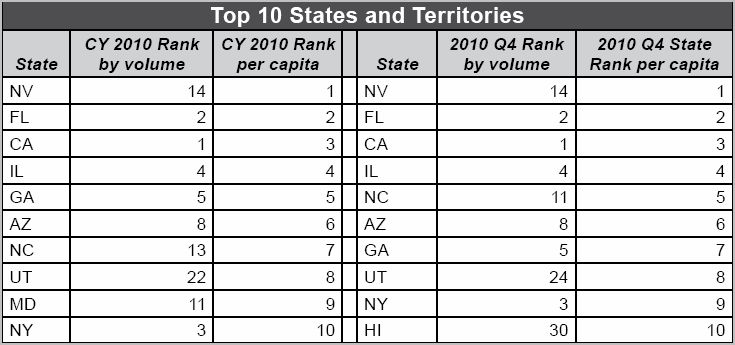
Nevada had the highest number of MLF SARs per capita in 2010, followed by Florida, California, Illinois, and Georgia.
The 5 MSAs with the highest per capita filings of MLF SARs in 2010 were Miami; Las Vegas; San Jose, CA; Riverside, CA; and Los Angeles.
The 5 counties with the highest number of MLF SARs per capita were Miami-Dade, Gwinnett in Georgia, Broward and Orange in Florida, and Nassau in New York.
SARs-TOP 10 (2010)
In both CY 2010 and 2010 Q4, California and Florida were the highest ranked states based on total numbers of subjects, followed by New York and Illinois. These four states consistently had the highest rankings every quarter of 2010.
For both the quarter and year, Nevada had the highest number of MLF subjects per capita, followed by Florida, California, and Illinois.
This was a change from 2010 Q3, when Florida was 1st in MLF subjects per capita and Nevada 3rd. In addition, Hawaii jumped in the Q4 rankings to 10th in MLF subjects per capita, up from 13th in Q3 and 26th in Q2.
Post Separator-2-LCG
"Other" Suspicious Activity
Nearly half of the filings involved debt elimination scams, while 13 percent included misrepresentation of income or employment.
Another 13 percent were for Social Security number misuse and 9 percent loan modification fraud.
Other-SARs (2010)
Post Separator-2-LCG
Visit Library
Law Library Image
FinCEN: Mortgage Loan Fraud Update
SARs from January 1, 2010 to December 31, 2010
Issued: March 28, 2011

Wednesday, December 15, 2010

FinCEN: 7% Increase in Mortgage Fraud

On December 14, 2010, the Financial Crimes Enforcement Network (FinCEN) released two mortgage fraud reports entitled Mortgage Loan Fraud SAR Filings, which together cover the first six months of 2010.

One report covers January through March 2010, and the other covers April through June 2010.

For previous announcements on this subject, please visit the Compliance ALERTS section of our Archive.

Taken together the reports show that suspicious activity reports (SARs) indicating mortgage loan fraud (MLF) climbed 7%, rising to 35,135 in the first half of 2010 compared with 32,926 in the first half of 2009.

In part, the increase is being attributed to increased attention to older loans spurred by repurchase demands.

In the first quarter of 2010, 78% of reported activities occurred more than two years prior to filing, compared with 44% in the same period of 2009, showing a continued focus on loans originated from 2006 to 2008.

Line-Webpage

First Quarter

FinCEN-SAR Filings-1Q-2010

Line-Webpage

Second Quarter

FinCEN-SAR Filings-2Q-2010

Line-Webpage

Key Findings

References to bankruptcy in SARs have steadily increased, rising to 7% of MLF SAR filings in 2010, compared to 1% in 2006 and 2007.

SAR reports referencing "short sale" and "broker price opinion" appeared 827 times and 41 times in SARs respectively during the first quarter of 2010. (Short sales and broker price opinions mentioned in SARs are sometimes associated with a particular type of flipping scheme known as "flopping." Flopping occurs when a foreclosed property is sold at an artificially low price to a straw buyer, who quickly sells the property at a higher price and pockets the difference.)

Line-Webpage

Visit Library for Issuances

Law Library Image
FinCEN: Suspicious Activity Report Filings from January 1-March 31, 2010, Mortgage Loan Fraud Update, December 2010
FinCEN: Suspicious Activity Report Filings from April 1-June 30, 2010, Mortgage Loan Fraud Update, December 2010

Line-Webpage

LENDERS COMPLIANCE GROUP is the first full-service, mortgage risk management firm in the country, specializing exclusively in mortgage compliance and offering a full suite of hands-on and automated services in residential mortgage banking.

Tuesday, December 7, 2010

FinCEN: Proposes Non-Bank Lenders File SARs

On December 6, 2010, the Financial Crimes Enforcement Network (FinCEN) proposed a requirement that non-bank residential mortgage lenders and originators, just like other types of financial institutions, establish anti-money laundering (AML) programs and comply with suspicious activity report (SAR) regulations. The requirements are provided in a Notice of Proposed Rulemaking.

The Bank Secrecy Act (BSA) authorizes the Treasury to issue regulations requiring financial institutions to keep records and file reports that the Secretary determines "have a high degree of usefulness in criminal, tax, or regulatory investigations or proceedings, or in the conduct of intelligence or counterintelligence activities, including analysis, to protect against international terrorism." The subject proposed rulemaking regarding residential mortgage lenders is derived from that authority.

At this time, the only mortgage originators that are required to file SARs are banks and insured depository institutions.

According to FinCEN, analyses of SARs in FinCEN's mortgage fraud reports show that non-bank mortgage lenders and originators initiated many of the mortgages that were associated with SAR filings.

The Notice of Proposed Rulemaking intends to provide prevention of mortgage fraud, including such activities as false statement, use of straw buyers, fraudulent flipping, and even identity theft associated with mortgage borrowing. These illegal activities, and others, have been identified in information provided by SARs.

This Notice of Proposed Rulemaking was informed by comments received following an Advanced Notice of Proposed Rulemaking (ANPRM) issued last year on July 21, 2009.
Comments: Due 30 days after publication in the Federal Register.

Lenders Compliance Group provides a robust and comprehensive risk assessment for auditing SARs. If you would like to prepare for the SARs filing requirements and/or provide independent testing and monitoring for compliance, please contact us.

Line-Webpage

Minimum Requirements

(1) Policies and Procedures: incorporate policies, procedures, and internal controls based upon the loan or finance company's assessment of the money laundering and terrorist financing risks associated with its products and services.
Policies, procedures, and internal controls must:

(i) Include provisions for complying with the applicable requirements of Subchapter II of Chapter 53 of Title 31, United States Code ("Records and Reports on Monetary Instruments Transactions"),

(ii) Integrate the company's agents and brokers into its anti-money laundering program, and

(iii) Obtain all relevant customer-related information necessary for an effective anti-money laundering program.

(2) Compliance Officer: designate a compliance officer who will be responsible for ensuring that:

(i) The anti-money laundering program is implemented effectively, including monitoring compliance by the company's agents and brokers with their obligations under the program;

(ii) The anti-money laundering program is updated as necessary; and

(iii) Appropriate persons are educated and trained.

(3) Training: provide for on-going training of appropriate persons concerning their responsibilities under the program.
A loan or finance company may satisfy this requirement with respect to its employees, agents, and brokers by:

(i) Directly training such persons or

(ii) Verifying that such persons have received training by a competent third party with respect to the products and services offered by the loan or finance company.

(4) Independent Testing: provide for independent testing to monitor and maintain an adequate program, including:

(i) Testing to determine compliance of the company's agents and brokers with their obligations under the program.

(ii) Determining that the scope and frequency of the testing is commensurate with the risks posed by the company's products and services.

NOTE: Such testing may be conducted by a third party or by any officer or employee of the loan or finance company.

(5) Compliance: compliance is subject to examination by FinCEN or its delegates, under the terms of the Bank Secrecy Act. Failure to comply with the requirements may constitute a violation of the Bank Secrecy Act.

(6) Effective date: an anti-money laundering program that complies with the all requirements must be implemented on or before the later of six (6) months from the effective date of the regulation, or six (6) months after the date a loan or finance company is established and becomes subject to the requirements.

Line-Webpage

Visit Library for Issuances

Law Library Image
FinCEN: Anti-Money Laundering Program and Suspicious Activity Report
Filing Requirements for Residential Mortgage Lenders and Originators
Notice of Proposed Rulemaking (12/6/10)

FinCEN: Advance Notice of Proposed Rulemaking
Federal Register, Vol. 74, No. 138 (7/21/09)

Line-Webpage

LENDERS COMPLIANCE GROUP is the first full-service, mortgage risk management firm in the country, specializing exclusively in mortgage compliance and offering a full suite of hands-on and automated services in residential mortgage banking.

Monday, August 2, 2010

FinCEN: 2009 Mortgage Loan Fraud

On July 30, 2010, the Financial Crimes Enforcement Network (FinCEN) released its 2009 Mortgage Loan Fraud (MLF) study which found the number of mortgage fraud suspicious activity reports (SARs) filed in 2009 grew 4 percent compared with the number of mortgage fraud SARs filed in 2008.

FinCEN also reported that just looking at the fourth quarter of 2009, mortgage fraud SAR filings increased 6 percent over the same period in 2008.

Consistent with recent years, 9 percent of all SARs filed in 2009 indicated MLF as an activity characterization. However, looking at just the fourth quarter, this proportion rose to 11 percent.

In addition to the increase in SAR-MLF filings, the analysis shows an increase in the prevalence of post origination loan reviews by a variety of mortgage market businesses other than mortgage lenders, such as mortgage loan purchasers, providers of mortgage insurance, insurance certificates.

The importance of quality control reviews through in-house or third-party auditors skilled in detecting potential mortgage fraud or misrepresentations is an important tool.

Highlights

The report also lists where MLF SARs are most common by state, by county, and by metropolitan area (MSA). The following table shows the Metropolitan Statistical Areas with the most SAR MLF filings and the number of mortgage loan fraud SARs that were filed in 2009.

Chart-1-Top10-Fraud (2010.07.30)

The volume of SAR filings in any given period does not directly correlate to the number or timing of suspected fraudulent incidents in that period.

The numbers reported show when the suspicious activity was reported even if the activity occurred prior to 2009. FinCEN's data indicates that almost 75 percent of mortgage loan fraud SARs report suspicious activity that occurred more than one year prior to filing the SAR.

Foreclosures, repurchases, insurance investigations, and enforcement actions appear in SAR narratives as contributing factors to the ultimate discovery and reporting of suspicious activities.

Further Review

This report and related studies should be taken together with May's report entitled Loan Modification and Foreclosure Rescue Scams - Evolving Trends and Patterns in Bank Secrecy Act Reporting, released in June and which examines early results from FinCEN's April Advisory, Guidance to Financial Institutions on Filing Suspicious Activity Reports regarding Loan Modification/Foreclosure Rescue Scams in order to gain a detailed understanding of loan modification and foreclosure rescue scams.

Both of these reports are on our website.

Visit Library for Issuance

Law Library Image

Mortgage Loan Fraud Update - Suspicious Activity Report Filings from October 1, 2009 to December 31, 2009. FinCEN: July 2010
7/31/10

Lenders Compliance Group is the first full-service, mortgage risk management firm in the country, specializing exclusively in mortgage compliance and offering a full suite of hands-on and automated services in residential mortgage banking.