CREATORS OF THE COMPLIANCE TUNE-UP®

AARMR | ABA | ACAMS | ALTA | ARMCP | IAPP | IIA | MBA | MERS® | MISMO | NAMB

Showing posts with label Fannie Mae Loan Quality Initiative. Show all posts

Thursday, February 9, 2012

Fannie and Freddie: New Appraisal Portal–Deadline Approaches

A critical appraisal requirement deadline approaches![i]
The requirement went into effect on December 1, 2011. The deadline is March 19, 2012.

In This Article *
Synopsis
Overview
Starting the Registration Process
-Registering with Fannie Mae
-Registering with Freddie Mac
Accessing the UCDP Portal
Using the UCDP Portal
Training
What to Expect from Lenders
Important Dates

Synopsis
On and after March 19, 2012, Fannie Mae and Freddie Mac (GSEs) will mandate compliance with their new Uniform Mortgage Data Program® (UMDP Program).[ii] The UMDP Program has been developed under the direction of their regulator, the Federal Housing Finance Agency.
The UMDP Program implements uniform appraisal and loan delivery data standards that are meant to support data accuracy and integration of mortgage data. Actually, the UMDP Program implements two of Fannie Mae's Loan Quality Initiative (LQI) objectives: electronic submission of appraisal data and collection of additional loan data in an updated format. Thus, the UMDP Program is an intrinsic part of the LQI requirements.
The UMDP Program includes:
· Uniform Appraisal Dataset (UAD): standardizes key appraisal data elements.
· Uniform Collateral Data Portal® (UCDP®): electronic collection of appraisal data.
· Uniform Loan Delivery Dataset (ULDD): leverages MISMO Version 3.0 standard. [iii]
In this article, I will pay particular attention to the Uniform Collateral Data Portal® (hereinafter, UCDP Portal).[iv] The UCDP Portal was activated in June 2011. This is a single portal for submitting data electronically of an appraisal file. Lenders must use the UCDP Portal to those data files, including the Uniform Appraisal Dataset (UAD),[v] when applicable, before the delivery date of the mortgage to Fannie Mae and Freddie Mac.
Appraisal report forms for all conventional mortgages delivered to the GSEs on or after March 19, 2012 must be transmitted through the UCDP Portal (prior to the delivery date of the mortgage) under these two conditions:
  • The loan application is dated on or after December 1, 2011, and
  • An appraisal report is required.
Variances and waivers will not be given to a lender from either GSE for the subject data, if a lender is not able to submit an appraisal before a single delivery or is not ready by the announced effective dates.
The loans subject appraisal data upload to the UCDP Portal at this time are conventional loans sold to Fannie and Freddie. FHA, VA, and Rural Development mortgages are excluded from the UCDP Portal requirement. Mortgage brokers cannot register for UCDP Portal.[vi]
There are three user categories that will access the UCDP Portal:
  • Lenders that have an existing Fannie Mae Seller/Servicer Number
  • Correspondents that do not have an existing Fannie Mae Seller/Servicer Number
  • Agents (Appraisal Management Companies, Appraiser Vendors)
Overview
There are many “moving parts” to the UMDP Program, but we will highlight the UCDP Portal.
The rule of thumb is, as follows: if an appraisal is required, the appropriate appraisal report form should be transmitted via the UCDP Portal for all conventional mortgages with application received dates on or after December 1, 2011 for loans delivered to the GSEs on or after March 19, 2012.

Wednesday, October 6, 2010

Fannie: Directs Servicers to Review Foreclosure Procedures

On October 1, 2010, Fannie Mae issued Lender Letter LL-2010-11 which directs all of its servicers to immediately undertake a review of their policies and procedures relating to the execution of affidavits, verifications, and other legal documents in connection with the default process.

Fannie issued this notice because it recently learned that there are potential defects with affidavits submitted by servicers in support of motions for summary judgment in states with judicial foreclosure processes. The issues pertain to "whether the individuals executing the affidavits on behalf of the servicer had the required personal knowledge of the information contained in the affidavits and whether the affidavits were notarized in accordance with applicable requirements."

The issuance provides citations to Fannie's Mortgage Selling and Servicing Contract and Servicing Guide provisions with regard to:

  • Servicer's basic duties and responsibilities
  • Compliance with applicable laws and mortgage documents
  • Servicer's audit and control systems
  • Consequences of non-performance of servicer's duties and responsibilities and non-compliance with applicable laws and mortgage documents

Highlights

Servicer's Basic Duties and Responsibilities

The servicer must have sufficient and properly-trained staff, and adequate controls and quality assurance procedures in place:

  • to carry out all aspects of their servicing duties
  • to protect against fraud, misrepresentation, or negligence by any parties involved in the mortgage servicing processes
  • to protect Fannie Mae's investment in the security properties
  • to provide borrowers with assistance when it is requested
  • to ensure that its staff is knowledgeable in all aspects of mortgage servicing to comply with Routine vs. Non-routine Litigation procedures, and contact Fannie Mae's Regional Counsel via e-mail if:
    • any routine legal proceeding becomes contested (i.e., the defendant in any proceeding files any appeal, motion for rehearing, or similar procedure
    • the servicer receives notice of a non-routine action that involves a Fannie Mae-owned or - the securitized mortgage loan or that will otherwise affect Fannie Mae's interests, regardless of whether Fannie Mae is also named as a party to the action.

Compliance with Applicable Laws and Mortgage Documents

All federal, state, and local laws (including statutes, regulations, ordinances, administrative rules and orders that have the effect of law, and judicial rulings and opinions) that apply to any of its origination, selling, or servicing practices or other business practices (including the use of technology) that may have a material effect on Fannie Mae, including:

  • fair housing
  • equal credit opportunity
  • truth-in-lending
  • wrongful discrimination
  • real estate settlement procedures
  • borrower privacy
  • escrow account administration
  • mortgage insurance cancellation
  • debt collection
  • credit reporting
  • electronic signatures or transactions
  • predatory lending
  • terrorist activity
  • the enforcement of any of the terms of the mortgage loan

Servicer's Audit and Control Systems

The servicer must maintain adequate internal audit and management control systems to ensure that mortgage loans are serviced in accordance with sound mortgage banking and accounting principles; to guard against dishonest, fraudulent, or negligent acts; and to guard against errors and omissions by officers, employees, or other authorized persons.

Requires the servicer to provide for at least the following:

  • a delinquent loan servicing system
  • a system to control and monitor bankruptcy proceedings
  • a foreclosure monitoring system

Consequences of Non-performance of the Servicer's Duties and Responsibilities and Non-compliance with Applicable Laws and Mortgage Documents

  • Agreement to Indemnify and Hold Harmless
  • Compensatory Fees
  • Specific Breaches of Contract
    • Specific breaches of the Contract as they relate to execution of affidavits, verifications, and other legal documents include:
      • Failure To Properly Foreclose Or Liquidate
      • Failure To Properly Manage, Dispose Of, Or Effect Proper Conveyance Of Title
  • Remedies for Breach of Contract

Visit Library for Issuance

Law Library Image

Fannie Mae: Servicer Review of Procedures Relating to the Execution of Affidavits, Verifications, and Other Legal Documents -
Lender Letter LL-2010-11
October 1, 2010

LENDERS COMPLIANCE GROUP is the first full-service, mortgage risk management firm in the country, specializing exclusively in mortgage compliance and offering a full suite of hands-on and automated services in residential mortgage banking.

Monday, September 27, 2010

Fannie: Launches EarlyCheck™ - Prior to Closing

EarlyCheck™ is a new web-based program that provides lenders with access to Fannie Mae Loan Quality Initiative (LQI) delivery data checks at any point in the lender's business process. The goal is to help lenders identify potential problems prior to loan delivery.

The initial offering of EarlyCheck has these access options:

  • Support for loans prior to closing: weekend of September 25, 2010, two new EarlyCheck access options were implemented.
  • An integration solution that can be directly integrated with a lender's LOS
  • A Web-based user interface
  • Support for loans in post-closing through the pre-delivery stage: effective with the July 26, 2010 Loan Delivery Release Notes, lenders access EarlyCheck data checks via the Loan Delivery system.

EarlyCheck has its own web page at eFannie.com that contains all the information needed to get started, including Registration, Release Notification, Additional Services, Resources, Training and Education, and Support.

The Early Check facility responds in real-time, and Fannie claims it offers loan-level results in a user-friendly report or data file. Findings contain messages that highlight the issues that need to be resolved (i.e., failed checks), the corresponding delivery severities, and key result data (including key calculated values and the standardized property address for the subject property).

For DU loans, the findings also show a comparison of the input loan data with the data used in the most recent DU submission, as well as key DU Underwriting Findings information.

There is also a new management reporting capability that assists lenders in monitoring usage of the EarlyCheck access options for loans prior to closing and help identify recurring potential eligibility and/or data quality issues that may need to be addressed.

We have been keeping you up to date on Fannie's LQI developments, guidelines, and requirements.

For more information and documentation, please visit eFannie's LQI web page.

Highlights

Identify Potential Data Issues

  • Helps identify potential data issues early in the loan process, when they can be remedied more effectively through:
    • Fewer delivery stops and corresponding financial and operational impacts;
    • Less manual error resolution during the delivery process and post-purchase;
    • Reduced funding/pooling delays resulting from delivery issues.

Process Points Access

  • At any point in their processes prior to delivery:
    • Underwriting
    • Prior to loan closing
    • Prior to funding correspondent loans
    • During post-closing and secondary marketing process

Supports Various Underwriting Methodologies

  • Desktop Underwriter (DU)
  • Manually underwritten loans
  • Non-DU AUS loans.

Checks

  • DU Compare (comparison of input loan application data with the data used in the most recent DU submission)
  • SSN checks
  • Occupancy checks
  • Address checks
  • Unit number checks
  • DTI checks
  • Loan limit checks
  • Required delivery fields
  • Other basic eligibility and data integrity checks.

The initial release does not include:

  • Product eligibility checks (loan terms, mortgage insurance coverage, Etc.)
  • Customer contract and commitment pricing checks
  • Pooling rules

Access Options

  • Via the Loan Delivery system to support loans in the post-closing stage. Users can import a Fannie Mae 2000-character delivery file, run the checks, and view or download the results.
  • EarlyCheck access options to support loans prior to loan closing include:
    • An integration option that can be directly integrated with a lender's LOS via a DU-like integration solution (i.e., it takes a 1003 flat file or MISMO AUS 2.3.1 file as input and returns viewable results and/or a result data file).
    • A Web-based user interface that enables a user to import loan data in a 1003 flat file format (which can be exported from most loan origination systems) or the MISMO AUS 2.3.1 file format, run the checks, and view the results.

Visit Library for Issuance

Law Library Image

EarlyCheck™ FAQs, July 29, 2910
EarlyCheck™ Release Notification, July 29, 2010
Loan Delivery Release Notes, July 26, 2010

_____________________________________

LENDERS COMPLIANCE GROUP is the first full-service, mortgage risk management firm in the country, specializing exclusively in mortgage compliance and offering a full suite of hands-on and automated services in residential mortgage banking.

_____________________________________

Friday, August 27, 2010

Fannie Mae: Clarifies Undisclosed Liabilities Policy

On August, 13, 2010, Fannie Mae clarified certain aspects of its Loan Quality Initiative requirements stated in its March 2, 2010 Announcement (SEL-2010-01).

In the March update, Fannie "required lenders to determine that all debts of the borrower incurred or closed up to and concurrent with the closing of the subject mortgage are disclosed on the final loan application and included in the qualification for the subject mortgage loan."

An unintended consequence of Announcement SEL-2010-01 was the interpretation by some lenders that Fannie Mae was implementing a new requirement that the borrower be re-qualified up until closing. Indeed, we have worked with lenders that were asked by investors to repurchase loans because the former did not re-underwrite prior to closing for undisclosed liabilities that had led to excessive income ratios - even though, prior to closing, the lenders had not updated credit and had no knowledge that the borrowers had undisclosed liabilities. We successfully rebutted these repurchase demands, but Fannie's update lingered.

Many lenders believed that the March update required a new credit report just before the closing of the loan. The new Announcement (SEL-2010-11) now states that "this was not Fannie Mae's intent."

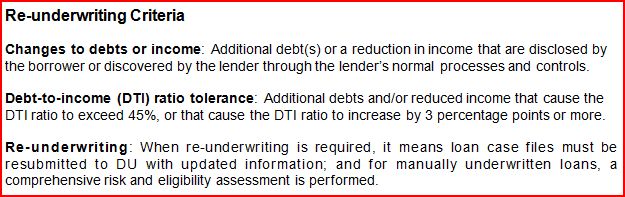
Fannie Mae has affirmed that lenders are not required to obtain a new credit report just before closing to check whether a borrower has taken out additional debt. If a borrower discloses or the lender discovers additional debt and/or reduced income after the initial underwriting decision was made, lenders are required to determine if a mortgage loan must be submitted for re-underwriting.

A re-underwriting will be required if the borrower discloses or the lender discovers additional debt(s) and/or reduced income after the underwriting decision was made up to and concurrent with the loan closing. The lender is not required to obtain a new credit report to verify the additional debt(s).

Still, a lender would be well advised to notify the borrower not to shop for a loan or take on additional debt between the time of the mortgage application and the closing date.

Effective Date

The new Announcement SEL-2010-11 replaces the undisclosed liabilities policy communicated in Announcement SEL-2010-01.

Compliance with the change is immediate, but must apply on loan applications dated on or after December 1, 2010.


For questions about this matter
or assistance with mortgage compliance,
please contact Jonathan Foxx, Managing Director.


Action Button Image 1

_____________________________________

Highlights

Re-underwriting Requirements

The requirements address when a lender has to re-underwrite a mortgage loan after the underwriting decision has been made up to and concurrent with loan closing for both Desktop Underwriter® (DU®) and manually underwritten mortgage loans, and includes a new re-underwriting tolerance for manually underwritten loans and simplification and expansion of the DU resubmission policy.

Fannie-Reunderwrite (1)

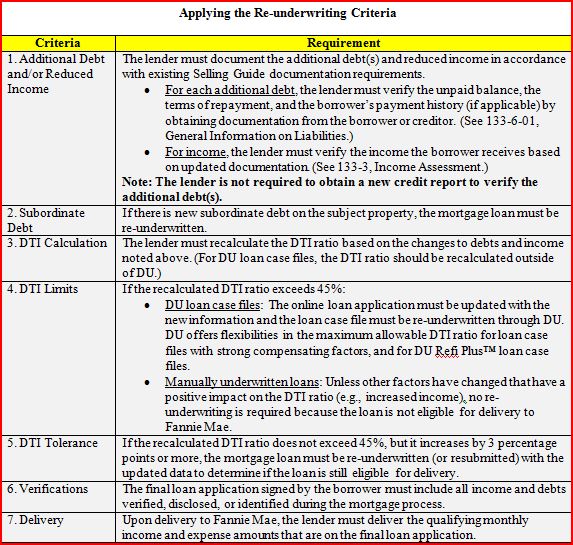
Applying the Re-underwriting Criteria

Fannie requires the following steps to be taken if the borrower discloses or the lender discovers additional debt(s) and/or reduced income after the underwriting decision was made up to and concurrent with loan closing.

Action Button Image 1

Changes to the DU Resubmission Policy

The following table describes the changes to the DU tolerances and resubmission requirements. The other tolerances in the Selling Guide remain unchanged (decreases to the interest rate, increases in income, changes to assets, and loan amount changes.

Fannie-Resubmission (3)

___________________________________

Visit Library for Issuance

Law Library Image

Undisclosed Liabilities and Re-underwriting Requirements
Fannie Mae: Announcement SEL-2010-11
August 13, 2010

Lenders Compliance Group is the first full-service, mortgage risk management firm in the country, specializing exclusively in mortgage compliance and offering a full suite of hands-on and automated services in residential mortgage banking.

Wednesday, July 14, 2010

Fannie Mae: Loan Quality Initiative Summary

Overview

Since the introduction of Fannie Mae's Loan Quality Initiative on February 26, 2010 (LQI), several important updates and announcements have been issued.

On June 28, 2010, Fannie updated its matrix, entitled Loan Quality Initiative (LQI) Summary and Additional Information (Summary), which summarizes enhancements, and provides key calendar date, tools, and resources.

The Loan Quality Initiative has focused on several areas, including:

  • policies that confirm the identity and occupancy of the borrower, validation of qualified parties to the transaction, and policies that address the borrower's credit profile;
  • updated quality control requirements for lenders and an improved feedback loop;
  • the delivery of additional information about the property and the appraisal;
  • loan delivery enhancements, including,
  1. validation of loan eligibility at delivery,
  2. a new capability that enables lender validation of data before, during and immediately after loan delivery, and,
  3. collection of additional loan data at delivery and transition to an XML format;
  • reporting and validation of mortgage insurance coverage data.

Inasmuch as revisions and implementation dates related to the above-mentioned areas are also incorporated by reference into Fannie's Selling Guide, the Summary is an important information resource and guide.

At this time, the Summary contains columns for:

  • Change or Enhancement: policy or procedure subject to revision
  • Communications: references and citations
  • Key Dates: effective dates for compliance implementation
  • Tools and Resources: information and outreach facilities

The Summary also contains a conversion matrix for the Calendar of Key Dates, chronologically outlined, with correlating Loan Delivery descriptions, and areas affected (i.e., Communications, DU, and Other).
Monitoring Fannie's LQI is central to mortgage compliance implementation and should be regularly reviewed by all compliance personnel.

If you have any questions about this matter or would like assistance with mortgage compliance, please contact Jonathan Foxx, Managing Director or call 516-442-3456 x 100.

Visit Library for Issuance

Law Library Image

Loan Quality Initiative (LQI) Summary and Additional Information
Revised 6/28/10
Fannie Mae

Tuesday, July 6, 2010

FANNIE MAE: NEW APPRAISAL GUIDELINES

Overview

On June 30, 2010, Fannie Mae issued additional guidance on appraisal-related policies, along with a number of other miscellaneous changes to its Selling Guide - Fannie Mae Single Family. Fannie's new policy requirements and clarifications concerning existing lender requirements are being added to a number of appraisal sections of the Selling Guide, with respect to post-purchase reviews of mortgage loan files.

Policies and Clarifications

  • Inclusion of interior photographs in the appraisal report
  • Lender changes to the appraised value and guidance on addressing appraisal deficiencies
  • Appraiser selection criteria
  • Sources of comparable market data
  • Selection of comparable sales
  • Communication under the HVCC
  • Seller concessions
  • Treatment of personal property
  • Market Conditions Addendum to the Appraisal Report (Form 1004MC)

Highlights

Inclusion of Interior Photographs in the Appraisal Report
B4-1.2-06: Appraisal Forms and Report Exhibits
Effective: All applications dated on/after September 1, 2010.

Lender Changes to the Appraised Value and Guidance on Addressing Appraisal Deficiencies
B4-1.4-21: Appraisal Report Review: Valuation Analysis and Final Reconciliation
Effective: All applications dated on/after September 1, 2010.

Appraiser Selection Criteria
B4-1.1-03, Appraiser Selection
Effective: June 30, 2010.

Selection and Use of Comparable Sales
- Data and Verification Sources
- Use of Foreclosures, Short Sales, and Builder Sales as Comparable Properties
B4-1.4-16: Appraisal Report Review: Sales Comparison Approach
Effective: June 30, 2010.

Miscellaneous Appraisal-Related Guidance
- Communication under the HVCC
- Seller Concessions
- Treatment of Personal Property
- Market Conditions Addendum to the Appraisal Report
Effective: All applications dated on/after September 1, 2010.

Visit Library for Issuance

Law Library Image

Fannie Mae: Selling Guide Updates
and Additional Guidance on Appraisal-Related Policies
Announcement SEL-2010-09
June 30, 2010

Thursday, July 1, 2010

Fannie Mae Revises Quality Control Requirements

by Jonathan Foxx

Jonathan Foxx, former Chief Compliance Officer of two publicly traded financial institutions, is the President and Managing Director of Lenders Compliance Group.

Our Regulatory Compliance Outlook column appears monthly in the National Mortgage Professional Magazine, considered one of the country’s premier mortgage industry publications.

Fannie Revises Quality Control Requirements

Fannie Mae announced revisions to its Selling Guide for Lender Quality Control Standards[1] by issuing an update on March 29, 2010 as part of its Loan Quality Initiative (LQI).[2] The LQI identified policies, processes, and technological enhancements involved in originating mortgage loans to Fannie’s underwriting and eligibility standards, with the further goal of mitigating repurchase risk. One consequence of the LQI was a substantial revamping of Fannie’s quality control policies (QC) specified in Part D of the Selling Guide.[3] The ostensible purposes of the revisions are primarily to update outdated policies and create more comprehensive audit findings.[4] The new quality control requirements affect all lenders that deliver mortgage loans to Fannie Mae for purchase and therefore, by extension, virtually all residential mortgage originators that originate conventional mortgage loans.

Effective: July 1, 2010

Highlights of Changes

There are eight (8) areas that have undergone change:

  1. Lenders must have written procedures for approving third-party originators and management procedures for third-party originations (TPOs).
  2. Revisions have been made to the QC process and the QC plan.
  3. Revisions have been made to outsourcing the QC audit.
  4. There is a new requirement for a pre-funding QC review.
  5. Revision to the sampling methodology and the timing of selection and completion of the post-closing QC audit.
  6. Revision to the post-closing review process.
  7. Update to Fannie’s Mortgage Loan File Document Submission Requirements.
  8. New requirement pertaining to the QC audit process.

Let’s take a brief look at these important requirements.

Outline of LQI Requirements

1. Accountability for Third Party Originations[5]

  • Written procedures for the approval of third party originators
  • Review of specific documents (i.e., financial statements, licenses)
  • Quarterly reviews of third party originated loans

2. QC Process and Plan[6]

  • Define standards and establish process as well as controls for originations
  • Provide a higher level of specificity

3. Outsourcing the QC Audit[7]

  • Establish a process to review the QC auditor’s work and procedures
  • Determine the QC auditor’s knowledge and competencies
  • Codify policies and procedures of the auditor’s review methodologies

4. Pre-funding QC Reviews[8]

  • Pre-funding reviews established
  • Provide senior management with findings
  • Determine appropriate selection methods
  • Review to provide information to detect and prevent:

-Misrepresentation

-Inaccurate Data

-Inadequate Documentation

5. Post-closing QC Timing and Loan Sampling[9]

  • Selections must be made within 30 days of closing
  • Reviews completed within 60 days
  • Notification to Fannie if QC is not done within 30 day cycle
  • Statistical sampling now available, versus 10% random sampling

6. Post-Closing QC Review Process and Data Integrity[10]

  • Owner Occupancy verification
  • Red Flags from Desktop Underwriter® or other sources

7. Mortgage Loan File Document Submission Requirements[11]

  • The 2007 Selling Guide form listing the document requirements for submitting loan files for QC auditing is reactivated

8. QC Reviews and Audit Review of the QC Process[12]

  • Within 30 days after the review, findings must be reported to senior management
  • QC process must ensure that QC audit’s procedures are followed and that assessments, conclusions, and findings are consistent and accurately recorded
  • Management responses and corrective actions must be documented and implemented

Compliance Considerations

Given the above-outlined updates and requirements to quality control, there are certain measures that should be reviewed in the quality control plan and, where required, management should reduce to writing the appropriate revisions affecting Fannie loan originations, including:

Given the above-outlined updates and requirements to quality control, there are certain measures that should be reviewed in the quality control plan and, where required, management should reduce to writing the appropriate revisions affecting Fannie loan originations, including:

●Ratifying written procedures governing the approval of third-party originators, which should include, at a minimum, an annual review of their financial statements, current licenses, résumés of principal officers, background checks, and the TPO’s quality control procedures.

●Precise, clearly defined procedures for monitoring loan quality through quality control auditing.

●Written policies and that document the loan selection process, the verification of data, and the reporting process with respect to pre-funding quality control.

●Affirming senior management’s responsibility to ensure that the quality control auditor is meeting all requirements as set forth by FNMA by reviewing all findings reported by the auditor and at least annually reviewing the auditor’s Operating Procedures.

●Affirming that loans selected for audit (1) will be made within 30 days of closing, (2) will be completed by the quality control auditor within 60 days of the selection, and (3) will be reported to senior management in the quality control findings within 30 days after the completion of the audit.

●Reverification in quality control of the borrower’s credit history by obtaining a new in-file credit report for all loans selected for audit, including manually underwritten loans and loans underwritten through DU or any other automated underwriting systems. If a borrower’s credit history was evaluated by using a nontraditional credit process, the quality control auditor should reverify a nontraditional mortgage credit report, or written references from creditors, for each of the credit references on the report and each credit reference.

●Enumerating Red Flags and incorporating them into the auditor’s process documents and quality control audit procedures.

●Affirming that all loans selected for a quality control audit will be checked to ensure the execution of all loan origination documentation, information, and verifications. Recite particularly all forms, disclosures, and procedures relating thereto, as well as specifically state the compliance review procedures for any federal or state laws subject to quality control audit.

Prompt Action

The revisions will require mortgage loan originators to change their quality control plans. The substantial rewriting of Part D of the Selling Guide affects several areas of the Loan Quality Initiative, including pre-funding, post-closing, sampling methodologies, QC reporting and outsourcing, timing, TPO reviews, document requirement forms, and other specific, auditing aspects of mortgage quality control.

Review and implementation of Fannie Mae’s new quality control policies and procedures, along with updating quality control plans, must be arranged now and ratified by senior management.


[1] Fannie Mae, Announcement SEL-2010-03, Selling Guide Updates for Lender Quality Control Standards, 3/29/10

[2] Fannie Mae, Lender Letter LL-2010-03, Lender Letter, An Introduction to Fannie Mae’s Loan Quality Initiative, 2/26/10

[3] Selling Guide, Part D, Ensuring Quality Control

[4] A copy of Fannie’s Announcement SEL-2010-03 may be obtained from my firm’s Fannie Mae section in our website Library at www.lenderscompliancegroup.com or Fannie’s Single Family Guide’s 2010 Lender Announcements and Letters section of www.efanniemae.com

[5] Selling Guide A3-3-01: Outsourcing of Mortgage Processing and Third party Originations; D1-1-02: Lender QC Process

[6] Selling Guide D1-1-02: Lender QC Process

[7] Selling Guide D1-1-03: Lender QC Staff and Outsourcing of the QC Process

[8] Selling Guide D1-2-01: General Information on Lender Prefunding QC Review Process

[9] Selling Guide D1-3-02: Lender Mortgage Selection Process for Post-Closing QC Mortgage Reviews

[10] Selling Guide D1-3-03: Lender Post-Closing QC Review of Underwriting Documents; D1-3-04: Lender Post-Closing QC Review of Data Integrity; D1-3-07: Lender Post-Closing QC Review of Closing Documents

[11]D2-1-02: Fannie Mae QC File Request and Submission Requirements; E-2-07: Post-Closing Mortgage Loan File Documentation

[12] Selling Guide D1-3-08: Lender Post-QC Review Reporting, Record Retention, and Audit


Thursday, June 10, 2010

Fannie Mae: Credit Reports Prior To Closing

OVERVIEW

Under Fannie Mae’s new Loan Quality Initiative guidelines, there is an affirmation that the lender is responsible for implementing "practices to identify undisclosed liabilities in a transaction."

Thus, it is the lender's responsibility to develop and implement its own business processes to support compliance with Fannie Mae's requirements  through the closing of a transaction.

Fannie Mae has not changed the policy as it relates to credit reports. Credit documents, including the credit report, are valid for 90 days from the date of the report and may not be older than 90 days at time of closing (i.e., the date that the Note is signed by the borrowers).

However, the lender is responsible for confirming and factoring in the undisclosed liabilities that were not present in the loan processing reviews conducted prior to and through to the date of closing.

Therefore, if the lender pulls a new credit report the day before closing and no differences are found compared with the original credit report, the lender is not relieved of representations and warranties for undisclosed liabilities.

Although pulling a new credit report may reduce the lender's risk exposure related to its representations and warranties on undisclosed liabilities, lenders remain responsible for any and all borrower debt up to and concurrent with closing.

HIGHLIGHTS

Actions

●Retrieving a refreshed credit report just prior to the closing date and reviewing it for additional credit lines.

●New vendor services are becoming available to provide borrower credit report monitoring services between the time of loan application and closing - Equifax's Undisclosed Debt Monitoring™ is one example.

●Direct verification with a creditor that is listed on the credit report under recent inquiries to determine whether a prospective borrower did in fact enter into a financial arrangement with the creditor, which may not be listed on the loan application.

●Running a Mortgage Electronic Registration System (MERS®) report to determine if the borrower has undisclosed liens or another mortgage is being established simultaneously.

New P-T-C Credit Report Finds Undisclosed Liabilities

If additional liabilities are discovered prior to closing, the lender must consider any such additional debts of the borrower in the qualification:

●If the lender is using Desktop Underwriter® (DU®) and identifies differences between the new and/or refreshed credit report and the credit report used when underwriting the loan case file through DU, the lender must take appropriate action when information that was not considered by DU might result in a recommendation other than that returned by DU.

Examples of situations in which loan case files should be resubmitted to DU:

     o If additional debt has been incurred and the inclusion of the additional debt would increase the total expense ratio to a level outside the tolerance specified in section B3-2-10, Accuracy of DU Data, DU Tolerances, and Errors in the Credit Report, of the Fannie Mae Selling Guide.

     o If new derogatory information is detected and/or the credit score has materially changed.

Example of a situation in which the lender should not have to resubmit the loan case file to DU would be if credit balances have changed slightly but the change in the total expense ratio remains within the DU Tolerances policy.

VISIT OUR LIBRARY FOR ISSUANCE

Law Library Image

Fannie Mae: Loan Quality Initiative (LQI) Program
FAQs - Update

5/28/10