CREATORS OF THE COMPLIANCE TUNE-UP®

AARMR | ABA | ACAMS | ALTA | ARMCP | IAPP | IIA | MBA | MERS® | MISMO | NAMB

Showing posts with label Mortgage Performance. Show all posts

Wednesday, January 5, 2011

Mortgage Performance Metrics: A Quick Look

COMMENTARY: by JONATHAN FOXX

Jonathan Foxx, former Chief Compliance Officer of two publicly traded financial institutions, is the President and Managing Director of Lenders Compliance Group, the first full-service, mortgage risk management firm in the country.

Line-Webpage

The Office of the Comptroller of the Currency (OCC) and the Office of Thrift Supervision (OTS) released their 3rd quarter 2010 mortgage Mortgage Metrics Report.

Published in December 2010, the findings are compiled from data on first-lien residential mortgages serviced by national banks and federally regulated thrifts.

The report provides information on loan performance through September 30, 2010, the year's 3rd quarter.

I think the report offers a broad view of mortgage performance, because the mortgages in this portfolio comprise 64% of all mortgages outstanding in the United States, that is, 33.3 million loans totaling almost $6 trillion in principal balances.

According to the report, mortgage delinquency levels:

  • Remained "elevated" and foreclosures (new, in process, and completed) increased during the 3rd quarter of 2010.
  • New home retention actions (modifications, trial-period plans, and payment plans) decreased during the quarter.
  • The overall credit quality of the portfolio of first-lien mortgages serviced by the largest national banks and thrifts seems to have remained "steady" during the 3rd quarter of 2010, after showing some improvement during the previous two quarters.

The full report is available in our Library.

Let's look now (see below) at five tables from the report and consider some statistical analysis.

Line-Webpage
Table 1-New Home Retentions

According to this table, servicers implemented 470,321 new home retention actions during the 3rd quarter. This represents a 17% decline from the previous quarter.

  • HAMP modifications decreased by 45.7% during the quarter while other modifications increased by 10.1%.
  • New HAMP trial plans decreased by 33.2%, and other trial-period plans decreased 21% from the previous quarters.

The report indicates that servicers attribute this decline resulted from requirements to obtain, verify, and analyze borrower income before beginning a trial period plan and the falling number of borrowers who are eligible for existing modification programs.

Line-Webpage

Table 2-Modifications Status 2008-10

The findings indicate that servicers modified 1,506,025 loans from the beginning of 2008 through the 2nd quarter of 2010.

  • At the end of the 3rd quarter of 2010, 48% of these modifications remained current or were paid off.
  • Another 10.2% were 30 to 59 days delinquent.
  • Almost 24% of the modifications were seriously delinquent, 9.4% were in the process of foreclosure, and 4.2% had completed the foreclosure process.
  • Modifications that reduced payments by 10% or more performed better than modifications that reduced payments by less than 10%.
  • At the end of the third quarter, 58.9% of modifications that reduced payments by 10% or more were current and performing, compared with the 33.4% of modifications that reduced payments by less than 10%.

Line-Webpage

Table 3-Modified-60

This table shows that more recent modifications have performed better than earlier modifications every quarter since the end of the first quarter of 2009, though the rate of improvement "appears to be moderating."

  • At 6 months after modification, 20.2% of the modifications made in the 4th quarter of 2009 were seriously delinquent compared with 33.5% of the modifications made during the second quarter of 2009.
  • The report states that this trend of lower delinquency rates following modification "corresponds with the increasing emphasis on repayment sustainability through reduction of the borrower's monthly payment, verified borrower income, and payment affordability relative to income."

Line-Webpage

Table 4-Redefaults at 60

One of the more interesting tables is this one, because it indicates that modified mortgages held in the servicers' portfolios performed better than modified mortgages serviced for others.

  • The report asserts that this variance may result from differences in modification programs, servicers' additional flexibility to modify mortgage terms, and the underlying quality of loans serviced for different investors.
  • Note that the modified government-guaranteed mortgages had the highest delinquency rates at 6, 9, and 12 months following modification, consistent with their higher overall delinquency rates.

Line-Webpage

Table 5-Post-Mod Delinquency-Lower Pmts

This table charts modified loan performance, by change in monthly payments, a statistical array of data that we have commented on in previous compliance updates, particularly with respect to the HAMP program.

The report finds that modifications with decreased monthly payments consistently had lower re-default rates than modifications that left payments unchanged or increased payments.

  • After 6 months, 14.6% of modifications implemented since the second quarter of 2009 that decreased monthly payments by 20% or more were seriously delinquent.
  • In contrast, 28.1% of modifications that left payments unchanged and 42.% of modifications that increased payments were seriously delinquent.

The report asserts that while lower payments reduce monthly cash flows to investors, the payments may result in longer-term sustainability.

Line-Webpage

Visit Library for Issuance

Law Library Image
OCC and OTS Mortgage Metrics Report -
Disclosure of National Bank and Federal Thrift Mortgage Loan Data:
Third Quarter 2010
Issued: December 2010

Monday, September 27, 2010

Fannie: Launches EarlyCheck™ - Prior to Closing

EarlyCheck™ is a new web-based program that provides lenders with access to Fannie Mae Loan Quality Initiative (LQI) delivery data checks at any point in the lender's business process. The goal is to help lenders identify potential problems prior to loan delivery.

The initial offering of EarlyCheck has these access options:

  • Support for loans prior to closing: weekend of September 25, 2010, two new EarlyCheck access options were implemented.
  • An integration solution that can be directly integrated with a lender's LOS
  • A Web-based user interface
  • Support for loans in post-closing through the pre-delivery stage: effective with the July 26, 2010 Loan Delivery Release Notes, lenders access EarlyCheck data checks via the Loan Delivery system.

EarlyCheck has its own web page at eFannie.com that contains all the information needed to get started, including Registration, Release Notification, Additional Services, Resources, Training and Education, and Support.

The Early Check facility responds in real-time, and Fannie claims it offers loan-level results in a user-friendly report or data file. Findings contain messages that highlight the issues that need to be resolved (i.e., failed checks), the corresponding delivery severities, and key result data (including key calculated values and the standardized property address for the subject property).

For DU loans, the findings also show a comparison of the input loan data with the data used in the most recent DU submission, as well as key DU Underwriting Findings information.

There is also a new management reporting capability that assists lenders in monitoring usage of the EarlyCheck access options for loans prior to closing and help identify recurring potential eligibility and/or data quality issues that may need to be addressed.

We have been keeping you up to date on Fannie's LQI developments, guidelines, and requirements.

For more information and documentation, please visit eFannie's LQI web page.

Highlights

Identify Potential Data Issues

  • Helps identify potential data issues early in the loan process, when they can be remedied more effectively through:
    • Fewer delivery stops and corresponding financial and operational impacts;
    • Less manual error resolution during the delivery process and post-purchase;
    • Reduced funding/pooling delays resulting from delivery issues.

Process Points Access

  • At any point in their processes prior to delivery:
    • Underwriting
    • Prior to loan closing
    • Prior to funding correspondent loans
    • During post-closing and secondary marketing process

Supports Various Underwriting Methodologies

  • Desktop Underwriter (DU)
  • Manually underwritten loans
  • Non-DU AUS loans.

Checks

  • DU Compare (comparison of input loan application data with the data used in the most recent DU submission)
  • SSN checks
  • Occupancy checks
  • Address checks
  • Unit number checks
  • DTI checks
  • Loan limit checks
  • Required delivery fields
  • Other basic eligibility and data integrity checks.

The initial release does not include:

  • Product eligibility checks (loan terms, mortgage insurance coverage, Etc.)
  • Customer contract and commitment pricing checks
  • Pooling rules

Access Options

  • Via the Loan Delivery system to support loans in the post-closing stage. Users can import a Fannie Mae 2000-character delivery file, run the checks, and view or download the results.
  • EarlyCheck access options to support loans prior to loan closing include:
    • An integration option that can be directly integrated with a lender's LOS via a DU-like integration solution (i.e., it takes a 1003 flat file or MISMO AUS 2.3.1 file as input and returns viewable results and/or a result data file).
    • A Web-based user interface that enables a user to import loan data in a 1003 flat file format (which can be exported from most loan origination systems) or the MISMO AUS 2.3.1 file format, run the checks, and view the results.

Visit Library for Issuance

Law Library Image

EarlyCheck™ FAQs, July 29, 2910
EarlyCheck™ Release Notification, July 29, 2010
Loan Delivery Release Notes, July 26, 2010

_____________________________________

LENDERS COMPLIANCE GROUP is the first full-service, mortgage risk management firm in the country, specializing exclusively in mortgage compliance and offering a full suite of hands-on and automated services in residential mortgage banking.

_____________________________________

Wednesday, July 14, 2010

Fannie Mae: Loan Quality Initiative Summary

Overview

Since the introduction of Fannie Mae's Loan Quality Initiative on February 26, 2010 (LQI), several important updates and announcements have been issued.

On June 28, 2010, Fannie updated its matrix, entitled Loan Quality Initiative (LQI) Summary and Additional Information (Summary), which summarizes enhancements, and provides key calendar date, tools, and resources.

The Loan Quality Initiative has focused on several areas, including:

  • policies that confirm the identity and occupancy of the borrower, validation of qualified parties to the transaction, and policies that address the borrower's credit profile;
  • updated quality control requirements for lenders and an improved feedback loop;
  • the delivery of additional information about the property and the appraisal;
  • loan delivery enhancements, including,
  1. validation of loan eligibility at delivery,
  2. a new capability that enables lender validation of data before, during and immediately after loan delivery, and,
  3. collection of additional loan data at delivery and transition to an XML format;
  • reporting and validation of mortgage insurance coverage data.

Inasmuch as revisions and implementation dates related to the above-mentioned areas are also incorporated by reference into Fannie's Selling Guide, the Summary is an important information resource and guide.

At this time, the Summary contains columns for:

  • Change or Enhancement: policy or procedure subject to revision
  • Communications: references and citations
  • Key Dates: effective dates for compliance implementation
  • Tools and Resources: information and outreach facilities

The Summary also contains a conversion matrix for the Calendar of Key Dates, chronologically outlined, with correlating Loan Delivery descriptions, and areas affected (i.e., Communications, DU, and Other).
Monitoring Fannie's LQI is central to mortgage compliance implementation and should be regularly reviewed by all compliance personnel.

If you have any questions about this matter or would like assistance with mortgage compliance, please contact Jonathan Foxx, Managing Director or call 516-442-3456 x 100.

Visit Library for Issuance

Law Library Image

Loan Quality Initiative (LQI) Summary and Additional Information
Revised 6/28/10
Fannie Mae

Thursday, June 24, 2010

OCC-OTS: MORTGAGE REPORT SHOWS MIXED REVIEWS

Overview

On June 23, 2010, the Office of the Controller of the Currency (OCC) and the Office of Thrift Supervision (OTS) jointly issued their Mortgage Metric Report (Report) for the first quarter 2010. The Report provides performance data on first-lien residential mortgages serviced by national banks and federally regulated thrifts. These mortgages comprise more than 64% of all mortgages outstanding in the United States.

Among the disclosed statistics, the Report showed that approximately 41% of loan modifications made in second quarter of 2009 were 60 days or more delinquent nine (9) months after the modification, and the failure rate within nine (9) months was almost 52% in the fourth quarter of 2008.

The Report further discloses that nearly 25% of loan modifications made in the fourth quarter of 2009 were 30 days or more delinquent after three (3) months and Home Affordable Modification Program (HAMP) recidivism rate was 17% in the same period.

Although the Report's Key Findings, Mortgage Performance, Home Retention Actions: Loan Modifications, Trial Period Plans, and Payment Plans, Modified Loan Performance, and Foreclosures and Other Home Forfeiture Actions give varying results, both positive and negative -- as the saying goes, the "devil is in the details!"

Visit Library for Issuance

Highlights
Findings

  • Delinquency rates dropped in the first quarter of 2010, with improvement in all categories of mortgages-prime, Alt-A, and subprime.
  • The number of foreclosures increased substantially, including new foreclosures, foreclosures in process, and completed foreclosures.
  • The number of loan modifications and other home retention actions also increased.
  • Re-default rates for modified mortgages remain high.
  • Recent "vintages" (i.e., 2009 loan modifications) performed better.

Visit Library for Issuance

Charts


Chart-1 Mortgage Metrics-3.10

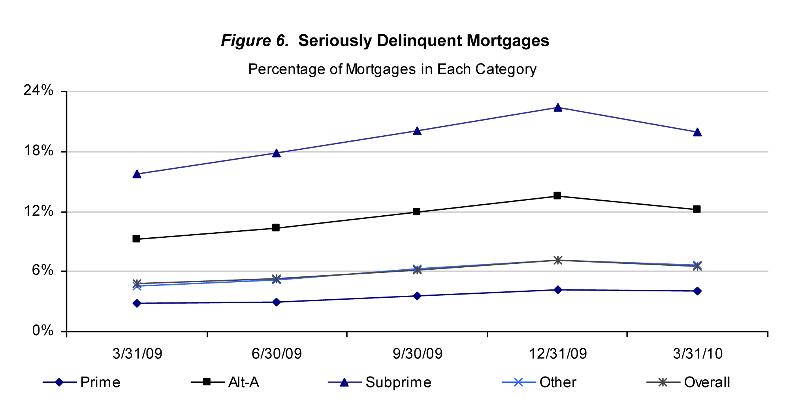
Serious delinquencies declined across all risk categories during the first quarter of 2010. Subprime mortgages recorded the most significant improvement, while prime loans had the least improvement. Overall, there were 2,210,495 seriously delinquent mortgages at the end of the first quarter, 7.5 percent less than the prior quarter but 36 percent more than a year ago.

Chart-2 Mortgage Metric 3.10

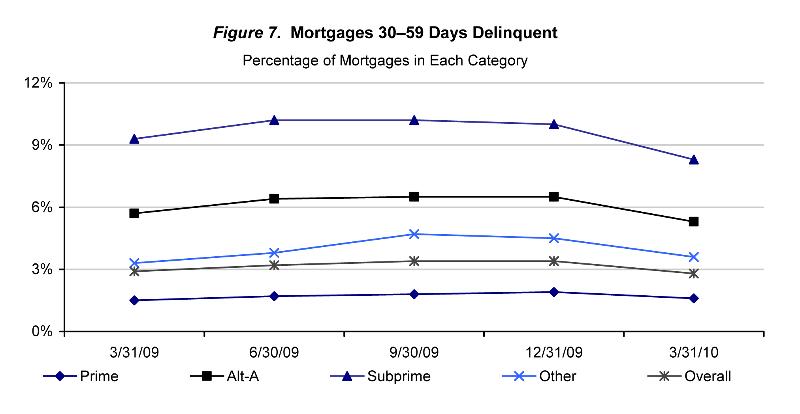
Early stage delinquencies-mortgages 30-59 days delinquent-significantly declined across all risk categories during the first quarter. Overall, early-stage delinquencies, at 2.8 percent, were 17.7 percent less than the prior quarter and 3.6 percent less than a year ago.

Chart-3 Mortgage Metric 3.10

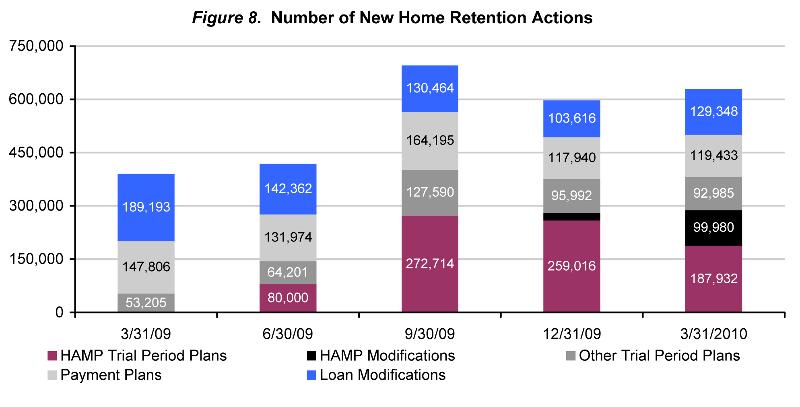
During the first quarter of 2010, servicers implemented 629,678 new home retention actions: loan modifications, trial period plans, and payment plans. This 5.4 percent increase in home retention actions from the prior quarter was driven by the 79,301 increase in HAMP modifications and 25,732 increase in other modifications, which more than offset the 74,091 decrease in new trial period plans. In total, servicers initiated 2,731,408 home retention actions over the last five quarters.

Visit Library for Issuance

Law Library Image

Mortgage Metrics Report
Disclosure of National Bank and Federal Thrift Mortgage Loan Data
First Quarter 2010
Issued 06/23/10