LENDERS COMPLIANCE GROUP® is the country's first full-service mortgage risk management firms in the United States, devoted to offering a full suite of services in residential mortgage banking, respectively, to banks and nonbanks, independent mortgage professionals, and mortgage servicers. We also provide state-of-the-art mortgage quality control auditing and loan analytics.
CREATORS OF THE COMPLIANCE TUNE-UP®
AARMR | ABA | ACAMS | ALTA | ARMCP | IAPP | IIA | MBA | MERS® | MISMO | NAMB
Monday, October 31, 2011
Learning to Play the HARP
Wednesday, October 12, 2011
Plethora of Languid Foreclosure Prevention Programs
Monday, March 7, 2011
"Repeal-But-Don't-Replace" - Ending Foreclosure Programs
The Committee believes that the elimination of these two programs -- the FHA Refinance Program and the Emergency Mortgage Relief Program -- provides $9 billion in savings.
- Home Affordable Modification Program (HAMP)
- Neighborhood Stabilization Program (NSP).
- The HAMP Termination Act of 2011 (HR 839)

- NSP Termination Act (HR 861)

House Committee on Financial Services, Press Release, 3/3/11
FHA Refinance Program Termination Act
HR 830 (2/28/11-3/3/11)
Emergency Mortgage Relief Program Termination Act
HR 836 (2/28/11-3/3/11)
Wednesday, February 9, 2011
The Principal Reduction Alternative
"The number of permanent mortgage modifications under HAMP remains anemic - there were just 522,000 ongoing permanent modifications as of December 31, 2010, with approximately 238,000 of those funded by and attributable to TARP. The remaining were funded outside of TARP by the GSEs. A combined total of more than 792,000 trial and permanent modifications have been canceled, with more than 152,000 trial modification still in limbo. These permanent modification numbers pale in comparison not only to foreclosure filings, but also to Treasury's initial prediction that HAMP would 'help up to 3 to 4 million at-risk homeowners avoid foreclosure' by reducing monthly payments to sustainable levels." (My Emphasis)
- NPV - the acronym for Net Present Value, when we've extricated the math and algorithm basics - is simply a calculation to decide if the lender is in a better profit position by approving a modification or would have a higher profit margin by foreclosing. It is part of HAMP procedures.
- Plus, the so-called waterfall process, which is really just a step-by-step analytical tool used for HAMP loan workouts. It consists of a series of calculations; however, in this case using such parameters as the gross monthly income, percentage of that gross income used to generate a target monthly payment, and so forth.
- Servicers evaluating HAMP modifications derive a mark to market loan to value (MTM-LTV) ratio on any loan greater than 115%. If so, a principal reduction then becomes available to reducing monthly payments to the eligible 31% of the borrower's gross income.
- Some generic rules: to get to the eligible 31% of gross income servicers reduce the interest rate, extend the loan term, even provide principal forbearance, but only use principal reduction as a last resort.
"Lenders will receive far more value from Principal Reduction modifications than from other mortgage modifications."
"Restoring the borrower's incentive to pay in this way [referring to principal reduction] nearly quadruples the reduction in re-default rates achieved by payment reductions through interest rate modifications and term extensions alone."
"Consistent with the HAMP concept, a PRA HAMP modification should be mandatory for participating Lenders whenever its NPV exceeds that of both the standard HAMP modification and the "No Modification" alternatives."
As the aforementioned SIGTARP report states:
"Treasury's central foreclosure prevention effort designed to preserve that goal [of 'preserving homeownership'] - the Home Affordable Modification Program (HAMP) - has been beset by problems from the outset and, despite frequent retooling, continues to fall dramatically short of any meaningful standard of success." (My emphasis)
"Lenders will achieve far greater financial benefits than with any current modification program, and borrowers will have a fighting chance to regain equity and security in their home."
Thursday, September 23, 2010
Fannie: Introduces Second Lien Modifications
On August 13, 2009, the US Department of Treasury (Treasury) published Supplemental Directive 09-05, introducing the Second Lien Modification Program designed to work in tandem with the Home Affordable Modification Program (HAMP). The Supplemental Directive 09-05 was revised on March 26, 2010.
HAMP and the Second Lien Modification Program (which is named "2MP") are meant to create a "comprehensive solution to help borrowers achieve greater affordability by lowering payments on both first-lien and second-lien mortgage loans."
On September 21, 2010, Fannie issued Announcement SVC-2010-14, which introduces its Second Lien Modification Program and provides guidelines to Fannie servicers.
All Fannie Mae-approved servicers must participate in the program for all eligible Fannie Mae second-lien mortgage loans and must implement the 2MP program no later than January 1, 2011.
_______________________________________
Highlights
Modification Eligibility
- Borrowers in Bankruptcy
- Coordination with Other Making Home Affordable Programs
Modification Process
- Matching Second Liens to HAMP First Liens
- Reliance on First-Lien Data
- Standard Modification Steps
- Compliance with Applicable Laws
- Borrower Communication
- Trial Period Requirements
- Borrower Response
- Effective Date of 2MP Modification
- Reclassification or Removal of MBS Mortgage Loans Prior to Effective Date of Modification
- Borrower Notice
- 2MP Modification Documents
- Assignment to MERS
Use of Suspense Accounts and Application of Payments
- Monthly Statements
Reporting Requirements
- Reporting to Fannie Mae Through HSSN
- Reporting to Treasury
- Reporting to Credit Bureaus
Mortgage Insurers
- Mortgage Insurer Approval
- Reporting to Mortgage Insurers
Fees and Costs
- Servicing Fees
- Late Fees
- Administrative Costs
Incentive Compensation
- Servicer Incentive Compensation
- Borrower Incentive Compensation
- Re-default and Loss of Good Standing
Compliance
Record Retention
Transfers of Servicing
_______________________________________
Visit Library for Issuance
Fannie: Home Affordable Modification Program:
Introduction of Second Lien Modification Program
SVC-2010-14
September 21, 2010
_______________________________________
LENDERS COMPLIANCE GROUP is the first full-service, mortgage risk management firm in the country, specializing exclusively in mortgage compliance and offering a full suite of hands-on and automated services in residential mortgage banking.
Friday, July 23, 2010
HAMP: “Continues to Struggle”
Yesterday, we provided an outline of the continuing downward trend of the Home Affordable Modification Program (HAMP) program, as reported in the most recent June Report, issued on July 20, 2010.
On July 21, 2010, the Special Inspector General for the Troubled Asset Relief Program (SIGTARP), stated in its Quarterly Report to Congress (Report), that HAMP "continues to struggle to achieve its original stated objective to help millions of homeowners avoid foreclosure 'by reducing monthly payments to sustainable levels.'"
The Report states that the number of homeowners being helped through permanent modifications "remains anemic," with fewer than 400,000 ongoing permanent modifications and HAMP has not put an "appreciable dent" in foreclosure filings. Furthermore, according to the Report and as we also indicated in yesterday's compliance update, the number of trial and permanent modifications that have been canceled substantially "exceeds the number of homeowners helped through permanent modifications."
In a telling statement of fact, the Report unequivocally finds that the Treasury "clings to its prior statements that it plans to offer trial modifications to three to four million homeowners, a measure that the SIGTARP has previously shown to be essentially meaningless," and that its refusal to provide meaningful goals is a "fundamental failure of transparency and accountability."
Finally, the SIGTARP takes the position that the "American people are essentially being asked to shoulder an additional $50 billion of national debt without being told, more than 16 months after the program's announcement, how many people Treasury hopes to actually help stay in their homes as a result of these expenditures, how many people are intended to be helped through other subprograms, and how the program is performing against those expectations and goals."
Without clearly defined standards, opines the SIGTARP, positive comments about HAMP's success are "simply not credible," and leads to a growing "public suspicion" that HAMP is an "outright failure."
It should be noted that of the anticipated $75 billion dollar cost of the Making Home Affordable (MHA) program that commenced on February 18, 2009, $50 billion will be funded through TARP. HAMP is one of the MHA programs.
If you have any questions about this matter or would like assistance with mortgage compliance, please contact Jonathan Foxx, Managing Director or call 516-442-3456 x 100.
Highlights
As of June 30, 2010, a total of 753,275 mortgages are currently being modified, either permanently or on a trial basis. Of those, 389,198 were active permanent modifications and 364,077 were active trial modifications.
SIGTARP uses statements from the June reviews provided by HUD and Treasury to explain why the number of cancellations of mortgage modifications has increased, as decisions on aged trials are being reached, such as:
Office of the Special Inspector General
of the Troubled Asset Relief Program
Quarterly Report to Congress
July 21, 2010
Thursday, July 22, 2010
HAMP: Continues Downward Trend
The government program established to assist homeowners in distress continues to under perform, with 91,118 trial modifications under the Home Affordable Modification Program (HAMP) being canceled in June and of those more than 70% had been in a trial period for six months or longer.
Based on the June 2010 Servicer Performance Report (Report) issued on July 20, 2010, it appears that, more often than not, most borrowers aren't surviving the trial modification stage.
Servicers also converted 51,205 trials to permanent modifications, approximately 3,481 more conversions than occurred in May. During the same period, the number of trial modifications also increased from May, growing from 30,099 to 38,728.
The recidivism rates for HAMP modifications six months after converting to a permanent modification are 5.9% of HAMP loans are 60+ days delinquent and 1.7% are 90+ days delinquent. At nine months after conversion, the rates rise to 7.7% for 60-day delinquencies and 2.4% for 90+ day delinquencies.
The velocity of the program is slowing down considerably!
On a cumulative basis, trial modifications started in September-October 2009 were 156,019, but the number of trial modifications in May-June 2010 were 15,753 - about a 90% reduction!
If you have any questions about this matter or would like assistance with mortgage compliance, please contact Jonathan Foxx, Managing Director or call 516-442-3456 x 100.
Highlights
●Number of permanent loan modifications: 346,816 to 389,198 (Increase: 42,382)
●Number of trial modifications canceled: 429,696 to 520,814 (Increase: 91,118)
●Number of "active trials": 467,672 to 364,077 (Decrease: 103,595)
These statistics clearly show that the number of failed trial modifications to date are significantly greater than the number of successful, permanent ones, while the number of trials started has dropped precipitously.
As indicated above, the velocity of the program is slowing down considerably. On a cumulative basis, trial modifications started in September-October 2009 were 156,019, but the number of trial modifications in May-June 2010 were 15,753 - about a 90% reduction!
This is the slowest month-over-month pace since the program began.
Taken together, the above two charts indicate why trials modifications are probably slowing down: servicers are now pre-qualifying borrowers and are also running out of eligible borrowers.
The median front-end DTI before modification is 44.8% (which is about where it has remained for several months); and, the back-end DTI before modification is an astronomically high 79.9% (which, in any event, has been in this high range of 77.5% to 80.2% for several months).
That back-end DTI discloses an inescapable fact: nearly 80% of the borrower's income is going to servicing debt - and nearly 63.7% of income even after loan modification - a troublesomely high back-end ratio, which indicates likely defaults in the future.
It's no wonder that many borrowers never make it out of trial modification into permanent modification. Indeed, these are "median" characteristics - so many borrowers have even higher risk profiles.
Clearly, the program is not meeting with the kind of success predicted at its inception and is gradually coming to an end.
Visit Library for Issuance
Making Home Affordable Program
Servicer Report - June 2010 (07/21/10)
Friday, July 2, 2010
July 1st: Home Affordable Unemployment Program
Overview
Under the Home Affordable Modification Program (HAMP), servicers apply a uniform loan modification process to provide eligible borrowers with sustainable monthly housing payments. On May 11, 2010, a Supplemental Directive was issued that gave servicers flexibility to provide assistance to borrowers whose hardship is related to unemployment.
When a borrower is unemployed, a HAMP trial period plan or permanent HAMP modification may not be appropriate, and in some cases, the borrower may not have the ability to make the required payments.
So, the Supplemental Directive requires servicers to consider eligible borrowers for the Home Affordable Unemployment Program (HAUP), which grants borrowers a forbearance plan during which regular monthly mortgage payments are reduced or suspended.
Borrowers will be evaluated for HAMP at the earlier of re-employment or 30 days prior to the expiration of the UP forbearance plan.
The Supplemental Directive pertains to first lien mortgage loans that are not owned or guaranteed by Fannie Mae or Freddie Mac (Non-GSE Mortgages) or insured or guaranteed by a federal agency, such as the Federal Housing Administration (FHA).
Effective for all participating servicers on July 1, 2010.
Highlights
Eligibility
Servicers are required to offer an HAUP forbearance plan to a borrower who meets the following HAMP minimum eligibility criteria:
- The mortgage loan is secured by a one- to four-unit property, one unit of which is the borrower's principal residence.
- The mortgage loan is a first lien mortgage loan originated on or before January 1, 2009.
- The current unpaid principal balance of the mortgage loan is equal to or less than $729,750.1
- The mortgage loan is delinquent or default is reasonably foreseeable.
- The mortgage loan has not been previously modified under HAMP and the borrower has not previously received an UP forbearance period.
Additional HAUP forbearance plan eligibility requirements include that the borrower:
- Makes a request before the first mortgage lien is seriously delinquent (before three monthly payments are due and unpaid). A request for UP may be made by phone, mail or email. Servicers must document the date of the UP request in the servicing file and, within 10 business days, confirm the receipt of the request with the borrower via mail or return email.
- Is unemployed at the date of the request for UP and is able to document that he or she will receive unemployment benefits in the month of the Forbearance Period Effective Date (defined below) even if his or her unemployment benefit eligibility is scheduled to expire before the end of the UP forbearance period.
Terms
- Term must be three months or upon reemployment (whichever is less). Servicers may extend this period according to their investor/regulatory guidelines.
- Monthly mortgage payment must be reduced to less than or equal to 31% of the borrower's gross monthly household income and may be suspended in full.
Transition to HAMP
Borrowers in an HAUP forbearance plan will be evaluated for HAMP at either reemployment or 30 days prior to the UP forbearance period expiring (whichever happens first).
Visit Library for Issuance
Home Affordable Unemployment Program
Home Affordable Modification Program Supplemental Directive
May 11, 2010
Thursday, June 24, 2010
OCC-OTS: MORTGAGE REPORT SHOWS MIXED REVIEWS
Overview
On June 23, 2010, the Office of the Controller of the Currency (OCC) and the Office of Thrift Supervision (OTS) jointly issued their Mortgage Metric Report (Report) for the first quarter 2010. The Report provides performance data on first-lien residential mortgages serviced by national banks and federally regulated thrifts. These mortgages comprise more than 64% of all mortgages outstanding in the United States.
Among the disclosed statistics, the Report showed that approximately 41% of loan modifications made in second quarter of 2009 were 60 days or more delinquent nine (9) months after the modification, and the failure rate within nine (9) months was almost 52% in the fourth quarter of 2008.
The Report further discloses that nearly 25% of loan modifications made in the fourth quarter of 2009 were 30 days or more delinquent after three (3) months and Home Affordable Modification Program (HAMP) recidivism rate was 17% in the same period.
Although the Report's Key Findings, Mortgage Performance, Home Retention Actions: Loan Modifications, Trial Period Plans, and Payment Plans, Modified Loan Performance, and Foreclosures and Other Home Forfeiture Actions give varying results, both positive and negative -- as the saying goes, the "devil is in the details!"
Highlights
Findings
- Delinquency rates dropped in the first quarter of 2010, with improvement in all categories of mortgages-prime, Alt-A, and subprime.
- The number of foreclosures increased substantially, including new foreclosures, foreclosures in process, and completed foreclosures.
- The number of loan modifications and other home retention actions also increased.
- Re-default rates for modified mortgages remain high.
- Recent "vintages" (i.e., 2009 loan modifications) performed better.
Charts

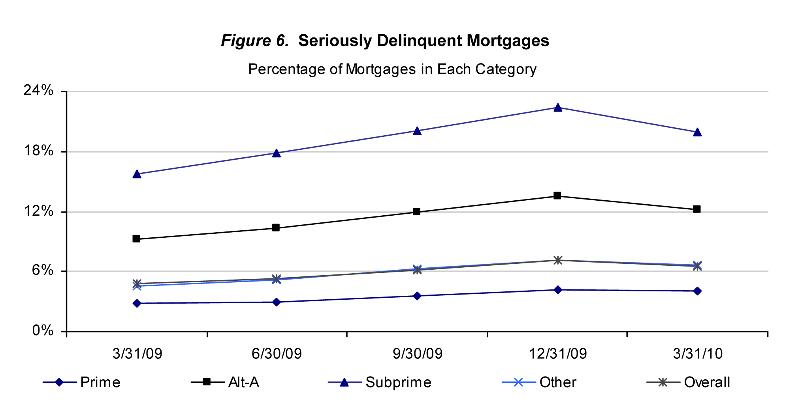
Serious delinquencies declined across all risk categories during the first quarter of 2010. Subprime mortgages recorded the most significant improvement, while prime loans had the least improvement. Overall, there were 2,210,495 seriously delinquent mortgages at the end of the first quarter, 7.5 percent less than the prior quarter but 36 percent more than a year ago.

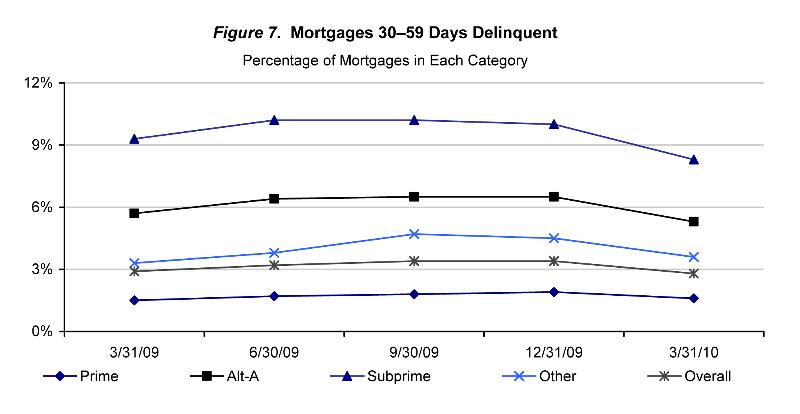
Early stage delinquencies-mortgages 30-59 days delinquent-significantly declined across all risk categories during the first quarter. Overall, early-stage delinquencies, at 2.8 percent, were 17.7 percent less than the prior quarter and 3.6 percent less than a year ago.

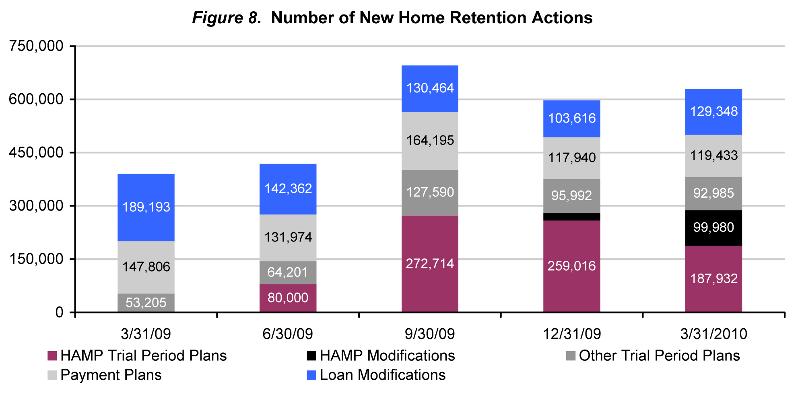
During the first quarter of 2010, servicers implemented 629,678 new home retention actions: loan modifications, trial period plans, and payment plans. This 5.4 percent increase in home retention actions from the prior quarter was driven by the 79,301 increase in HAMP modifications and 25,732 increase in other modifications, which more than offset the 74,091 decrease in new trial period plans. In total, servicers initiated 2,731,408 home retention actions over the last five quarters.
Visit Library for Issuance
Mortgage Metrics Report
Disclosure of National Bank and Federal Thrift Mortgage Loan Data
First Quarter 2010
Issued 06/23/10